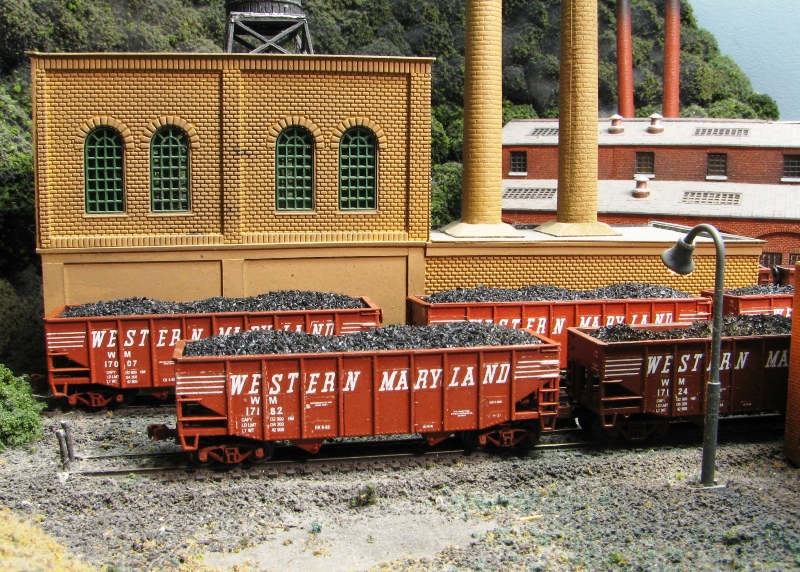
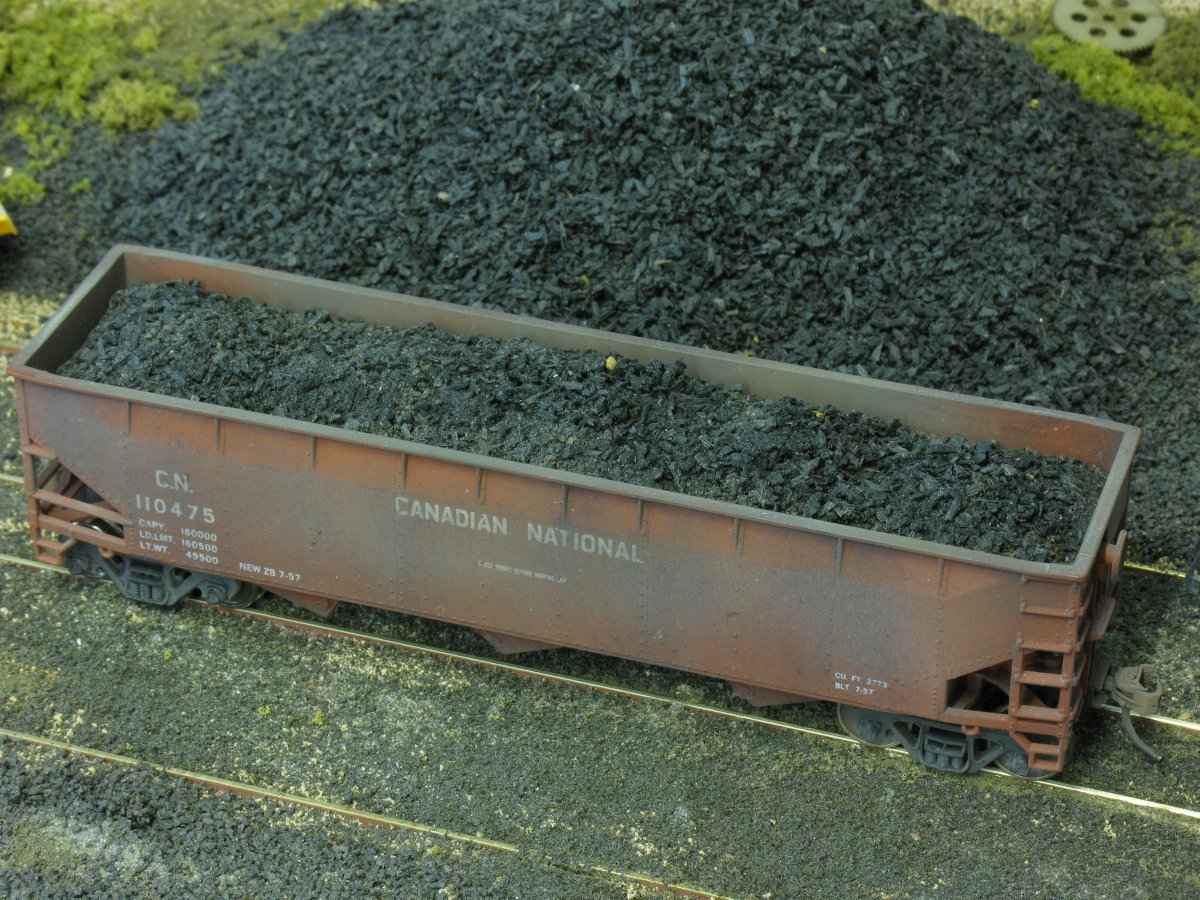
I recently purchased some coal loads that fit my Walthers RD-4 coal cars. I want to run these as if they are simply passing through and are loaded/unloaded somewhere off of the layout. My question is. How do I remove the coal loads without lifting the cars off the track? I figure if I lift them off the track, that it would be time consuming.
put a piece of 220 sandpaper on a counter top and sand the sides slightly so the loads slip in. You can use a small screwdriver to lift the loads out, put a samll wire loop in the load and paint it black for a handle or put in a ferrous metal plate and lift it with a magnet (or glue a magnet under the load and lift it with a steel rod/bar.
I use foam rubber for coal loads. I cut it to shape, and spray paint it black. When the train arrives at the unloading point, you just pop it out with a small screwdriver, or just pinch it with your fingers.
Whose loads are they? Are they made of resin, plastic, plaster, or other? Depending on the weight of the load, the magnet will be hard to pick up something heavy and frankly I would worry about the integrity of plaster. I have a bunch of JWD easyfit resin loads, which slip right into the car. I do pick mine up off the track to get the load out, but I don’t see why you couldn’t hollow the back out to add a metal strip in.
IMO, best approach would be to make electro-magnets. Then they could be placed inside some suitably-disguised structure with track leading in. The coal cars could then be pushed inside, the load lifted out discretely with a button push to engage the electro-magnet, and then pulled-out (or pushed on through) to make ready for the next car.
But then what do you do with the load that is stuck to the electromagnet? If it is inside a structure you will have to make some provision to remove it without damaging the structure.
If you have loads that fit correctly and slide in and out easily, it’s pretty easy to just catch one side with a fingernail and lift it up, then slip a finger under it and remove it. At least that works for me, I have a coal dock on my layout and I generally don’t have to remove the cars from the track to remove their loads.
Gee, do I have to design everything for ya !?!?!? [:-^]
Okay. How about this. You put your electromagnet on a swivel (probably two to keep it level and even). Then you get a solenoid to attach to the side of it that can push (or pull) it off to the side, whereupon you place a small box or container that can collect the loads.
So the operation goes:
Get the car into place.
Flip the switch to engage the load magnet (picks up the load)
Flip the switch to engage the solenoid (pushes magnet & load off-center)
Turn Off magnet (load drops)
Turn Off solenoid (magnet swings back into place)
Remove car
(wash, rinse, repeat as needed)
For extra points you could add a small microprocessor, some cheap transistors (the ubiquitous 2N3054 would probably be an easy selection), some suitable resistors (offhand I’d guess at about 5.6k ohm for the base and maybe 1k ohm for load limiting-- you’d probably want to try some different values and see what worked best)-- some diodes and caps (or coils) for snubbers, an led and a suitable resistor-- and do it up right. One button to push that performs the cycle and an LED to light up to tell you when its in operation. I’d suggest maybe a PIC16F64 or some such as the CPU. They’re cheap, easy-to-find, and easy-to-program with freebie compilers. Add a roll of magnet wire, a nice ferro-bar of some sort (steel, iron would at least work-- maybe a good solid bolt or something), a DC source-- 12volts-ish with some current capacity-- probably 250-500mA or bigger, maybe put a large capacitor or two (say 470hF or bigger) across it for extra ooomph.
Build a nice little enclosure out of styrene, left-over brick walls from
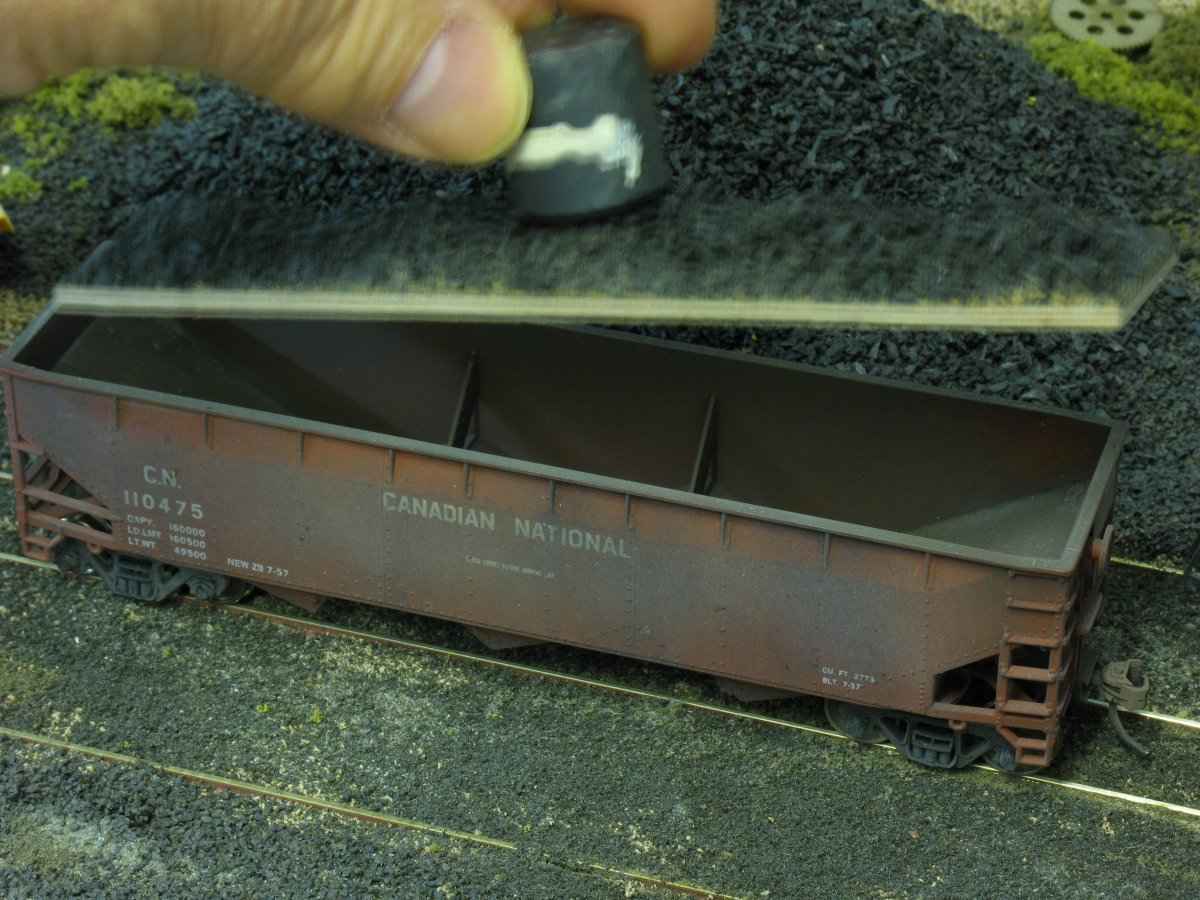
Knead some black (or a color that matches what you are hauling) modeling clay untill sticky. press on top of the load and lift. Voilla! your load is removed! That is the way I do it.