Assuming I want to turn only engines, and my longest would be a F3 A&B. How much real estate do I need?
All my track is packed up in moving boxes at the moment or I would experiment.
Assuming I want to turn only engines, and my longest would be a F3 A&B. How much real estate do I need?
All my track is packed up in moving boxes at the moment or I would experiment.
Quickie,
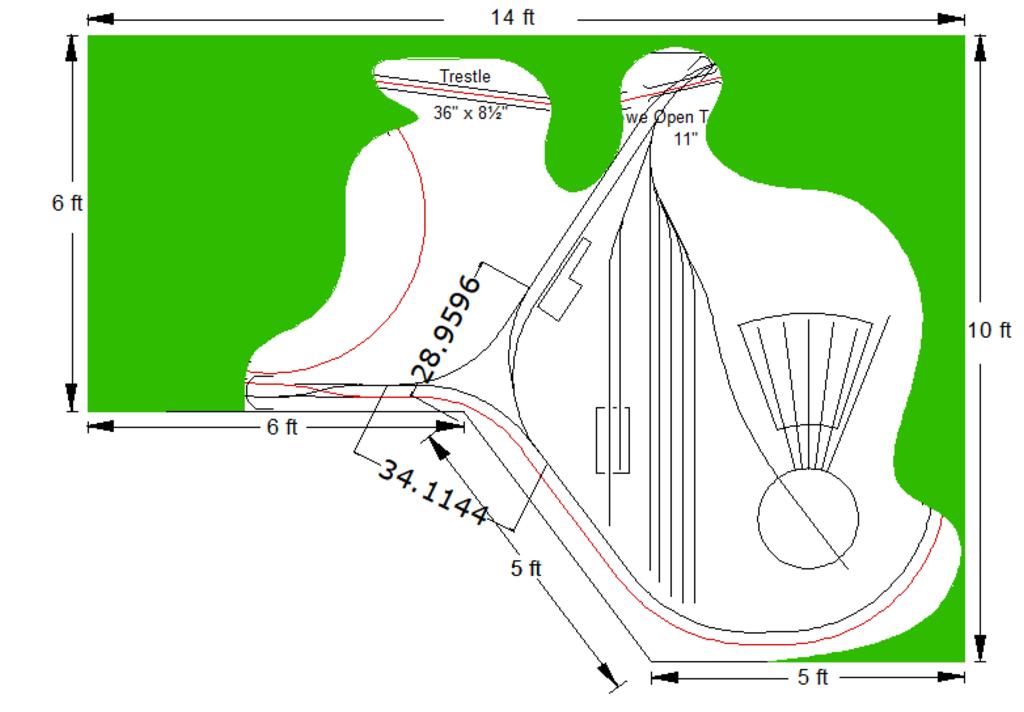
Atlas #6 Turnouts.
Mel
My Model Railroad
http://melvineperry.blogspot.com/
Bakersfield, California
I’m beginning to realize that aging is not for wimps.
Since you are using 4 axle F units, you can make the wye very compact. You could go as low as 15 inch radius curves and #4 turnouts.
My Stewart F units will run through 16 inch radius Unitrack without problem, but they cannot have American Limited diaphragms installed.
I did a quick rough sketch, and it looks like 48 by 48 would be more than enough. If you use small Peco turnouts and curve the tail you could make it even more tight.
-Kevin
It depends on your radius and the length of your tail track. If you use a 10" radius and have a 6" tail track, it can be pretty compact. Of course, not much will handle those curves.
If you use a 36" radius and have a 36" tail track, pretty much everything will run on it, but it will take quite a bit more space.
Depending on the available sizes in the track you want to use, using wye turnouts can make it fairly compact. If you have the depth for a tail track but not much width, you can make a scissors wye. Some good options are in the old Atlas Custom Line Track Plans book. I don’t know if the current versions of those books have the pages in the back with those handy track arrangements, but it’s something worth looking for.
–Randy
Wye not get creative?
 Wye_overlap by Edmund, on Flickr
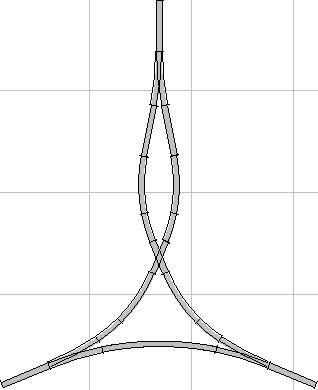
There’s also what I’ve heard refered as a “scissors wye” where the two legs overlap eachother.
Cheers, Ed
The scissor wye in the Atlas book just had to two legs cross one another and then come back together with a single wye turnout. So movement through it was the same as a ‘standard’ wye.
–Randy
Ed I can put my crossing and my Wye is the same spot.
Randy I’m having trouble imagining a scissors wye. Can you describe it more fully? Google shows me a lot of eye scissors.
If you really are going to limit yourself…permanently, to just an AB set and a Mikado with tender, I would strongly advise drawing it up in scale after you establish how low in radius you can go.
On the other hand, if you would maybe like to hedge your bets (always a wise choice when it comes to spending time and money on a layout you hope to enjoy for a few years), go a bit bigger. Wider radius, longer tails, maybe you’ll get a small articulated or a 4-8-4 through there in time. Just sayin’…
Whatever your decision, do make sure your rolling stock will run through it as you intend them to, and don’t nail anthing down until you’re sure.
At lower left in the photo, at the left end of the green masking tape, is what makes the scissors. A crossing, and diverging and converging legs.
Yes, the picture on the linked thread is exactly the one from the Atlas book.
–Randy
So, Henry’s issue with the wye is the ability to turn only engines. If the use of a wye is to turn whole trains, a lot more real estate will be required.
I have always toyed with the idea of using a wye to turn whole trains, or at least passenger car consists, just outside my large downtown passenger station. But, I have never successfully implemented one since my layout footprints are long and narrow, not suitable for wyes to turn trains.
Another way to turn trains, and for that matter just locomotives, is to install a balloon track. But that too takes up a lot of space.
On the prototype, Santa Fe used a turntable in the coach yard just outside Dearborn Station to turn locos, not only steam engines but also diesels.
Rich
I have a balloon track and wonder about how much real estate it uses compared to a wye. Often part of a balloon track can use some existing track for one side of it. I can turn big chunks of train on mine.
Here is my balloon track that goes around my RH. Below is a real balloon track (long gone)that goes around the RH in Vancouver. Lots of crossing tracks going over the RH tracks here.


Hello All,
I measured an F A-B set and generously it would take approximately 16-inches of tail track to clear the end of the wye turnout.
As far as the area necessary…
On my pike I have a wye that consists of two PECO #2 turnouts, 15-inch radii legs; two sections per leg, and an Atlas Mark IV wye turnout.
The dimensions of the wye are: the #2 turnouts are 33-1/2-inches apart on the main, and 30-inches deep, with only a 9-inch tail.
Accommodating a 16-inch tail would require an area 33-1/2-inches by 38-inches using #2 turnouts, 15-inch radii legs, and a Mark IV wye.
Hope this helps.
Brent what is the radius of the outside balloon track?
Scissors wye
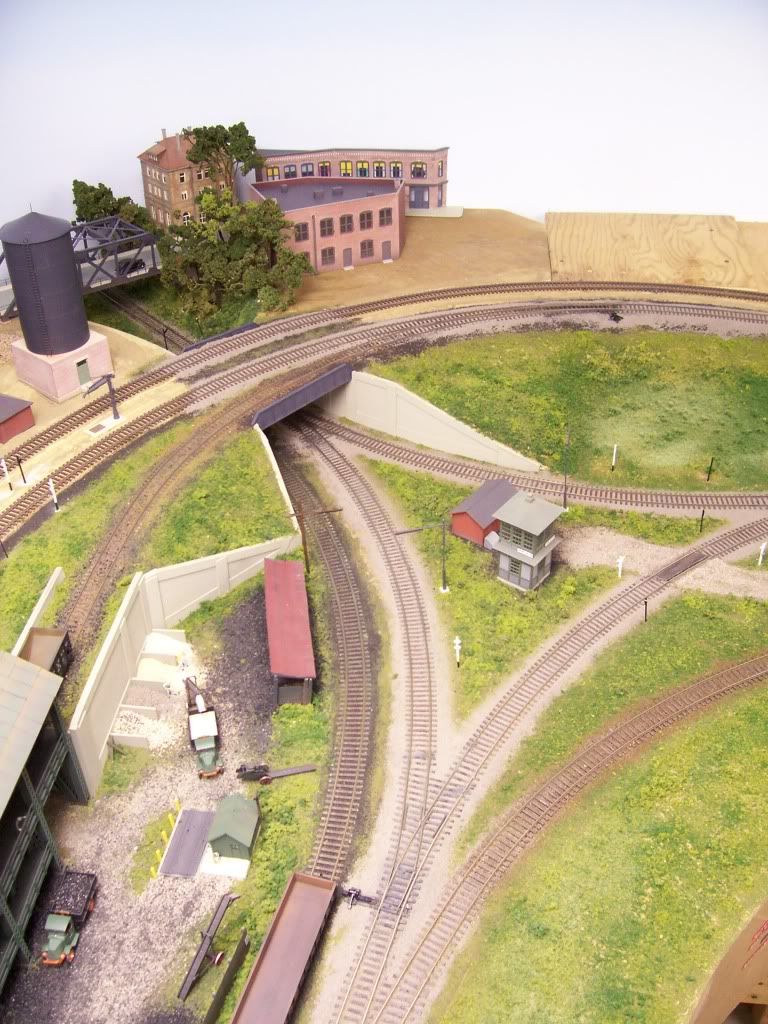
I have a wye mainly for turning locomotives, but also use it for turning cars, both freight and passenger.
All three turnouts are Shinohara #2.5 wyes, and the radii of the three tracks are all 32". The tail track dead-ends in a corner of the room, with 22" of track beyond the turnout that’s located under the bridge…
Wayne
Henry, the radius is 24.5 " at the tightest point, it isn’t a consistent turn. My turntable is only a 90’ and my 2-10-4 will not go on it but can be turned on the balloon track at dead slow.
The balloon track is 13’ long so it is able to accommodate a passenger train of moderate size, though I do not include my three baggage cars when I pull one around.
That is surprising to hear. I would not have believed that a 2-10-4 could negotiate a turn that tight.
I would really like to add a 2-10-2 to my roster, but assumed it would never negotiate my minimum radius curves.
-Kevin
Most 2-10-2’s had smaller drivers than more modern locos like 2-10-4’s. The Bachmann Spectrum 2-10-2 will handle 22" radius.
Keep in mind, it us not the number of coupled axles, it is the number of coupled axles and the driver diameter that controls rigid wheel base and thereby required radius.
Five coupled engines with 57" or 63" drivers are way different from five coupled engines with 69" drivers.
My planned wye is pretty big, built with 36" radius. It will connect to a hidden staging yard. Whole trains will be backed into it at times.
Sheldon