After I have seen Joe fugate’s excellent dvd volume 2 I know how muchroom benchwork is constructed. But how do I construct doubledeck (no mushroom) benchwork?
If you are doing an around the walls do your structural work like the letter F. If you are doing an island make you structural work like this:
I
I
I
I understand the F method you suggest but… For the lower level I use the legs to support the benchwork, but how do I support the upper level so It’s not falling down? On a mushroom benchwork like Joe Fugate’s it’s bolted to the seiling but there must be other ways to support the upper level?
If it’s around the walls use a shelf bracket like this,
http://www.acehardware.com/product/index.jsp?productId=1297130&cp=1254881.1255049.1306708&parentPage=family
there are thousands of different ones some fancy some plain.
bill
if you want to hang a shelf from the ceiling there is this,
http://www.closetmaid.com/pod/RafterShelf.cfm
bill
When I had a double deck it was built to be completely free standing… The upper level was only a foot deep to be used as a mining branch so the benchwork was built out of 1x4 like the rest of the benchwork and simply supported by the back legs… There were no turnouts in out of reach areas so for me, this worked out quite well. The back legs were simply long enough to set the height of the upper level, much like the F type design suggested above… A deeper upper level (built like I did it) would require frontal support… Weren’t you asking about Shadow boxes??
Good luck,
Jeff
Look at the construction as a double deck with a shadowbox look, but without the sides. I’m trying to come up with a construction method where I can support the upper level without any supports that intrude into the lower deck.
For my double-deck shelf-type layout I will use shelf brackets like the ones that Bill (roadrat) suggested. Just screw them into the wall joists to get the best support possible.
Can that technique (shelf brackets) be adopted to a free standing double decker layout as well? Like this one?
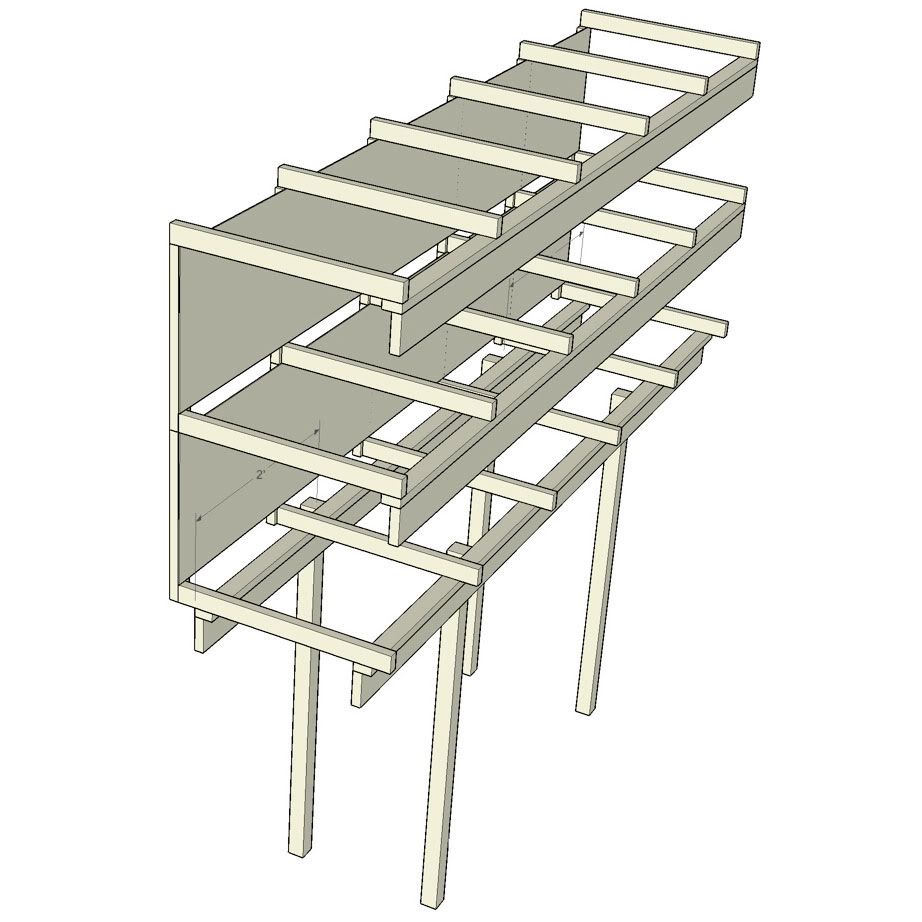
It’s not 100% finished, just a starting point for futher discussions.
Electrolove, this is kind of a structural engineering issue. Even though I am not one, the weak point of your drawing is where the vertical member connects to the L girder at the bottom. All the weight above wants to cause a collapse in the direction of the aisle.
You need to find a way to counteract that force. Some kind of brace at that joint could make it viable, but you will really need to keep the total upper deck weight down in that design.
You will also need bracing where each deck connects to the vertical members. That bracing only needs to support tha deck it’s connected to. The one at the bottom needs to carry it all.
If it can be done, is it a better option to build a doubledeck layout like this?

Is this a common solution?
I’m going to use 1 inch square tubing welded together.

Top level.

Bottom level.
This a Guy’s layout in Wellington NZ, very cool.
Tubing when welded properly is very strong and the top level doesn’t need to very wide.
Ken.
Ken, Is that your new layout room?
I wish I was this far ahead, no.
We have sold, signed sealed delivered. We start moving on the 5th Dec.
Ken.
Once you get the walls involved, the task is much simpler. It was the free standing part that needed more engineering.
On my layout I have 3 long peninsulas that come out into the room. In each case there will be railroad on both sides of the backdrop, and at the end of each peninsula is a big turn. The backdrop / structural support is not just straight down the middle, it bends and follows the layout.
Imagine trying to stand a single playing card on edge, you can’t. But if you bend it, not only will it stand up, but it can support another card placed flat on top.
In my case the upper deck is so large, I need some other stabilization, so I use a number of different methods, including hidden angle irons, and attaching the upper backdrop to form a connection between the deck and the ceiling. They can hold a lot of weight as you can see from from the photos…


