As a model railroader since the '50s, I’ve “clotheslined” more than a few trains. Over time I realized I needed wider curves and proper weight distribution, etc.
But what do the proto railroads do? Are the heavy cars up front and MTs in the rear, or maybe it’s just not a problem with them.
Your comments please!
Thank you!
I knew the expression as ‘stringlining’ – clotheslining is when you get a line across your neck while riding at high speed!
The idea is to restrict pulling force in curves and on grades so as not to overcome weight and flange forces. That may involve strategic use of helpers or DP, and keeping empties (including rakes or blocks of baretable articulated well cars) toward the rear of a train.
Yes, “stringlining” is the term. Thank you!
It is a concern on real railroads. A few years back there was a derailment somewhere in the Midwest where one of the contributing factors was a string of empty center beam flat cars being in the middle of a long consist. Google “stringline derailment” and you will find many examples from the real world, including relatively recent ones. So the stringline derailments on your model RR is just your model accurately portraying the real thing.
Unfortunately, the real RR’s do not have the hand of god to help with the cleanup…
5 Likes
One of the more famous forum threads started with a discussion of the problem:
Stringlining is a known issue with real railroads.
It’s cause is trailing tonnage finding the ‘weak spot’ in train makeup. When I was working, my carrier, had a number of train make up special instructions to prevent such derailments. One such restriction stated that in a mixed merchandise train there could only be 30 empty cars on the head end of the train. Another restriction was to prevent long empty cars on the head end of trains, especially the center beam cars that transported pulpwood, wallboard and lumber which in addition to being long and light also had a high center of gravity with the car’s center beam. The more the trailing tonnage, the more strain is placed on the head end cars.
1 Like
mobilman44:
Fifty years ago, Cajon Pass (in Southern California) had had a rare light snowstorm before dawn, and a westbound Santa Fe train was coming down the less steep North track. The train had been made up wrong, with 85-foot flat cars on the front and the boxcars on the rear. Just before Cajon the wrong makeup put a bunch of cars on the ground! Within a few years, many of the curves in Cajon Pass were revised, and swooping curves became the standard!
1 Like
I recall seeing a photo-spread in Trains Magazine some 25, maybe 30 years ago showing a Penn Central freight rounding Horseshoe Curve and the photographer caught several 85’ Trailer-Train auto rack flats derailing right before his camera. I’m sure the cause was due to their position in the train but, of course, at the time of the photo that probably couldn’t be verified.
Found it:
And more recently with center beams:
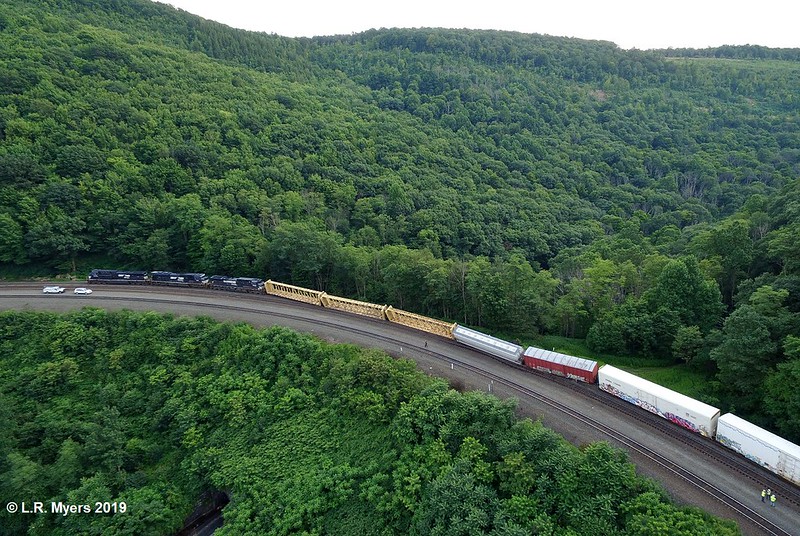 190726_9_curve by akmyers83, on Flickr
A few weeks later…
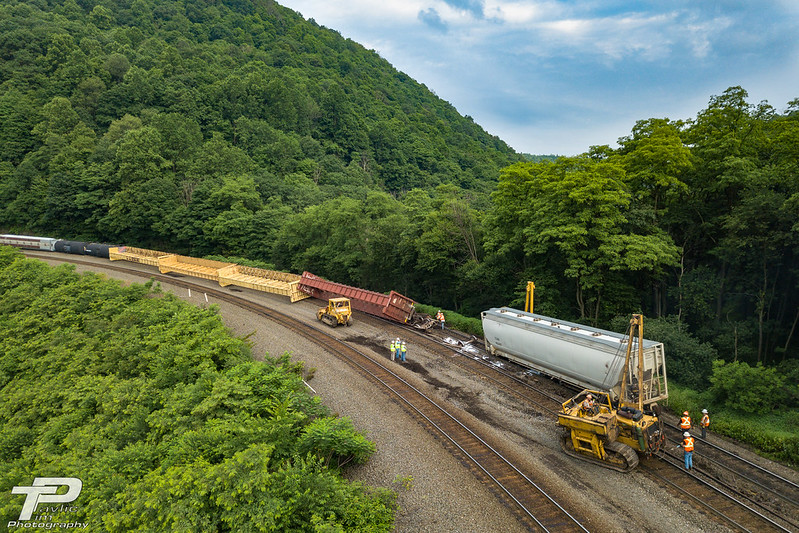 Oops… by Timothy Pavlic, on Flickr
Train dynamics have to be pretty tough on hilly/curvy terrain with helpers in the mix, too. Like pushing a chain.
Regards, Ed
2 Likes
Two Words
Trailing Tonnage
The more tonnage there is behind the ‘weak spot’ the more likely the weak spot will come off the rails.
2 Likes
Thank you for the response and terrific examples / information! Somehow I just didn’t feel this would be a problem these days, but obviously the physics stays the same, along with the consequences!
Looks like stringlining is still rearing its ugly head. (derailment begins around 2:40)
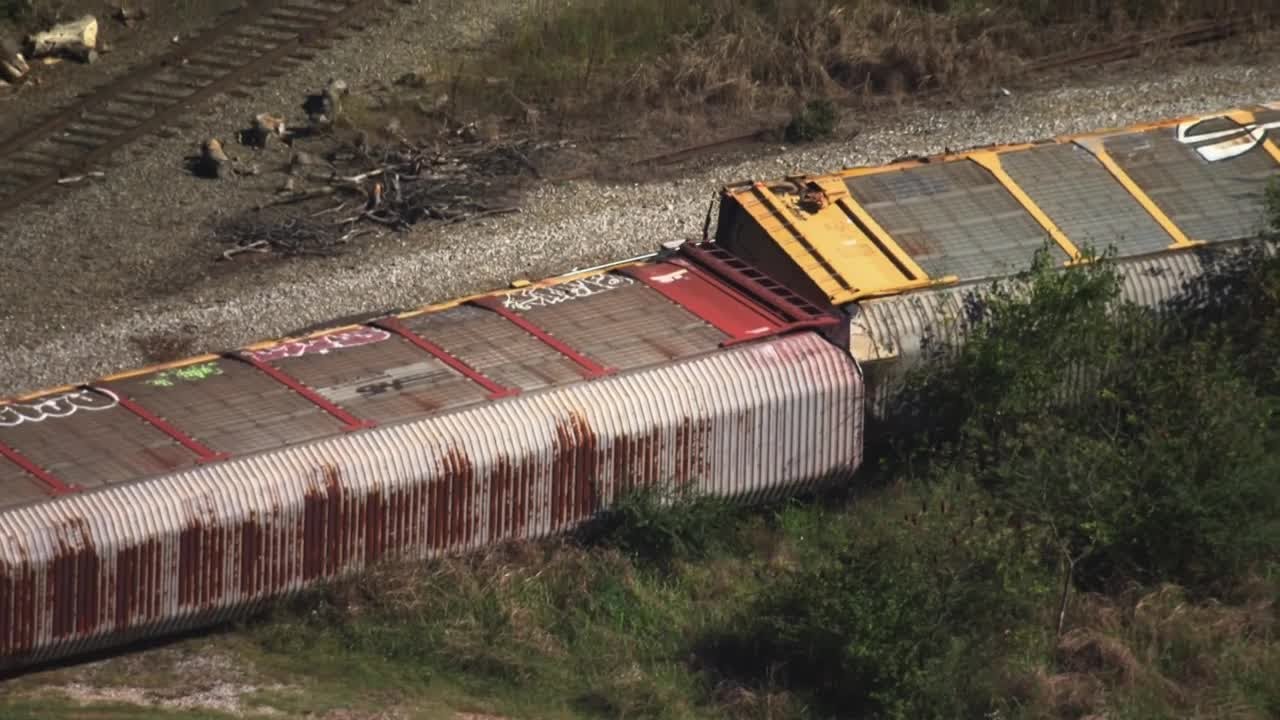
Cheers, Ed
1 Like
Definitely looks to be a stringline derailment. The key is how much tonnage was behind the derailed cars ‘streaching the string’. In my experience with CSX we did not routinely have any issues with Auto racks…of course when I was working (pre PSR) auto rack trains operated on their own and were normally not mixed into a general merchandise train.
When building a multi-block general merchandise train with all the various restrictions on car placements within trains and having contiguous blocking within the train - i pity the Yardmaster.
Among the restrictions are HAZMAT, consecutive empties, long car-short car coupling, TTOX 2-axle cars are just few that I can recall off the top of my head.
1 Like
This was on a very sharply-curved wye (see the almost model-railroad-esque curve at the beginning of the video!) with tall empty auto racks, probably with those 28" wheels, ahead of too many loads. I’ll be uncharitable and suspect poor train handling, not just empties and loads in unfortunate juxtaposition.
NS used to do the same thing where the old Pennsy Sandusky line wyed with the former NYC main in Sandusky, Ohio. A 150 car Triple-Crown Road Railer didn’t like that curve too much, either.
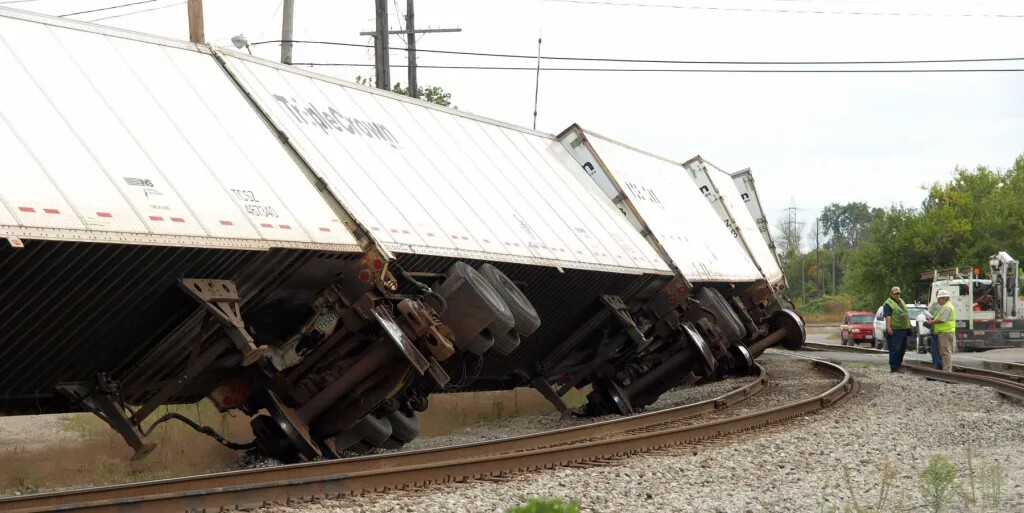
Bill Johnson photo
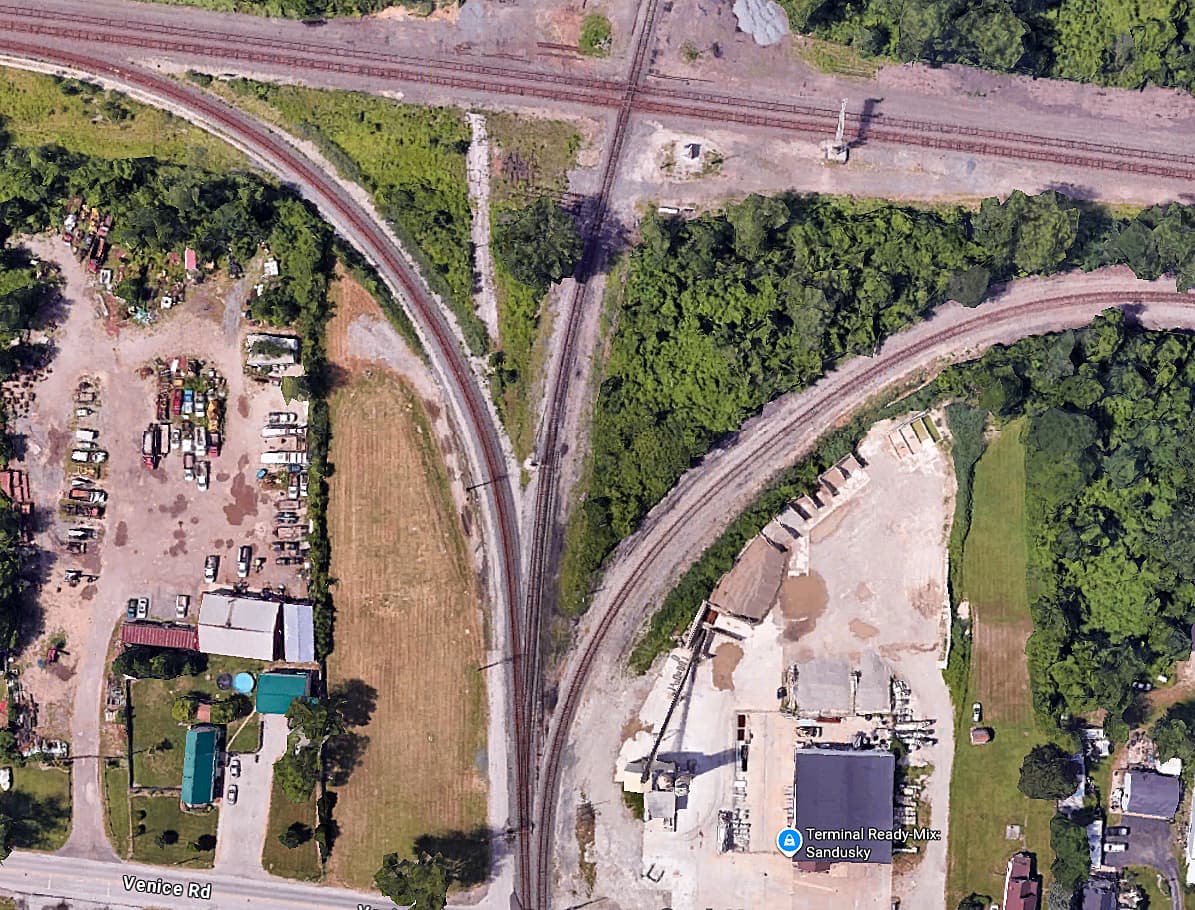
I heard that this might have been instigated by a broken train line toward the rear of the train, maybe even the EOT.
Another fun one was all these Fed-Ex trailers that decided to lay down near Horseshoe Curve (maybe near Bennington Curve?)
Regards, Ed
2 Likes
Drag (trailing tonnage) from the rear of the train finding the ‘weak point’ in the train make up rounding any curve. Braking initiating from the rear of a train increases the effective tonnage of the train at ‘that point in time’.
1 Like
In Cajon Pass of Southern California BNSF is running four-miles long trains. Fifty years ago, they put a train on the ground, and that inspired them to widen many curves. What they did apparently worked as those four-mile long trains stay on the rails!
By the mid-1990s the SP was already using cut-in distributed power over Beaumont Hill – it was a great show watching across from Hadley’s with groups of locomotives shouting in Run 8 every few minutes as each uphill train passed. That use of power distributed in a long or heavy consist is likely much more effective against string lining than curve easing (as opposed to line relocation) would be.
Heck, the Espee was using distributed power with the original AC’s over Tehachapi to prevent stringlining.
AC = Articulated Consolidation
2 Likes
Which were after the MC’s, Mallet Consolidation
Add to that correct train makeup! However, if distributed power was totally the miracle, it seems BNSF would in a minute use the Raton route, lengthen several sidings and ease congestion on the Southern Transcon.