The title says it all. How late were Class 1 railroads still using small steam engines for maintenance, freight yards, etc.? I have seen pictures where a train pulled by an E or F unit shows a small steam engine in the yard someplace. Just curious.
I can’t talk about ALL railroads, but lots of them got rid of their smaller steam locos first. That was why diesel switchers were sold, way at the beginning.
The ONLY steam on the SP&S that survived after 1954 was ALL of their 4-8-4’s and ALL of their 4-6-6-4’s.
But staying with small steam, the SP&S still had 3 2-8-0’s in 1954. Their 0-6-0’s were retired in 1951-52.
Going to the mid-size, their last 2-8-2 was retired in 1954, and their last 4-6-2 in 1953.
The GN had a dead line of retired steam held until about 1960. I don’t recall seeing ANY small steam in the line.
Ballparky, I would say the answer to your question would be about 1950. Or “the early fifties”.
Ed
I recall that the Reading Railroad kept an 0-6-0T for a shop goat unitl 63 or 64. A Reading fan can probably give a closer answer. The Wabash kept some 2-6-0s for a line that had a light bridge loading untill the mid 50s. The N&W kept some of their late built 0-8-0s in service right up to 1959 or 1960. As some one else has posted a lot of the major railroads started their diesel use by trying out diesel switch engines so a lot of steam switchers went to scrap early.
There was a PRR 0-6-0 being used to switch out gon loads of scrap steam engines from the scrap line until 60/61 when its fire was drop and joined it brethren in the scrap line.A SW1 took over the switching until the end in late 62/early 63… Coal for the 0-6-0 was loaded by a end loader and water was added by hose.
I’ll through in my GSVP N&W steam videos and let you know in an hour or so. I believe N&W was the last, or one of the last class 1s to drop fires for good.
Portsmouth, Ohio and Iager and Williamson WV were where N&W steam lasted the longest, some lasted into 1960. The last were 2-8-8-2 Y6. 0-8-0s were built by the N&Ws Roanoke shops in 1953. A couple lasted into 1960.
Edit:
The last N&W steam locomotives in regular service dropped their fires in May/June 1960.
Actually switch engines were usually some of the first to be dieselized because switch engines are smaller and smaller diesels were built at first and cities had smoke ordinances that the railroads wanted to avoid violating.
Most of the smaller late steam was either for a unique location (light branch lines), or in one specific shop where an engine could be maintained or because the railroad really liked steam (N&W).
The RDG 1251 was a 2-8-0 that the RDG rebuilt into an 0-6-0 (the RDG did a lot of kitbashing) and it was only used at the RDG shops.
Most of the late steam were the biggest and fastest of the railroad’s engines (4-8-4’s, 4-6-6-4’s, 2-8-4’s and all the later “super power” steam). Most of them were confined to select corridors so that the expensive support facilites (water/fuel/maintenance) could be eliminated outside of those limited areas.
Far from being a Class One, and I hope I don’t offend anyone by posting an interesting aside, It might be worthwhile to look at the operations of steam locomotives at Northwestern Steel and Wire:
https://en.wikipedia.org/wiki/Northwestern_Steel_and_Wire
The last steam locomotive to olperate was on December 3, 1980.
I realise the OP was only interested in Class One railroading but the conversation drifted toward switching and I thought it would be appropriate to mention the operations at Sterling, Illinois just the same.
Regards, Ed
Thanks all for the replies!
Once upon a time, the Boston & Maine bragged that they were completely dieselized by 1957. On the B&M the small 2-6-0 Moguls lasted the longest. They were pulling commuter trains in and out of Boston right up to the very end. The big steamers were the first to be scrapped. A few of the big jobs were kept around for a while to supply steam to defrost track switches in the winter.
One of the drivers for scrapping the last steamers was a desire to shut down the coaling towers, water tanks, ash pits, roundhouses, turntables and all the employees needed to operate them and keep them filled. Once the last steamers were gone, all that steam support stuff could be retired.
Pardon my ignorance, but were roundhouses and turntables exclusive to steam engines? Although I guess if you had, for example, an A-B-A setup with F units, The final A on the trip into the freight yard could then be the leading A unit out, correct?
No…Diesels needed turn for various reasons and they needed servicing so the roundhouse filled the bill for several years until they became to costly to maintain then there OSHA and EPA regulations to follow.
A few turntables still exsist and is used for turning wide cabs…
Turntables no, roundhouses sorta no.
Yes an A-B-A set might not need to be turned, but an A-B set would, single engines would (locals) or sets that had to be broken up and put back together because one engine failed or was due an inspection. Roundhouses are not well suited for diesels since an A-B-A or A-B-B-A set was longer than a turntable or a roundhouse stall in most cases and wasn’t designed for the quick turnaround that diesels afforded.
Indeed but,they was used by braking up that A-B-A set after all the draw bars was replaced with couplers for various reasons and one was for maintenance instead of having three units out of service because one broke down now instead they have one down while two remain in service.
Railroads wanted diesels but,didn’t want to build the shops to maintain them since they had roundhouses.
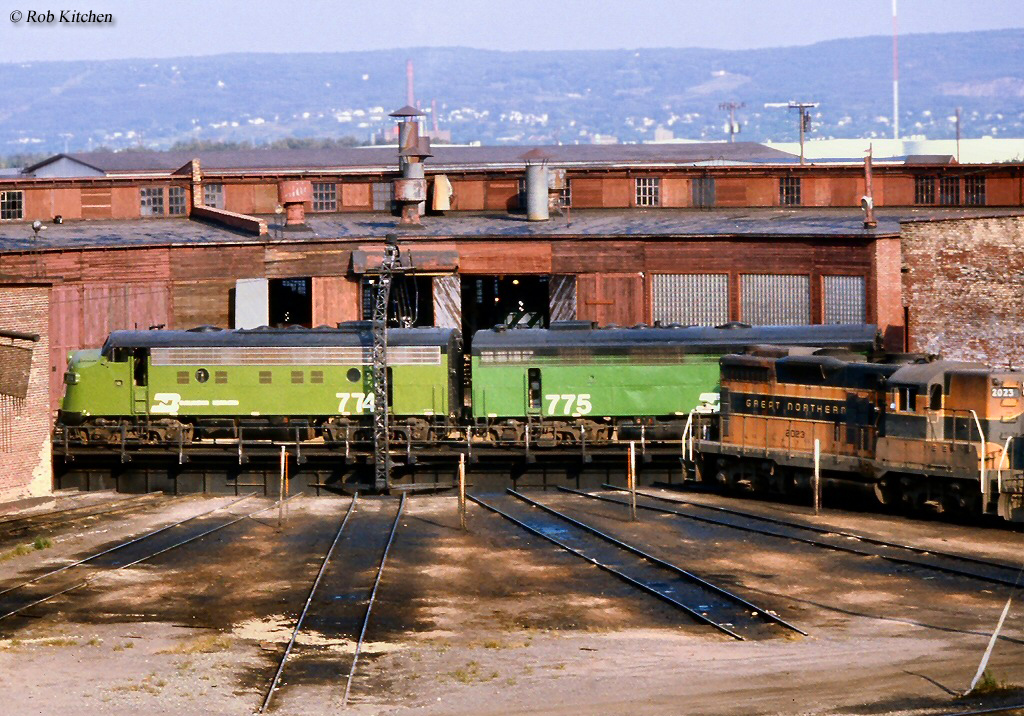
[#offtopic] [#offtopic]
In regards to the above photo: A classic example of color variations on railroad equipment. The BN paint shop must have used Floquil on the A unit and Scalecoat on the B?
Interesting.
Ed
Well, I can’t add to the turntable discussion, but to answer the original question, my wife grew up in Billings, MT., and lived accross the street from the line that ran from NP’s main yard in Billings, to the sugar factory, C&H. A steam engine did the switching, as she remembers it running back and forth, which follows State Steet. It’s all there, the C&H plant is now called the Western Sugar Co-op.
This was in the early to mid 60’s.
Mike
Just to add to a couple of points already made…
As was mentioned, many (most?) railroad’s first diesels were switchers. The great advantage of a diesel was that it could operate pretty much all the time, whereas steam engines required daily servicing. By the start of WW2, diesel yard switchers were more common than we might now realize.
IIRC, a typical late-steam turntable could handle an A-B set of F-units (like the BN units shown in the earlier post - BTW I believe that’s the old GN roundhouse in Superior WI?). This worked out pretty well, as the first F-units, the FTs, were designed to be an A-B set connected by a drawbar, and many later F-units were similarly set up. (Even if a railroad assigned four F-units the same number, like 5075 A-B-C-D, and treated them as one unit, they weren’t all connected by drawbars. Normally they were two A-B sets back-to-back.)
Many railroads found that the problem with the FTs was that often one A-B set wasn’t enough power, but two sets (A-B+B-A) was too much. After WW2, many roads bought individual F2 or F3 A-units to operate in A-B+A sets. As noted, with an A-unit at each end, the engines didn’t have to be turned after each trip, but would often still need to access the roundhouse for maintenance.
Building a “square house” for diesel maintenance was ideal, but in the transition era many railroads just continued to use their roundhouses until they could build a diesel facility. Minnesota Commercial railway in St.Paul MN still uses a turntable for their diesels. Since it ws designed for small switch engines, it’s interesting to see one of their big C-630s squeeze on there.
Stix’s comments on FT’s got me thinkin’. Just last night, I was thumbing through a GN picture book, and thinking I NEED a set of GN FT’s (and so do YOU, I might add).
I’m lucky enough to have a copy of a 1952 GN diesel diagram book. So I did some thumbin’ through.
GN’s four unit FT’s that were EVEN numbered (400 to 428) were drawbarred except in the middle, having couplers there.
GN’s four unit FT’s that were ODD numbered (401 to 405) were all drawbar.
GN’s three unit FT’s (301 to 305) appear to have been all-drawbar.
The same holds for their two unit sets. Some of which were AA (247 to 249).
The drawbar-on-each-end B units were shorter than the drawbar-coupler B units. The all-drawbar GN four unit FT’s were 9’ 6" shorter in overall length than the separable.
Ed
Colorado & southern used a standard-gauge 2-8-0 around Leadville into the 1960s because deisels at that time would not work well at the 10,000 ft elevations.
The shorter B units were “FTSB (FT - Short Booster)” units. They were designed by EMD at the request of some railroads that wanted to run three unit sets. Whereas normal FT B-units were set up to have a drawbar at one end and a regular coupler at the other (the end with the overhang), FTSBs were made to use a drawbar on both ends, and didn’t have the overhang of other FTs (both A and B units).
Unlike the regular B-units, FTSBs couldn’t be ordered with a steam generator and water tanks for passenger operation…same of course with the A-A option.