I’ve got a steep, not so high (say 8") hillside fashioned with cardboard strips covered with plastercloth. In one area, fairly straight at the bottom, I’ve decided to add a couple of timber retaining walls (one above the other, kinda making terraces. I bulit the bottom 16" retaining wall today, borrowing from a Chooch product design using 1/8" basswood, and like how it turned out and will build another 15" or so one tomorrow to go above it.
My question is how to go about adding the Sculptamold hillside texture and paint and integrate the retaining walls. Elsewhere, I’ve simply added a layer of (white) Sculptamold on plastercloth and then painted it earth color (later will add more texture as dirt, rocks, grass, etc). I’m staining the timber retaining walls with an India ink wash and that looks ok. But I need to add Sculptamold to get a final hillside shape to push the retaining wall into. But then can’t paint the Sculptamold behing the retaining wall.
With no advice, I’d try two steps: first add a layer of white Sculptamold to get close to the final shape that the retaining wall will fit. Then, mix some Sculptamold including my earth paint color, and create a final (colored layer) to push the (stained) retaining wall into. Is this the best way?
Plus, can I then add some dirt and talus I have behind any space behing the retaining wall, and secure it with white glue and wet water as usual? Or will the glue mess up the stained (basswood) retaining wall finish? Should I seal the stained retaining wall to avoid changing its color/texture?
I’m sure a number of you have addressed this application so I would appreciate (as always) the benefit of your experience and advice. Thanks in advance.
First, you determine the need and purpose for the retaining wall. You seem to have done that, so you should also have an idea where it will be placed. So far, so good.
Next, you should set it as close to the existing slope as possible, and glue it into place so that it is vertical…the way it would have been engineered and erected in situ. You can use PL300 from Lepages for this as it is strong. You can pare away any oozed stuff that shows, or shape it and paint it. Then, cut a foam plug, shaped to take up as much of the open volume behind the retaining wall as you can. Glue it all so that it is solid. You can plaster cloth over the plug, or backfill around it with sand or kitty litter. Or use masking tape as a cap. Then some rip-rap or talus…your choice. And that should be about it.
You’ll have to make the rest of the slope above the fallen stuff that is being retained look like the fallen stuff.
I’ve done this with Grandt Line log retaining wall segments. One way is to just push the white Sculptamold in behind. Then use some acrylic thinned to a stain to wash over everthing, using the bristles to get to everything down in the cracks between the logs or timbers. This works fine for a lot of what I do, where it’s a mining operation and everything starts taking on a patina of dust from the mud the dried up since the last rain. It also works well with the plastic Grandt Line segments, which pick up just a little of the stain, and the Sculptamold that sucks that stain up like a hobo pulling on a bottle of Nighttrain.
I’ve also use real dirt, ballast, etc. Filled the area with black-painted stuff to take up most of the space, say a block of balsa. Then once it’s glued in place, dribble in the fill between the spacer and the inside of the walls.
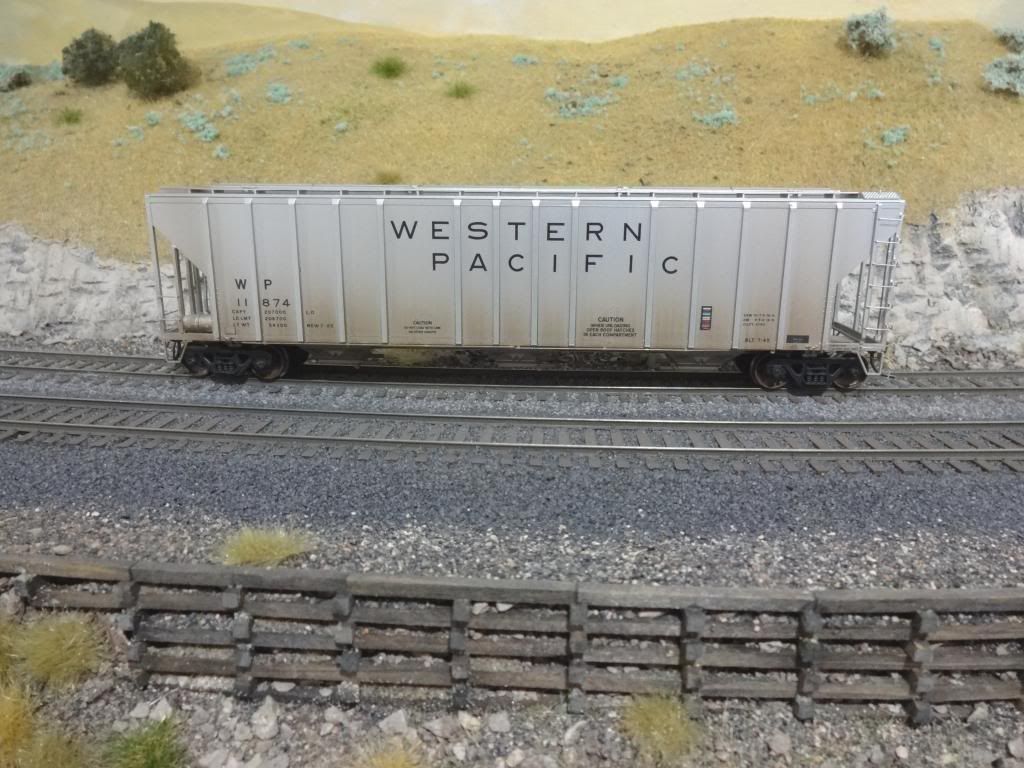
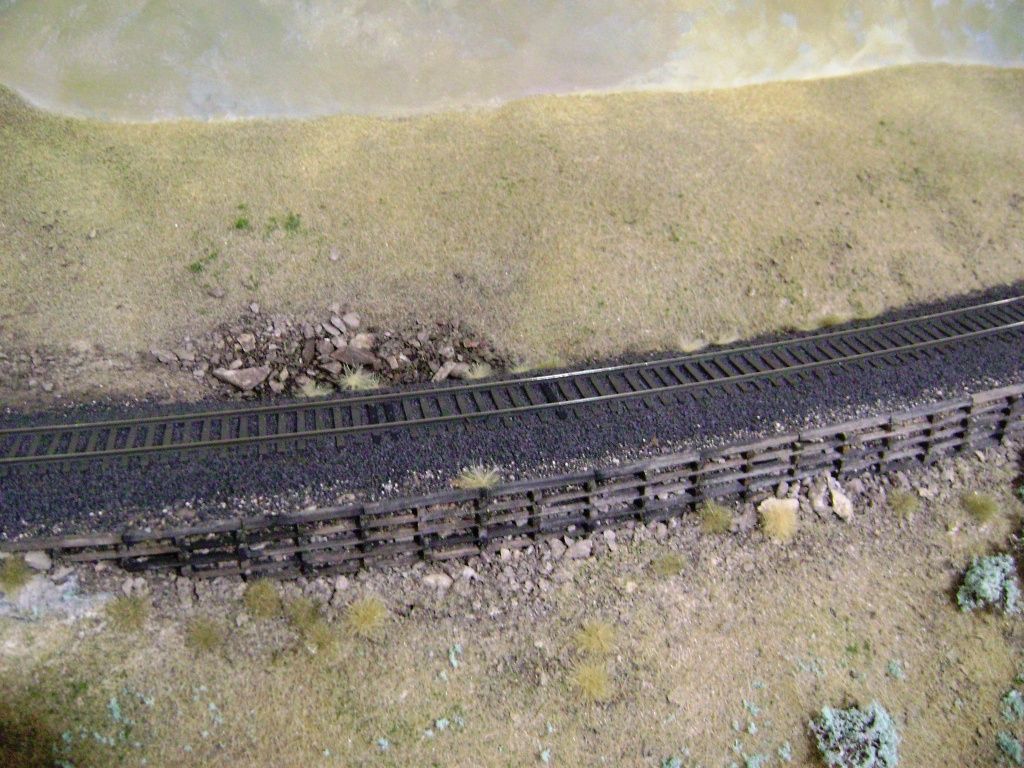
I have several cribbing and other wood retaining walls. I build them from scale stripwood and/or bridge ties. In most cases, I build the wall off the layout and install it in one piece. Depending on the application, I may add a ledge of plaster on the hillside to hold up the wall, or I may secure it first and build up to the bottom with dirt and rocks. To get the wall in place, I’ve used hot glue, CA and accelerator, and yellow wood glue
This wall was added to a plaster ledge, and dirt/rock/sand fill was added and glued with my usual 50:50 white glue:water mixture. Since the ground cover everywhere uses similar natural materials, the stuff added around the retaining wall fits right in.
Here’s a wider view of a wall built and installed the same way as the one above. Parts of this one rest on the plaster shell, while others were initially in midair until the rock fill was added. A few drops of hot glue held the wall in place until the rest of the scenic material filled around it.
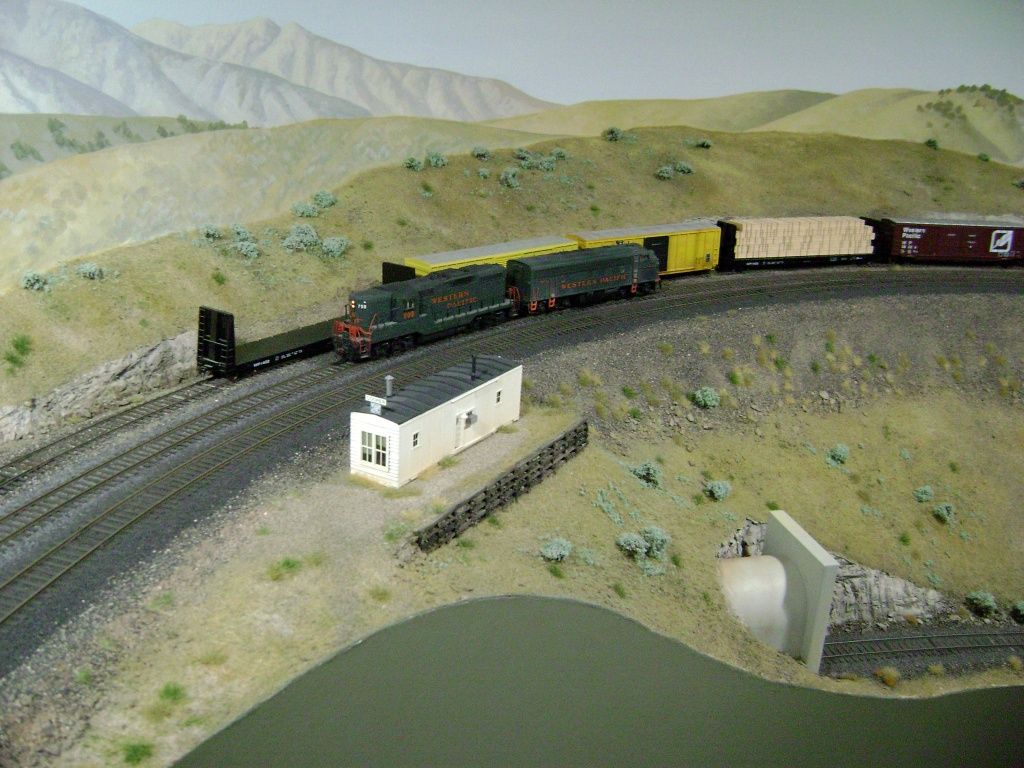
A base for this boxcar depot was assembled from foam core board and added atop the scenery shell. I built the retaining wall to fit around it and left some space for fill behind the wall. Again the dirt and rocks were filled below it to integrate the wall with the rest of the slope.
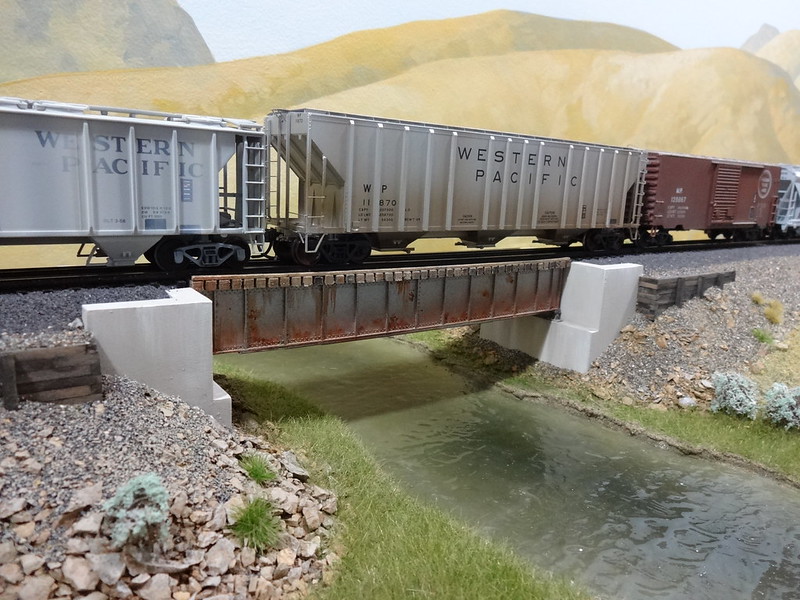
These walls were added to the edges of the plywood roadbed. Since fill material would not be visible behind them I didn’t leave any space for it, and only filled above and below. There isn’
I remember seeing several of these sometime in my past. Had thought of modeling some, but hadn’t given much thought to how to set them in place. Looking at your ideas and the responses here, this came to mind. Build and stain your cribbing, then lay it face down and butter it with Sculptamold, if a little gets on the front, dirt gets on the front of the real things too. Carefully paint or stain the Sculptamold between the timbers, but here again if a little discoloration of the timbers occurs, it should look realistic. Once dry, put in place and fill behind it with a foam chunk or some fill material. Cover that with Sculptamold and paint or stain it to match the surrounding ground. Good luck, Richard
Thanks for all the suggestions and nifty examples. You all are a big help! I partcularly like the idea of using variations on this around the layout. A you know, these are very expensive little projects, requiring around $1 of basswood strips, plus paint and glue.
Not sure I could go for this, as it sounds like you could ruin the walls in no time. Not to say it necessarily wouldn’t work, I just can’t figure out how I could do it that way. If you want to stay with Sculptamold for everything, throw some color into it so you won’t have to color it after you add as described. Otherwise, I’d suggest gluing the walls in place on the layout and filling with rocks and sand. If you don’t have a natural source close by, most home centers sell bags of play sand, paver sand, and finely crushed aggregate. All of these can be used for model scenery. Filling with sand and rock goes very fast and anything you don’t want on the wall either falls away or can be removed easily before gluing.
Going the “natural” route that Rob suggests can also help if you model a specific prototype. I model mining RRing the Colorado’s San Juan Mountains around Silverton. I have several containers of the yellow-ish local earth/mine tailings sorted in different sizes. That’s what I use when I fill my Grandt timber cribbing (Part #5260)
I am currently constructing a crib timber retaining wall. What I plan to do is stain the wall, then create a sheet to fit behind it. I will paint this background sheet my earth color. I will then coat it with white glue, place the wall on it and then fill the gaps with a dirt, gravel filler. I will then brush excess dirt off timbers add any additional dirt in those gaps and then soak it with scenic cement or diluted white glue. Once complete I will glue wall in place on the layout and use sculptamold around the perimeter of the wall to smooth it into the landscape.
I’ll post picture when done. Hopefully this will work well.