I thought it was best to start a new thread to address this point:
I completely agree with this.
How does a newcomer get started in model railroading? Does Kalmbach still publish the HO Primer? Is there a local hobby shop where they can browse and get a complete set up of what they need?
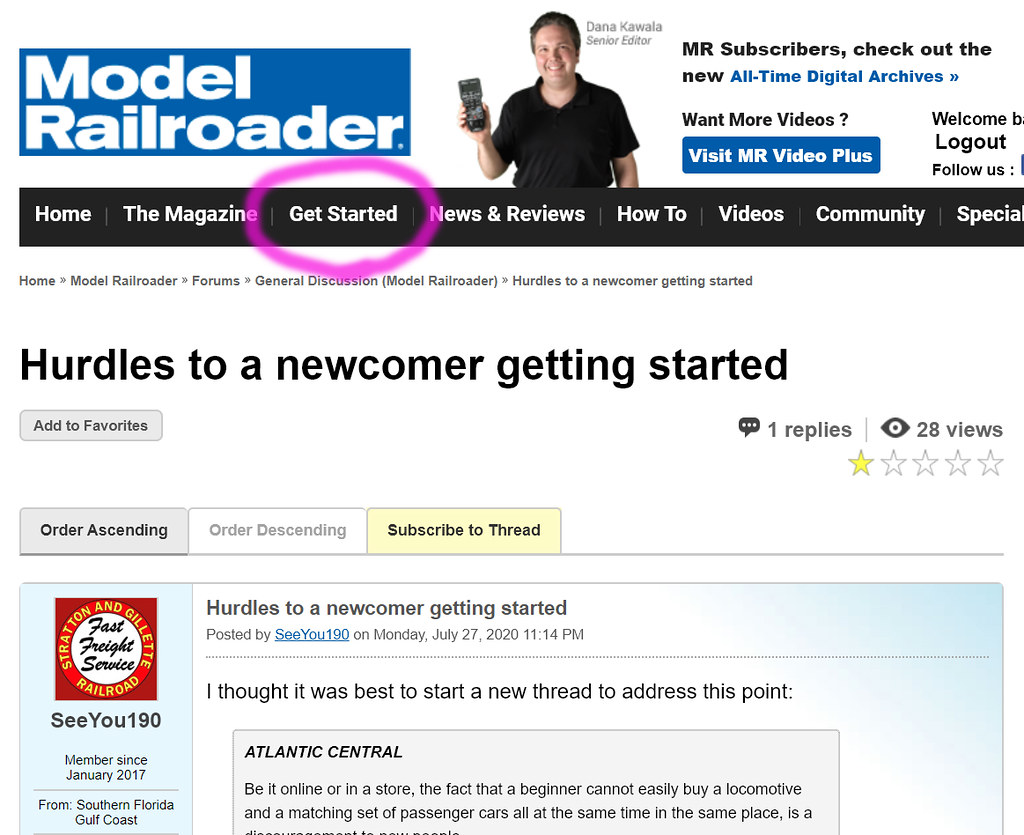
I posted recently how I could not find a “getting started with model railroading” tab on the home page of any of the major model railroading websites. Well, the NMRA comes through. There is a “getting started” tab on their home page. How many new model railroaders will find this?
I would enjoy a discussion on what it must be like for a newcomer who has just seen something thatr inspired him. Maybe a Model Railroader in a Doctor’s Office or a model train featured on a TV show.
Please don’t respond with what you would tell him to do, he does not know you. Put yourself in their shoes… where do you go, and how do you get brought into the fold?
Today, everything is online. The first reaction to any person living in this day and age of the internet would type “getting started with model trains” into Google, start reading websites and watching YouTube.
I have pointed this menu bar out to several inquisitive newcomers to the forums in the past. Generally they were thankful and appreciative. Hopefully the information provided was helpful.
Sometimes the internet is like an onion where you have to peel back some layers to get to the core.
Ed: When I clicked on that last week it took me to an outside online retailer selling tools. Today I just got an ad for tools and some links.
I suppose if a candidate was introduced to the hobby through an eye-grabbing article in Model Railroader it would make sense for them to go to the Model Railroader website. This seems like a great pathway.
I am going to read throught the information contained there.
I wonder if that may be somehow related to some browser (mal)function or odd cookie redirect?
Anytime I click on those topic headers I get redirected to MR’s site and delve into a great deal of information contained therein. I also like to visit the user videos and photo contributions. The “HOW TO” menu will also offer some great layout building information.
I’ve heard some forum responders say “Gee, I didn’t even notice those tabs were there”. Ya’ gotta’ dig to get to the ore [:)]
I walked into a hobby shop. I forget how I learned of this one LHS, but I knew I wanted to visit it after an errand driving my dad to the ferry in Nanaimo, where the hobby shop is/was. I left with a BLI Hudson and some tracks.
I hadn’t visited hobby forums before that, but soon learned that they exist and that they’re great resources.
This is probably the one great deficit left behind by closing hobby stores that sell trains and train sets. Apart from that wonderful experience of browsing in them, and of finding some hidden gems and bargains, you learn where train shows are happening, or you’re given a phone number of a guy who knows a guy whose friend installs decoders…if you want one installed.
The demogrphics thread that Brent started really got me thinking. I never really considered myself having a “typical” entry into the hobby, but now looking back… it seems like I did.
I received Tyco train sets for Chirstmas every year for about a decade or so. My dad and I built a 4 by 8 Murphy Bed style HO Train Set layout in the garage when I was very young.
When I became serious about Model Railroading in High School, I joined Scale Rails of Southwest Florida, and really learned a lot about the hobby that way.
I always had local hobby shops to learn at. A&J models in Cape Coral, Carl Wilson’s Clear Track in Fort Myers, Gulf Coast Model Railroading in Sarasota, Orange Blossom Hobbies in Miami, Happy Hobo in Tampa, and Colonial Photo & Hobby in Orlando. Only two of those remain.
I read every issue of Model Railroader and every book from Kalmbach.
Absolutely nothing about that pathway seems unique or remarkable. It all sounds very typical.
It sounds like most of us came into the hobby through a similar set of experiences and situations.
Now that a lot of that is gone, I became a little concerned for the total newcomers.
Never forget you tube is your friend. There are several videos on getting started in the hobby.
Back in the day a good hobby shop was the place to go to get information… Now in the computer age model railroad forums and you tube is the go to places.
Most readers of this thread cannot put themselves in the shoes of a guy who may be interested in getting started with model railroading because they already know where to go. Most of us got started because we wandered into a LHS or knew somebody who had a layout. It is one of the many reasons why interest in the hobby continues to decline. There simply isn’t the widespread access to the hobby that there once was. That’s it, pure and simple.
In many ways, due to the internet you could argue that the hobby has become more accessible than it used to be. When I got my first train set as a kid, the nearest hobby shop was a 3 hour round trip away. Books were unavailable at my local small town library. I learned on the fly and with what supplies came with that first train set.
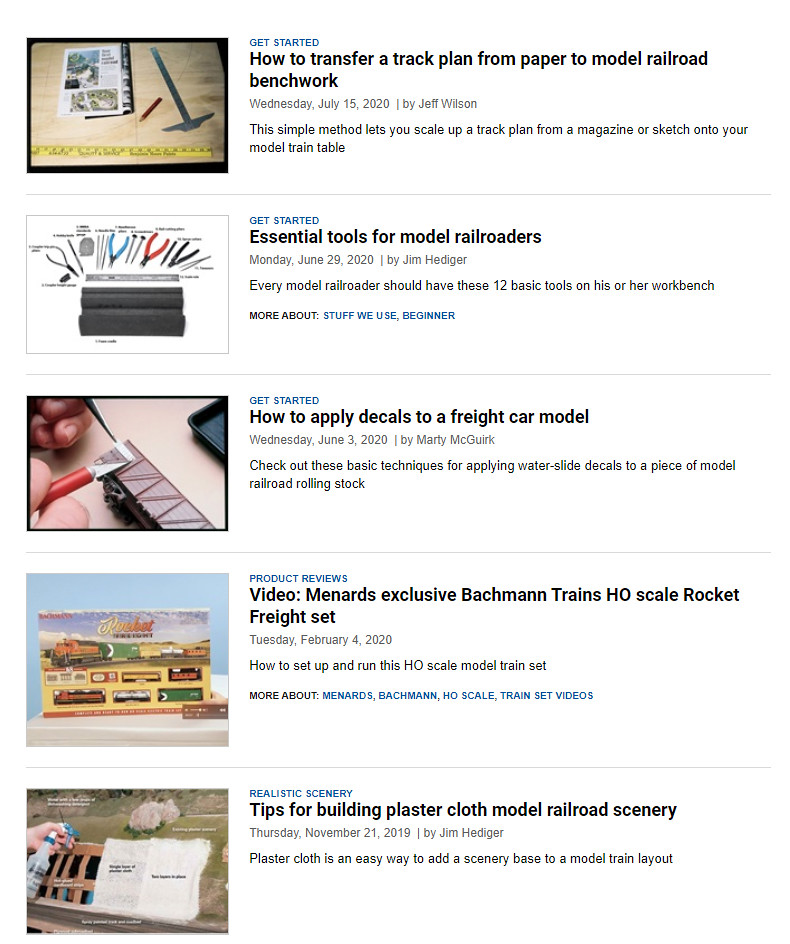
However, I sometimes cringe at the the advice or information provided to newcomers even when it is given with the best of intentions. Take for example the “Essential Basic Tools” article on the getting started page. A dozen very handy tools are listed there. 35 years into model railroading and I still don’t have all of them. I did a substantial amount of modeling for years with only three of them. Screwdrivers, pliers, and a hobby knife. I’m not saying it was always easy, but it was always possible.
I feel the same way about the usual “figure out precisely what you want to model and only buy what applies” advice. Excellent advice to someone with more than just their feet wet. In my opinion though it isn’t good for a newcomer. How do they know precisely what they like if they haven’t done it? My advice is, buy what you like and will have fun with. The rest will work itself out later. In the meantime enjoy the hobby.
I learned very little from any hobby shop I ever was in. I was introduced to the hobby at a young age by my parents. That’s where I learned all the basics, like getting the wheels of the cars and locos on the track, and how to control the trains. We weren’t subscribers to any of the magazines, but we had a few issues - a couple of late 50’s RMCs and at some point in the early 70’s, something must have caught my Dad’s attention and he picked up a couple of copies of Railroad Modeler. I am and have always been a voracious reader, reading well above my age level when younger, so I found books on model railroading, and read them. Even the old books, which may seem out of date - while today we have all sorts of sophisticated electronics to add control and animation, the basics really are little changed. Sure, we have nice glues for putting benchwork together, affordable power drill/drivers that most everyone has, no more heating up the hide glue, drilling holes with a brace or an eggbeater drill, none of those wonderful old Yankee screwdrivers - but the concept and need for a stable base to build on remains unchanged. There seems to be a reluctance to look at what is considered “old” or even “ancient” material. One of my favorite books I discovered at the library back in the day was David Sutton’s “Complete Book of Model Railroading”. It was chock full of information, not to mention photos of some of the nicest layouts of the day - that day being 1964. In fact, while looking for something else the other day, I happened to be looking through some MR issues from the time and there was a full page ad fromt he publisher selling this very book. I would check it out for the two weeks, take it back, and a visit or two later, check it out again - I finally found a copy of my own and I still occasionally read through it. Just because the book is older than I am doesn’t mean there is nothing of value in it.
Rich, Check out model railroading on you tube and face book… It far wider then you think. Today’s new modelers are computer savvy and know how to find information. I did indeed put my thoughts as a new hobbyest that knows nothing about the hobby and found tons of information on starting the hobby on you tube and by using google…
As far as the hobby shop information that depended heavily on the honesty of the owner. Did he sell a new modeler things he did not really need or did he start the new modeler with the needed basics?
Reading the posts on this forum and looking at the newbies that join our local club, I can identify two typical types: the 12-15 year olds, and the “older adults” getting in or back into the hobby. For the latter, it appears that many had a toy train set when they were a kid, then they got into serious school, cars and/or girls, and are now interested in coming back to the hobby after getting some of their spare time back (and some extra bucks). Our club takes part of “shows” at our local shoppping centre, where a few guys set up some portable layouts. We’re getting most of our new members from these shopping mall shows. They ask questions and we provide some tips and invite them to our club.
I’d be curious to know how the 12-14 year olds get hooked on the hobby. To me, I can’t imagine them getting the bug from a computer - seems counter-intuitive.
Simon
PS: I don’t know anybody who started the hobby with passenger trains. They are too costly and they don’t particularly look good on 18" radius. Most sets are sold as freight trains.
Mike, As teeager I had PRR steam,UP steam, Santa Fe steam, a United Class B two shay,I painted and decaled several Athearn BB SW7s,GP7s ad GP35s for NYC, PRR and had 3 Hobbytown RS-3s painted for NYC… I had four Alco Models RS-1s painted for my Detriot Connecting.
I had tons of fun operating those engines at the Columbus HO club.
I have often look back on those simple fun fill anything goes modeling days…
Some times I wonder when I switched from anything goes to more “serious” modeling. Serious modeling for me means having cars and locomotives fit the era I’m modelng.
What you really want is a train store, not just a hobby store. If your local retailer is making money selling model railroad stuff, not just running his own store as his hobby, you will get all the help you need. If you don’t have a local train store (LTS should be the acronym we use) then these days a hobby shop will be of no help at all unless there is a real train nut in charge. In which case it’s a train store masquerading as a hobby store.
Source 2 is the amazing internet. Google is your friend. Ask it anything and sift through all the nonsense for awhile. Pretty soon this site and maybe three or four others will be your constant companions. Don’t overlook the UK or Australian sites, we’re all captivated by the same nonsense.
And it can be amazingly rewarding. No other hobby quite captures the combination of collecting, making and learning something new quite so well.
We enjoy primarily a historical hobby. To get the most out of it you should read/view/ attend railroading history sources as you build and operate your model railroad. Pretty quickly you realize that the prototype literally transformed the world, the entire world. Before the railroad transportation was very expensive and very slow. Very soon after Trevithick and Stephenson showed how it could work everything got very cheap, very quickly. Today, with container ships linking the railways, long distance freight costs approach zero per useable unit of just about anything. That’s the history underlying our fascinating hobby. Just the history of the entire modern world, that’s all.
One of the mind boggling questions I was asked by several teenager during the week of the county fair was “How does DCC work and is Bachmann DCC trains any good?” When I ask how they learn of DCC their answer was on face book.
I started with a Lionel train set I got for my birthday at age 5. Looking back, it was a tremendous sacrifice for my parents as my Dad was in his first year of med school (he went to med school with 2 kids, and left with 4). All I ever wanted for Christmas or my birthday was train stuff; and in a couple of years, I had enough track and a couple of switches to put on a 4 x 6 board. Everything changed the Christmas I was 11; my grandparents gave my brothers and I a Tyco train set, something I wanted, and they didn’t. Soon, the 027 came off the board and the HO went on it. In high school, I joined a club in Abilene, where I learned about Kadee couplers. I moved to Abilene after college, and started a new club (old one lost its lease and disbanded). Moved to DFW and was involved with the original Texas and Northern club in Oak Cliff; that’s where I learned that politics was almost as important as trains.
I have no idea how kids would easily be exposed or get involved in the hobby today. There is not a hobby shop within 90 miles of Bryan/College Station. Our club is small and not visitor friendly from a comfort standpoint. We have a modular group; but finding venues that will let us set up is getting harder and harder. We had a community center that let us set up for $150 a weekend; except they have raised their rates to $750 a day. The local mall has no current interest in letting us set up, even though we have in the past, with no issues.
I guess my point is it is necessary to show the hobby in order to grow the hobby. The internet and youtube is great, but the ability to see running models is the best way to seed new growth in the hobby. Interacting with kids and their parents, answering their questions, letting them run the trains; telling them the who, what, where, how, how much; that is how you make new folks get interested in the hobby.
I just checked this out. I have posted pictured of my tool boxes many times, but I only have 10 of the 12 listed, and 1 of the items I do have I never use.
A pin vise is not on the list. I use that more than anything.
Also missing: test light/volt meter.
We had the same problem in Scale Rails of Southwest Florida in the 1990s. We had four beautiful portable layouts: HO, HO/HOn3, N-Trak, and N scale.
We set these up several times a year in malls at Christmas time, our own train shows twice a year, at the Lee County Fair for two weeks, and at schools.
Then all of a sudden no one wanted us anymore. They wanted fees to use the space or invitations did not come.
This was strange because our set-ups were always very popular.
My answer to the encouraging interest issue has been to build a layout in one of my grandson’s basement, He is 6 months old at the moment. I should be finished by the time he’s six.
My other grandson owns the Brio trainset of my dreams.
When he visits me he gets to play with the G gauge Playmobil (LGB) train “set”. We have quite a bit of track and a lot of turnouts…most recently bought with my HO stuff. Also, his new cousin’s house has become very interesting. In addition to two large friendly dogs there is now a pretty amazing HO train downstairs with dozens of locomotives, dozens of freight and passenger cars and lots of track to run them on. Gets him very focussed quite fast.
DCC needs significant improvement to appeal to the current generation. Development is expensive and the learning curve to “convert” current modelling experts will be steep. Investment capital aside there really is no reason DCC has to remain incompatible with DC. The state of current dual mode models is really pretty fine and DCC as it currently works isn’t necessary or even particularly desirable.
All that is really needed now is constant voltage DC to the rails and smarter decoders. It will come but ironically, the NMRA standards are hindering development. Great idea at the time but technology marches on and standards have to change to keep step.
An interesting and difficult question. I think it is a huge hurdle to get started if you come to scale model trains without first having had toy trains. You don’t really need much help to get started with toy trains, although in my day you had to know that Lionel (and Marx) were one gauge, 3 rail, and American Flyer was another, 2 rail.
If you were in toy trains you likely hung around the train store a little and looked at the scale stuff and talked to folks or overheard conversations. Maybe you looked at Model Railroader or RMC now and then on the magaaine rack or bougtht one (50 cents in my youth!) and picked up some basics. Kalmbach used to have a magazine called Model Trains that catered to both tinplate owners and beginners in scale model trains and by the time you were ready to make the switch from tinplate you knew a few things like minimum radius, couplers, DC versus AC, brands of trains and track, and so on.
For example, somehow (looking at MR?) I knew that the Maerklin trains that I saw at Casanova’s hobby shop in Milwaukee were NOT compatible with the other lines of HO trains I saw there. Maybe I overheard Jerry behind the counter say that to someone. I see people at Trainfest looking at Maerklin trainsets and Walthers trainsets and I wonder, do they even suspect that those trains are not compatible with each other?
While there is a plethora of beginner stuff on YouTube and Facebook and elsewhere, you still have to know a little bit to ask the right questions that find that stuff. A true beginner with no background in toy trains is going to fumble around plenty before they find what they need. And while Google and Facebook and YouTube may well be “your friends,” they are friends that don’t always agree and can even be strident about it.
Being a geezer I still think a book for beginners, one that takes one consistent view of how to get started, makes sense, rather than try to