There are at least four test tracks in the process of being built in the United States. Elon Musk is building a 6 ft diameter mile long track near SpaceX and sponsoring a contest for pod design. I am somewhat disappointed that the inside of the tube has a flat concrete surface, but at least the 120 or so entrants should provide a lot of ideas.
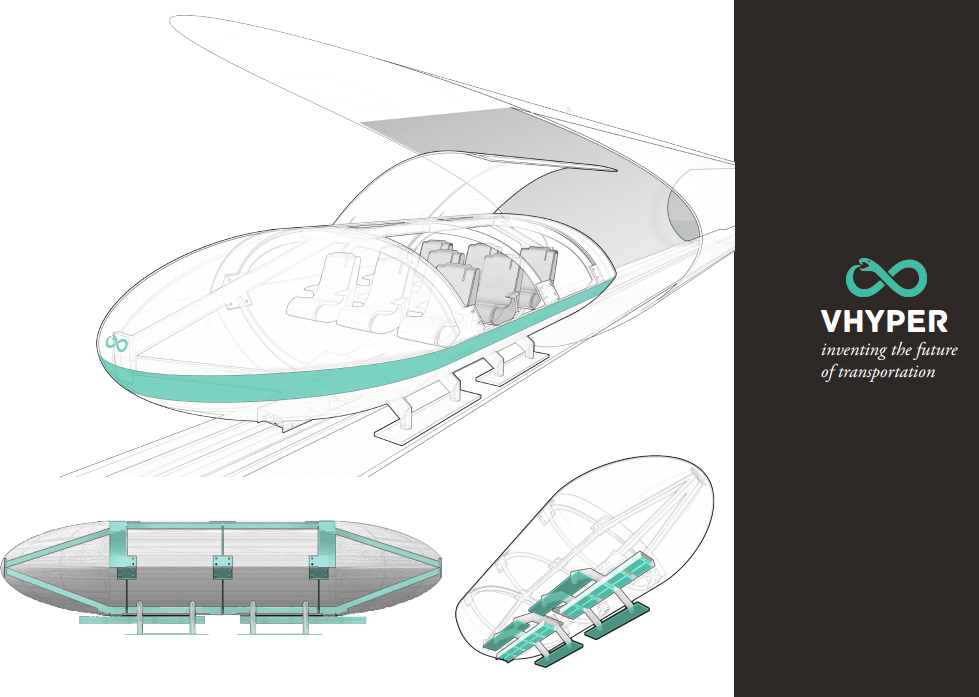
Hyperloop Transportation Technologies will start building a 5 mile test track north of Los Angeles on property purchased in Quay Valley, California. They say that they will probably build hyperloop systems in Asia or the Middle East. I doubt that the hyperloop will exit the station building with a curved track, as in the artist rendering, but maybe they know better. If you know more about them, please let us know.
Another company, Hyperloop Technologies, is probably the most ambitious with two test tracks in the making. The first is an outdoor 1/2 mile uncovered two rail affair in North Las Vegas, Nevada, probably for testing its propulsion components, but could be adapted for more. The second test track will be 2 miles long, for which 20 or more tubes have already been built and delivered by truck to Nevada. The tubes are said to be 3.3 meters in diameter and various lengths have been spotted. They look to build a Hyperloop system in the United Arab Emirates, possibly between Dubai and Abu Dhabi. They are also talking to China’s largest railway equiptment manufacturer CRRC about collaboration and investment.
China, Korea, various in Europe, Canada, and South Africa were some of the countries that expressed early interest in the hyperloop and were exchanging and obtaining information. China had about ten different cities, presumably universities, that participated. They and the Swiss were previously working on vacuum maglev systems. What all these countries now are doing is a good question. In the United Sates, should Amtrak, our railroads, FedEx, UPS, USPS, major shippers and our government be interested in what is happening? It will be inter
They are a long way away from transporting human beings that way. It’s also more volitile than rail transportation in that the transporting vehicle cannot touch the sides of the tube or it will disintegrate completely and just human remains and metal fragments will end up in the tube.
Good luck getting the public to step into that mode until it is made fail safe.
if the vehicle fits snuggly (even if not touching) in the tube, doesn’t the air impede the vehicle and the resistance would increase at least proportionately w/ speed?
I don’t have a copy of Musk’s paper handy, but I thought the idea was to evacuate the tube ‘enough’ that the air provides hydrodynamic support for the capsule via the ‘airskate’ pads or whatever (at reasonable residual compressibility and drag) with the propulsion being via intermittent coils to magnets on the capsule.
One ‘advantage’ being that you don’t need a continuous magnetic repulsion or attraction structure, as in maglev, for guidance.
At least, that’s what I thought I remembered. Keep your oxygen masks and wear your skintight ‘pressure underwear’ in case of leaks … and don’t forget to go to the bathroom first!
The squarish and angled front on the capsule/pod has changed to a straight circular entry to the axial compressor for the two hyperloop companies as seen below. The linear induction motor may also have a different design since the I beam in the SpaceX track is in the way.
Over the weekend 22 designs were selected and given money to build their capsule for final testing on the SpaceX track in June. The overall winner from MIT had an aerodynamic profile and used magnets instead of the ‘airskate’. It looks like the government is also paying attention to hyperloop with the DOT and Anthony Foxx partaking.
Just a thought. Let’s say this technology starts to bear fruit…for transporting freight. Do you think the railroads would get out front and embrace the new way of doing things, or bury their heads in the sand and try to fend it off?
How could it possibly? No intermodal, no bulk, no produce, vehicle size wrong, vehicle packaging wrong, no demand to speak of for low-latency shipments vs. what is more easily achievable by conventional express companies … about the only niche I can see is courier, and no railroad will ‘embrace that new way of doing things’ as a profit center justifying all the new construction.
An air bearing with a 54 inch perimeter, (for example 13in x 14in), can carry 60,000 pounds. So four of these can carry 240,000 pounds, which is close to that of a loaded railroad car. This load can be moved with about 240 pounds of force which is said to be 10 times better than conventional wheels. The manufacturers don’t give numbers for comparison with a loaded railroad car, nor how fast these air bearings can go. The speed may be dependent on how laser straight the tube can be constructed and how smooth the surface. In a curve, the change in direction has to be very gradual and near perfectly made, which may be difficult. If low drag forces and stability can be achieved, a limiting factor could probably be excessive heat which degrades the air bearing material. The link below shows a hyperloop car/pod/capsule with a 40 ft container inside. However, a lot of testing and constructing needs to be completed before we get to cargo transport.
That is true. But can the tube and its support structure take that kind of load? I doubt it would do it for long, or hold the required precision to keep the air-bearing arrangement working consistently…
this looks to be about 2lb/ton, standard Railway resistance is considered to be 4lb/ton plus grade, air etc. Thus the Hypertube reference is only about one half of the steel wheel on steel rail the 10x times may better relate to rubber tired transport.
There were capsule/pod design entries from 27 different countries, mostly from universities. Some universities had multiple team entries such as host Texas A&M, and a few times, multiple institutions collaberated. Most entries were from the United States followed by India and Canada. If you click on a university in the following link of participants, you can get some more info on their entry, but so far there isn’t much in the way of pictures and details of actual designs.
I was able to find more info by googling the particular university and hyperloop.The top five capsule designs and some of their characteristics are as follows:
Massachusetts Institute of Technology - carbon fiber and polycarbonate aero shape, electrodynamic maglev with a catapult starting aid, low speed wheels, (see previous links and link below)
Delft University of Technology (Netherlands) - carbon fiber, aero shape, staggered doors, electrodynamic maglev, low speed wheels. (Dr. Oleg Chevtchenko, an expert on high temperature superconductors and the resulting magnetic field, became a research professor here in 2005, and is also an advisor for ET3.)
University of Wisconsin, Madison - lightweight, novel Halbach magnetic wheels, regenerative eddy current braking, fire supression, fast Controller Area Network