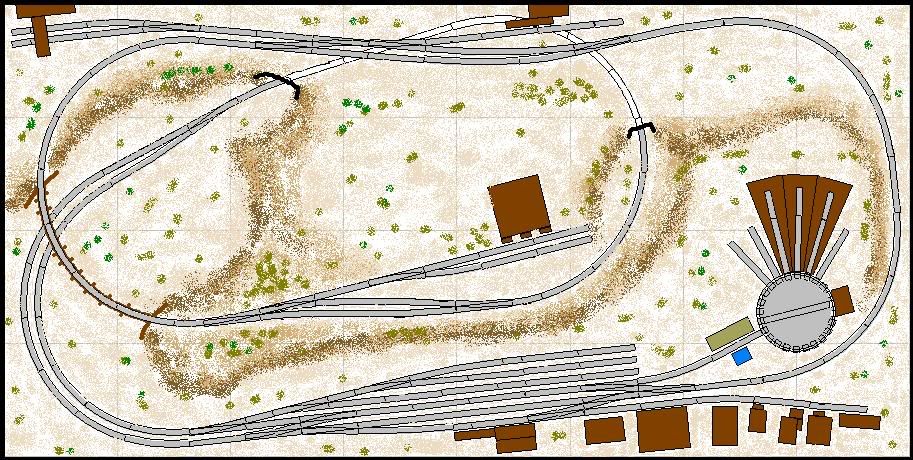
I have been reading these forums for over a year, and I have finally built my benchwork, but now I need help designing the actual layout. I downloaded the atlas track plan software, but I am terrible at using it, so it is next to worthless for me. So that is why I have decided to post on here.
My benchwork is L shaped, around the walls. Each section of the “L” is 8 feet long, and 2 feet wide. At the end of one section of the “L”, there is a 4ft by 8ft plywood table that is a penninsula, reachable from both sides.
This layout is HO scale. I would like a continous run, with some switching. I am modeling late steam, early diesel era. It would be an eastern Ohio landscape, with Pennsylvania being the railroad. It is not a prototype, and each part of the railroad does not have to be super-realistic.
I would like the layout to be both DC and DCC. I want to have a coal mine on the layout, along with a tunnel and a bridge. Freight trains will be the primary train on this layout. Other than that, I am open for suggestions. I am going to use Atlas code 83 flex track on top of a foam table top.
My initial thoughts were to have a town on the 4 x 8 sheet of plywood, and the mine be off on a part of the “L” shaped section of the layout. Any help will greatly be appreciated.
I am about to go away for a couple of days, but would like to catch up with you on this, it sounds like we are both at about the same point in layout construction. I agree with you on the Atlas software, I quickly found a pencil and paper could achieve the same results much quicker. I have a thread running at the moment titled “Planning HO layout including narrow gauge shortlines.”
Both DC and DCC is tough. You have to be very carefull you don’t cross your wires or you will burn up your DC engines. Plus its doubly expensive. You have to put in all the controls of a DC layout which negates much of the benifit of having DCC.
You have a problem with continuous running since in order to do it you have to be able to make a complete loop. You can’t put a turn back loop around a 2 ft wide benchwork. You need a wider section, at least 4 feet.
DCC and DC together is doable. I have Bachman DCC and can run DC engines along with my DCC ones. So for me, it’s two DCC engines and one DC engine and I have individual throttle control over all three.
There is another way to do DC and DCC together. Have a switch that switches out one and switches in the other.
Wall shelfs with HO work OK. You have to “dogbone” the ends so you can turn around. Also, be careful that you can reach everywhere. 30" is the max reach. You need to be able to have an isle on two sides of your 4’ section. So in words it would be a 4’ turnaround, a run of 30" shelf and the another 4’ wide turnaround. Sort of a U shape.
DC and DCC is definately doable. Anybody who doesn’t think so can come look at my layout. I set it up initially for DC block control with two packs on the outside loop connected through a series of DPDT switches to each block and one pack on the inside loop, also through DPDT switches (for addition of a second pack later). When I got my Bachmann EZ Command system I simply disconnected one pack from the outside loop and wired it in at that point. On the inside loop I connected it to the other side of the main DPDT switch. In this way I can run a train on the main in DCC and use the DC pack to switch the spurs and/or inside loop or any combination thereof and I don’t have to worry about burning up my DC locos.
As has been said, DC and DCC is doable, but it’s a lot of work and extra expense. It’s your project though, so if thats what you want, no problem.
As to the Atlas software, it can be cumbersome at first. The flex track tool takes a lot of fiddling to get it to work, but it does work. I’ve created a lot of plans with this software and I’ve gotten to where I can make it it most anything I want it to, but that was with lots of trial and error. The one thing I really havent been able to figure out is the elevation tool. That one still mystifies me. Oh well! The point is, the Atlas software can be used and it does work, it just takes some practice. To give you an idea of what can be done with it, here’s an N scale plan I did about a year ago.
Click to enlarge
If you’d like, I might be able to assist you in your planning. Let me know if you’re interested.
I would very much like your assistance. I have never built my own layout before, and I really dont know where to go from here. I may end up enclosing my layout, so that it is a big circle. I know that this will be a duck under, but I am ok with that. I think that this will give me more options for my layout design. Thanks!
I think you can probably do quite a bit with what you have, though continuous running would be limited. 4x8 just isn’t a ton of room for HO. It can be done though.
Do you have some ideas on what you’d like to see in your layout, beyond what you’ve stated already?
Size of loco’s and train length?
How a about minimum curve radius?
You mentioned a coal mine. Any other industries in particular?
Since you picked the region and a coal mine, I’m guessing that we’re talking some mountains. What about water? Your coal mine could be a small mine that heads down to a dock and loads onto a boat or barge for transport elsewhere off the layout. A car barge would also give you a connection to the outside world, so cars can come and go off of the layout. Just a thought.
Anything else?
I’m thinking that with your current benchwork you could have the coal mine on the leg as you said earlier, and have some staging under it for a small fiddle yard. This would increase your operations aspect tramendously. Add in a couple more industries and maybe the car barge and your RR could be quite busy for it’s size.
So, would the white area I have here be an accurate representation of your current space?
Duck unders get a bad rating, but I’m 66 and I have a duck under and it’s no problem. The secret is to have your layout’s main elevation at slightly between your chest and shoulders.
This gives a much better view of things and easier to work on providing your layout isn’t to wide across so that you can easily reach across it. You may need a little step in some places, but this makes it very easy to duck under and the benefits ( I believe) out weigh the duck.
pcarrell, That is almost the exact dimensions, except you need to move the 4 x 8 table 2 feet inward, towards the far side of the “L” shape. I am nearly positive that I am going to enclose this layout by attaching the far side “L” to the 4 x 8 table, which will generate far more operational posibilities.
Yes, I am going to connect it with a two foot wide section. Since the 4 x 8 section sticks out 2 feet farther than the end of the “L”, I was thinking of connecting the end of the “L” to the 4x8, which would be a diagonal connection, and then connecting straight across 2 feet back from that. I hope that makes sense.
I added to my benchwork today, so now it is a completely enclosed layout. It is essentially a large “O” shape now, with a duck under. I connected the left part of the original “L” shape, to the 4x8 table.
I can see that you’ve made some progress with your options of area here, what dimensions of loop are we talking now, assuming that most of it is 2’ wide. I’m thinking that the area you have to work with is very similar to the area that I have got available to me. Roughly the outer dimensions of my space are 8’ x 18’ loop that is about 25" wide. This area is not negotiable as it is being built inside half of a 40’ shipping container. Workspace/studio takes up the other half the container. To get more track and achieve several constant loops whilst allowing for yards I am planning on several elevations. The lower and middle elevation, in HO and the higher elevation in HOn30, or a derivative thereof to represent Australian narrow gauge in 2’6". I really want to run DCC but price is the inhibiting factor, not so much the main DCC equipment, but the added cost of each chip for each locomotive.
I believe this to be pretty accurate to the drawing you sent.
Now, you said you wanted continuous running, and that should be very do-able with this configuration. Some industries (like your coal mine) should also be pretty easy.
Now we have to talk about some basic design perameters.
Have you thought about your outside conection to the world? Do you want to handle that by railbarge (like on a river) or by a land connection? Here’s the difference. By railbarge you’d have to model a small harbor (nothing major if you don’t want), but you get to keep all of the rails out in the open and there’s really no hidden trackage except for what might be in a tunnel. With a land connection you either use up open space on the layout top to model the connection, or you have some grades to a lower level where the staging track, but that trackage is hidden so you’ll be running out of sight for a while and there’s the maintainance side of things.
Probably for you, modeling one major RR, you’d be modeling a branch of a major RR (like the Penn.) and your connection would be a land connection with the mainline, but thats just the way I see it. You could make a case either way. You could be modeling a branch that delivers to a major river and the connection to the main is assumed to be elsewhere (with an appropriate track for that connection running off the edge of the layout or behind a hill, or something like that - think “future expantion” connection!).
So, what do you think? Small harbor and town or a land connection.