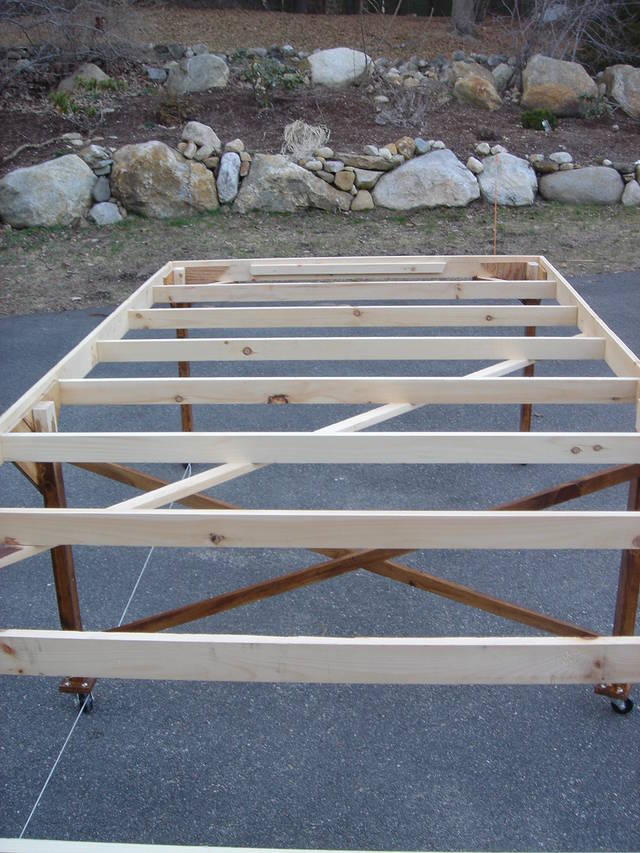
I plan to build bench work in a ladder style (if that’s the correct term) similar to this:
but smaller. Mine will only be 36" x 70". The main difference is my material will be Gatorfoam instead of wood. By Gatorfoam, I mean this stuff, and not styrofoam or foamcore board:
I’ve already bought the material and it is very light, stiff and strong which I need for portability. My biggest concern is having a strong bond between the cross members and the side pieces. The above link describes Gatorfoam as an “extruded polystyrene foam board bonded between two layers of Luxcell wood-fiber veneer.” Therefore, I guess I need a glue that will bond both the
What thickness gatorfoam are you working with? I know it comes in a varity of thicknesses and have heard of it being used for tops, backdrops and structures, but never for structural members, but don’t know of anyone that has used stuff over 1/2" though it comes thicker.
A show I went to recently had a vendor with information on it. It referers to Aileen’s Tacky glue and latex adhesive caulk for adhesives. I would also think that Liquid Nails for Projects would work too, as it is compatable with extruded foam.
Try some different things on a couple of small scrap pieces and see how it works.
Oops. I should have mentioned it’s 3/16" Gatorfoam which I will cut into 3" strips for the cross members. The surface will be either 1" extruded pink or blue styrofoam, or possibly foamcore board, but I don’t want to make it a structural component if I can avoid it.
I’m confident the materials will be strong enough, but I’m concerned about getting a good bond on the joints. Latex adhesive caulk sounds like a good idea. I think I’ll try it first. Thanks.
Well, this is 1/4" plywood, not 3/16" gatorfoam, but maybe you could do something similar:
At least it will give you a larger contact/bonding surface between the two materials than what you get by putting the crosspieces on edge across the top of the other pieces.
I might be dense, but I didn’t understand what it was that “won’t work on the sides”. You can of course have make both L joints and T joint using notch and tab to increase the contact surface between the two pieces - people have been making furniture for hundreds or thousands of years using those principle.
Also, both notch and tab joints, butt joints and for that matter girders laying across supporting beams of some kind can be reinforced by gluing blocks of something (or triangular gussets) to an inside corner of both pieces.
My vocabulary may be a bit off - but hopefully you understand what I mean anyways.
Good old yellow carpenter’s glue works well with Gatorfoam. I’d beef the corners and T joints with glue blocks. If you don’t want to add the weight, try gussets made from gatorfoam.
I’m gonna try that. After a bit of googling, I think I understand what L & T joints are, but glue blocks and gussets sound more within my abilities. If that doesn’t make sense, please forgive my lack of knowledge, but at least I can mentally picture a plan which I think is what you mean. I also think it will be strong and light enough. Thanks, mfm37.
I second the yellow carpenter’s glue. I’ve used Gatorboard (or Gatorfoam) on our last two layouts and used carpenter’s glue with good results. The outside surface and foam inside is porous enough for the glue to give a strong bond.
Tacky Glue works well for gluing things down to the surface, like cork roadbed, plastic sheet for streets, etc, but I wouldn’t use it for the actual layout construction.
Here is a link to Alcan’s site it will tell you anything you need to know on how to use Gatorboard, but I need to ask you why do you want to use Gatorboard? Yes it should be much lighter but at what cost.I don’t imagine it will hold up to moving it around etc.
It is going to be extremely expensive and to what advantage? You can get a sheet of 3/4" oak plywood and rip it into 3" lengths and use it for building your open grid type bench work. Simply screw & glue it together. Taking care to pre-drill the plywood before screwing it together. For speed of assembly I first glue the pieces and tack them all together with a nail gun then go back and drill my pilot holes and screw in deck screws not dry wall screws. A common mistake as drywall screws can snap but generally deck screws are much stronger.