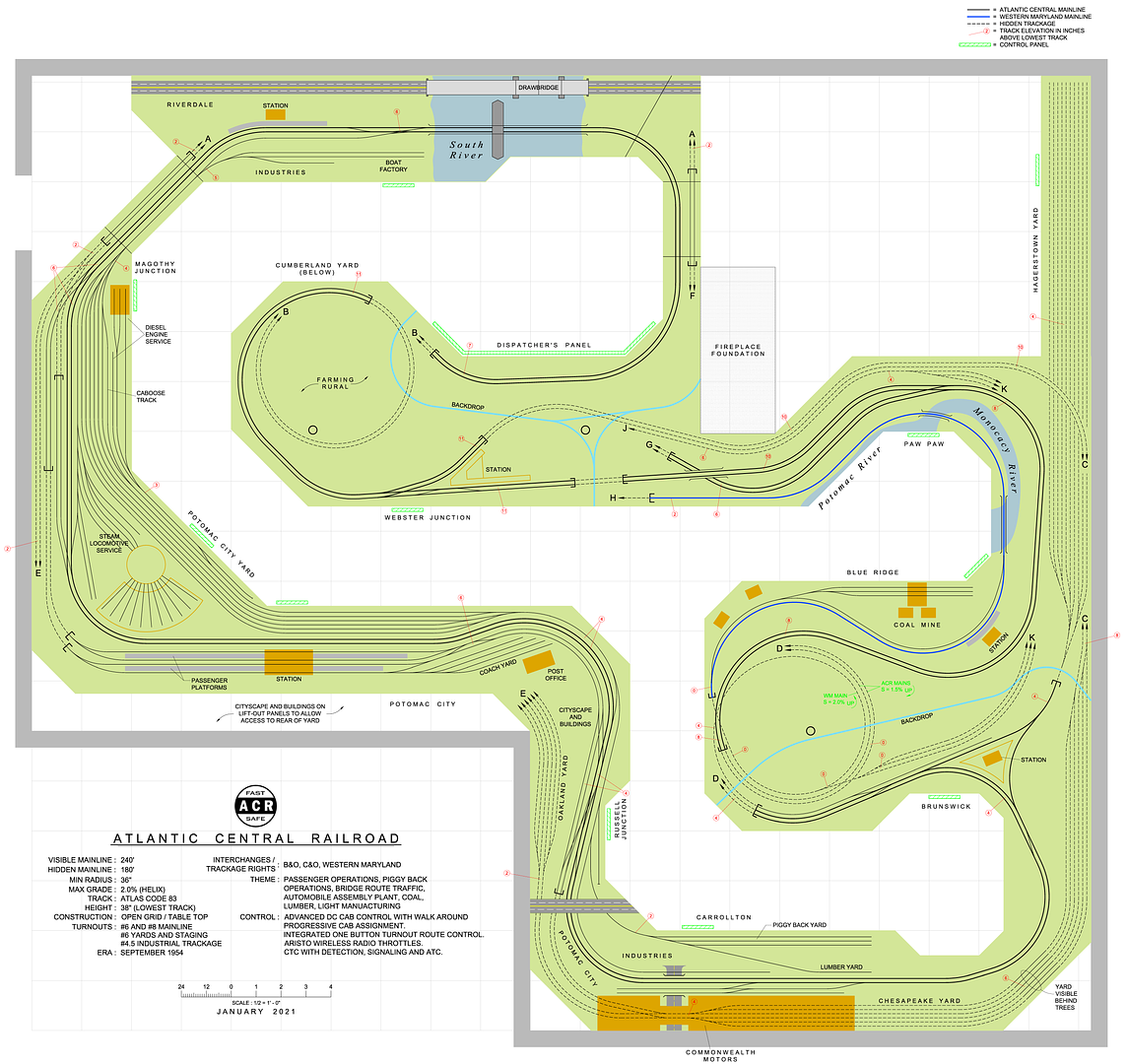
Seems to me that if a layout is already going to have a turnback loop of appropriate radius at the end of a peninsula, there wouldn’t be much difference in how to scenic the loop or the helix.
I’m not a fan of putting spurs and buildings inside of a turn back loop. Looks trainsetish to me. Unless its a roundhouse/engine servicing. JMO. So the only way to scenic a loop is to fill it with scenery…best if its a mountain because that’s when nature would cause a need for a loop, as opposed to scencking the relatively tight radius 180 degree loop like its in the wide open Texas panhandle. All JMO.
Having said that, I think a helix in the corner of a room probably wastes a lot of interior space.
Atlantic Central you are correct about the space needed. The area inside of the helix is dead space not usable for anything unless you can come up with some ideas for the use of the space.
Already answered. Scenery.
Inside the helix? Sure, whatever.
Seems to me that if a layout is already going to have a turnback loop of appropriate radius at the end of a peninsula, there wouldn’t be much difference in how to scenic the loop or the helix.
I’m not a fan of putting spurs and buildings inside of a turn back loop. Looks trainsetish to me. Unless its a roundhouse/engine servicing. JMO. So the only way to scenic a loop is to fill it with scenery…best if its a mountain because that’s when nature would cause a need for a loop, as opposed to scencking the relatively tight radius 180 degree loop like its in the wide open Texas panhandle. All JMO.
Having said that, I think a helix in the corner of a room probably wastes a lot of interior space.
Radius 34" (Centerline inscribed on the deck sections)
Grade/slope 1.73% (from the vendors tables)
Source: TracksideScenry.com
Construction Material: Gatorboard.
I fixed down Atlas Code 100 flex track using tiny screws I ordered on Ebay from a UK vendor. They fit in the olds molded into the Atlas flextrack ties. I created a tiny hole with a pin vise first and then screwed in the tiny screws with a tiny screw driver bought in a set at the dollar store.
Sheldon. I can’t read the words, but are the light blue lines that bisect the peninsula’s backdrops? That’s the way I would scenick a turnback loop, with a tunnel or series of tunnels also placed in the right spot.
A person could do the same with a tall multiloop helix. Just make the radius at the outer entrances and exits of the helix quite a bit broader than the inner circle.
A person needs lots of space for a helix, IMO, but also needs lots of space to have even a turnback loop of “appropriate” radius.
I won’t have the space for either,which is why I have to stick to around the room donut shaped layouts for the most part.
The photos on that other website look to be about one year ago. Have you completed the trackwork in the helix and for the surrounding approaches? Have you run trains up and down? I’m curious if there is enough finger room in case of derailments or uncouplings in the helix.
The photo showing the yard lead wrapping around the outside of the helix is from late October last year.
Since then I installed cardboard strips with hot glue for a scenery support base and installed plaster gauze over almost all of it.
I don’t get tons of hobby time so progess isn’t as fast as I’d like. I’m planning to start adding a layer of plaster over the plaster gauze this weekend.
I haven’t test run trains. I’d like put in some sort of guard rails to keep any errant rollings stock from diving to the floor first. But the track in the helix looks solid and the only possible area needing tested is the transition from the lower yard into the helix.
As for finger room, I’d guess this helix has as much as any. Most helixes are designed to provide sufficient clearance but keeping the grade as gentle as possible. You sacrifice and have a steeper grade if you want more finger room, something to keep in mind.
I hate turnback loops where you can see the whole loop.
If you look at my new track plan the peninsulas have backdrops and you do not see the other side of the “loop”.
And as explained above, the loops are both one turn helixes, partly hidden to extend run and change elevation from one side of the back drop to the other.
But those peninsulas are big, so even with a backdrop, the scene on each side is deep, 3-4 feet or more.
I always find it interesting the assumptions people make about track plans in these kinds of discussions.
My layout was carefully designed to limit the amount views “outside the curve” and for none of those situations to show a whole “loop”.
Depending on your goals, the helix is a useful tool, but it does come at several costs.
Sheldon
Sheldon. I can’t read the words, but are the light blue lines that bisect the peninsula’s backdrops? That’s the way I would scenick a turnback loop, with a tunnel or series of tunnels also placed in the right spot.
A person could do the same with a tall multiloop helix. Just make the radius at the outer entrances and exits of the helix quite a bit broader than the inner circle.
A person needs lots of space for a helix, IMO, but also needs lots of space to have even a turnback loop of “appropriate” radius.
I won’t have the space for either,which is why I have to stick to around the room don
first need to determine the height of each level of the helix which includes the deck, track, clearance for train and thickness of finger to handle derailments which i estimate to be 2.72 in
the nominal grade around the helix in simply the height above over the circumference of the helix. but the effective grade of the curve also needs to be considered. the effective grade is estimated to be 17.5 / rad for N-gauge.
the table below (corrected) shows value for various radii, where a 30" radius results in a total grade of 2%