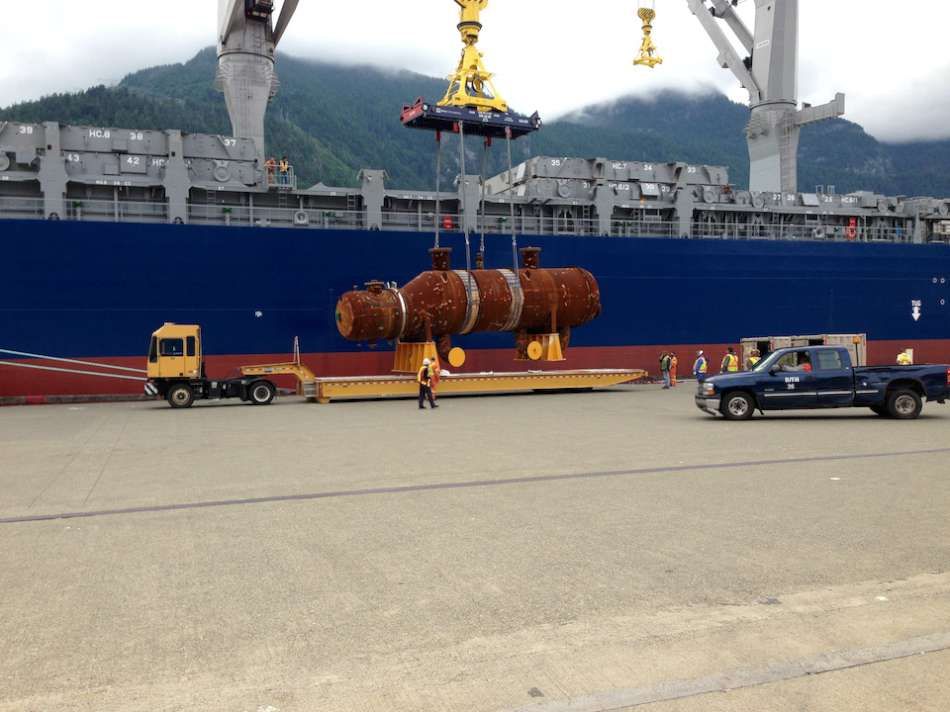
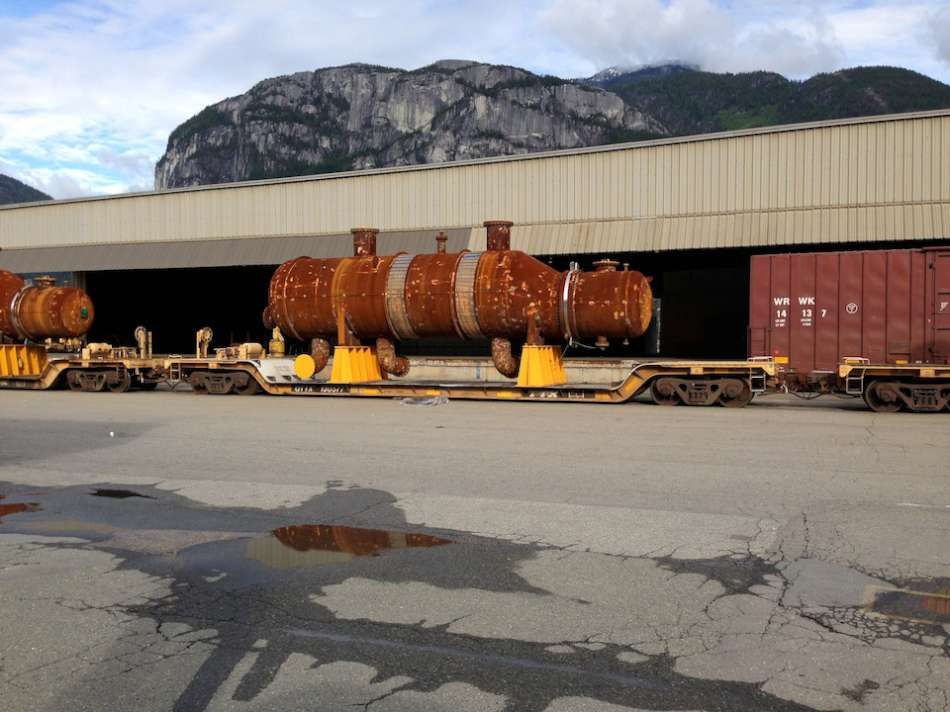
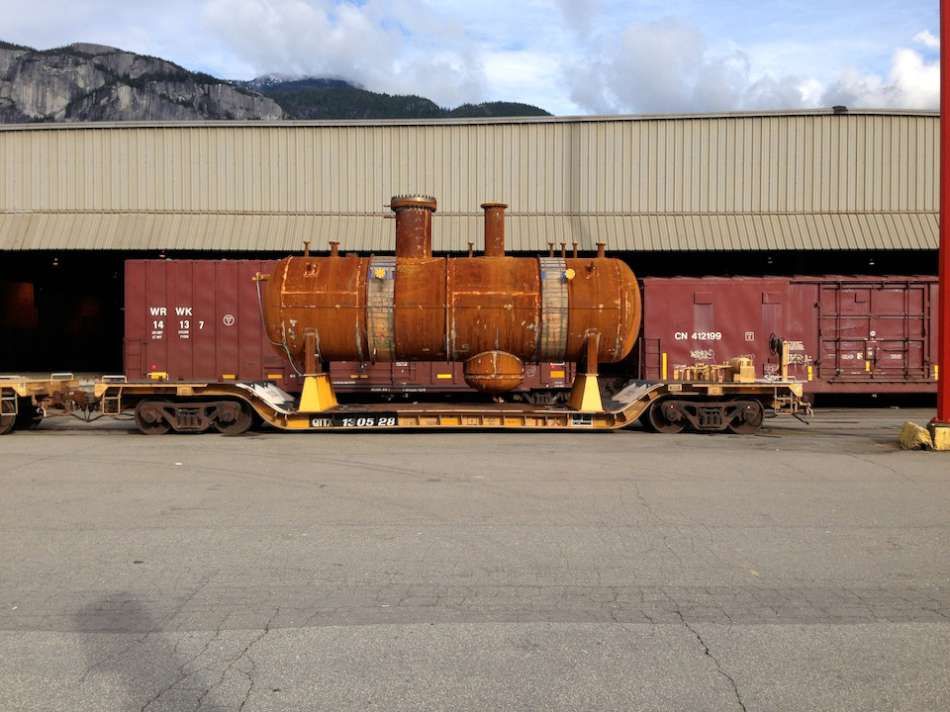
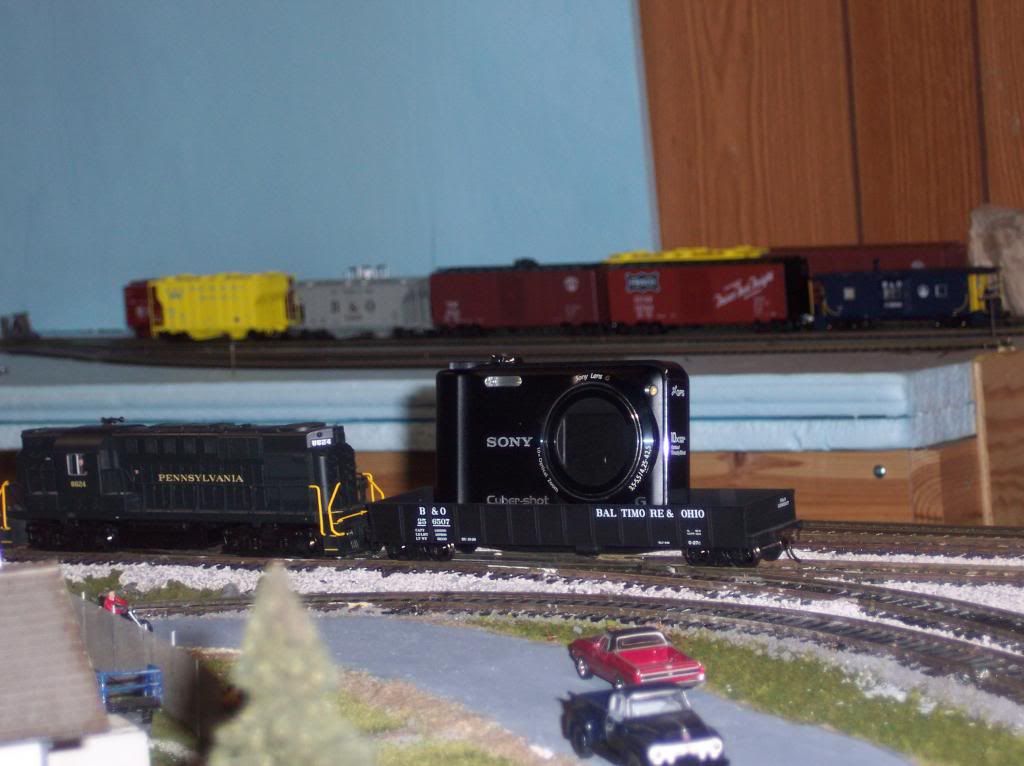
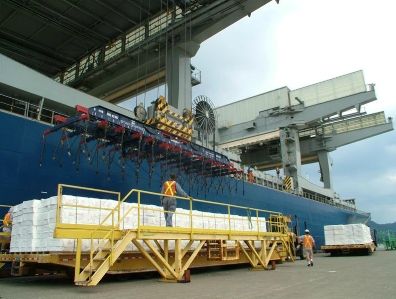
Photos from a friend longshoreman at Squamish Docks. Interesting loads are intended for oil refinery in the interior of the province. I liked the depressed flat deck rail cars, so he also sent me some links to the real thing, and the model (hence posting here in Model RR Gen Discussion).
Great pics! Thanks for passing them along. The loads here look like they would be very easy to do with Plastruct components, although getting that rust just right might be a project.
Interesting photos, got me thinking about an old depressed center flat car I’ve got squirreled away, if I remember correctly it rides on four trucks. Modeling one of those rusty vessels sounds like a fun project.
The vessel being off loaded from the ship was called a “milk bottle” back in my oil refinery days. Those vessels are seriously heavy, I once saw a 100 ton crane lose a “milk bottle”, somebody goofed big time. Could have been worse, but fortunately the crane operator had the presence of mind to free wheel the hoist and let the load fall before the crane was pulled all the way over. Thankfully only one injury, as the crane toppled it’s cab door slammed shut, breaking the operator’s hand.
I thought it was a bit odd that they’d offload to a trailer, then reload to a RR car, but it may just be the way it works there. Mayeb the OP can ask his friend what’s up with that.
The tractor is certainly nothing special, just a standard single-axle spotting tractor. However, it looks like a heavy-duty trailer, with multiple wheels in back. Something is going on under the front, multiple wheels or ? I think the yellow things at the front corners are just landing gear, but maybe not. One things for sure, the lift mechanism normally associated with a spotter’s fifth wheel, used instead of getting out and cranking the landing gear up, wouldn’t be up to lifting a trailer that weighed much more than a fully load OTR semi-trailer. So maybe it’s the oversize nature of these shipments, more than the weight, that puts them on the railroad?
Don’t know the weight of the “milk bottle” that got away from that crane and rigging crew that day, apparently they didn’t either, but it was similar in size to the one being off loaded in the photo, though it might have been a high pressure vessel with increased wall thickness. The mishap took place during a plant demolition project.
Later rumor had it that the crew wasn’t aware that the vessel was still holding a large amount of water that hadn’t been drained from an earlier wash out procedure. The pick had been made, but the vessel got away when being lowered. Lowering the boom angle and making a pick off the side reduces the lifting capacity of a wheel mounted crane. I’ll stick with seriously heavy as a good description of the vessels pictured.
" Hi Dave I can answer a few questions about our operation that Mike
Lehman has. The rail does not go to the side of the dock here so we
needed to have something to get the pieces from the ship to the rail.
The trailers we were using are designed for carrying woodpulp
and have a capacity of 70 tons. See attached photo. They just have feet
on the front.
We hook up like a standard tractor trailer and lift the trailer
with the tractor.
These trailers also have air brakes. A mobile crane was brought in to
lift the pieces from our trailers to the railcars. The large pieces
weigh 55 tons and the smaller one is 38 tons.
They are going by rail because of their size."
Trevor
[](http://i168.photobucket.com/albums/u172/dcrane_2007/trailer_zpsb9a5f883.jpg)
and they probably were some form of heat exchanger in the refinery
as they were
full of piping and not empty type of tanks.
FD: Depressed center flat car of special construction having the portion of floor extending between trucks depressed to provide necessary overhead clearance for lading.
AAR Type:
F432
Detail Info:
Flat Car, Load Limit: 200,000lb and greater, Inside length: 53-60ft
Thanks to you and your friend for the details. Really adds an interesting element to the pics.
Makes me wonder if they’re using a beefed-up lift for the fifth wheel. Or maybe not and they don’t go into detail if they have to make a warranty claim if they’re the same capacity as the ones as used in the fleet I helped manage one time. The lift in those tractors is pretty bullet-proof, but the typical loaded lift was in the 25 ton range.
Kind of makes me wonder why they didn’t use a double drive axle spotter, too, but if it’s a heavy duty single drive and they don’t get on the public roads with it anyway, that seems to be doing the job.
I have asked my friend if he wouldn’t like to join the forum himself. He is a wealth of knowledge about railroads and modelling, a lot from his father who was a steam engineer on the PGE here in British Columbia, and one of the last men to take the Royal Hudson out on regular duty up to the interior. His father had emigrated from England with his steam ticket in the 1950s so also had lots of knowledge of English railroading as well.
More importantly, his father was a meticulous record keeper of his years as an engineer and was modelling HO in the 1950s and early 60s. And he has a fantastic collection of slide photographs of the area railroads from that decade when slide photography itself was fairly new.
I love it when I buy something like my Great Northern 310 ABA set and Trevor comes up with slides of the prototypes on the job taken by his father while down in Washington or so forth.
Also like to see his brass steam locos left to him by his father, with all packaging and receipts…purchased new for something like $125-$150 apiece.
While you’re in the asking questions mode, could you ask if there were any tie downs holding those loads onto the cars, or were they just secured to those pedestals? I don’t see any cables in the pictures.
Those slides are a family treasure, literally impossible to replace. I know what you mean about seeing a pic that virtually takes you back decades in a moment.
maxman,
It’s possible they’re welding those loads in place. Raw stuff like that often is.
Cisco: Great shots, but can you tell me where these might be heading? you mentioned the Interior of B.C. the only place I can think of a refinery is south of Ft.St. John at Taylor, is this it? I cannot think of any other refineries in the interior.
Yes, the collection is really something. Trevor also has a 1950s era layout (saved in sections ) with remarkable wooden track bed on which are hand laid rails and switches, and an electric (not electronic ) switching controlling centre and block control.] Did I mention he has , left from his father, every issue of Model Railroad Magazine (I think it is that) for a span of a decade or so over the 1950s to 60s. I have yet to get over to see that set.
[edit] ahh, great. See below for clarifications from the man himself.
I have sent him the links to register. He will have other historical info and features for us, I’m sure.
I am here and willing to share my interest with all who ask.
Dad came to Canada in 1948 and started modeling the day after he came here. Some of my layout dates from that time. I do not have a plastic car or locomotive on it. I have bought a few modern pieces but they get little time on the layout as I do not have a place to set it up at the moment. The Model Railroader and Trains issues fo back to the late 1930s. The first being sent to England where dad came from.
The large tanks are going to Fort McMurray in Northern Alberta.
I have driven Capacity Yard trucks (tractors) which are single axle, much like this one, though the rear axle is rated for something like 44,000 pounds. I have picked up and moved road trailers loaded far beyond what they should have been, one I estimated was in the 120,000 pound range. (I’m surprised the trailer didn’t break!) So the fifth wheel was picking up around 60,000 pounds. The truck I drove had a 5.9 Cummins engine, yes, the same engine Chrysler uses in the pickups (with much less computerization and smog controls).