I have been designing layouts for myself and others, and hand laying track, since about 1975.
If I decide that 36" radius is the minimum radius except for industrial trackage, that is the minimum. It is not the minimum “until I have a problem, or until I need to squeeze in that one more siding” and say, “well, 34” radius will be ok in this one spot".
If I set a multi tiered standard for radius, that’s fine, but I would still design any curved turnouts the way I have explained.
OK, but our models are already operating on the hairy edge of the engineering in question, why not given them a better chance in this already difficult situation?
Write whatever operating rules you think or prototypical, but make the trackwork work as well as possible.
What if the inner route is the mainline, or primary route?
i believe straight turnouts on mainlines are aligned such that the mainline follows the straight path, the “normal” route and the “diverging” route take the path away from the mainline.
the divering route requires slow speeds because the turnout is forcing the wheels/cars to relatively abrupty change direction
i understand that using the normal path for the mainline is not often possible to do with model railroad.
Again, OK, I get that, it is the desired practice.
But the prototype breaks that rule all the time when they need to. They build high speed diverging route turnouts for junctions on high speed lines. They use closing frogs, and VERY high frog numbers when needed.
On my new layout I will have a number of double track junctions with equal priority traffic on each route, with diverging route “speeds” nearly as high and primary route speeds.
I run the mainline thru the diverging route of #6 and #8 turnouts without any thought, it is about smooth track flow, not rigid definitions of straight and diverging. After all, the substitution radius of a #6 is about 45", more gentle than my standard easement.
It is a model railroad, and even in my 1500 sq ft, with 36" minimum radius curves w/easements, and #6 and #8 turnouts everywhere but industrial areas, it is still selectively compressed.
I do avoid curved turnouts, and so far on the new layout plan I only se
Why would we assume that? Maybe the curved turnout is in the middle of the arc, or feeding out of the arc to make a siding longer.
No matter its position, imagine the point end track, and the inner track destination connected with a constant radius, then have the outer radius take off as a larger radius from whatever point is necessary for its destination.
I always thought the advertised radius was if you laid a circle of track in that radius, the turnout would fit in that circle pretty good.
Since a potion of the turnout leading into the points is shared by both routes, then it should be obvious that the published radius is just a “will work” for planning number.
The technical details offered in this thread are really interesting, but I think they might be missing the point, no disrespect intended.
The real question is whether or not a curved turnout will work in the desired location. My old club used several Peco Code 83 curved turnouts in order to make the track fit where it needed to go. Space was an issue. Our goal was to maintain a minimum radii of 32", and the Peco curved turnouts allowed us to maintain those radii quite nicely. IIRC, in all cases the through route was the inside curve.
However, one thing that we discovered as we were laying track is that in several cases we could make a regular Atlas Code 83 #6 turnout fit in just by moving the turnout location down the track towards the siding a few inches. The through route was still on the curve.
I have a feeling that the above my information serves only to muddle the conversation. Sorry!
The detailed discussion Greg and I have been having relates to building your own curved turnouts, and how best to lay them out.
Since no manufacturer makes a curved turnout with a minimum 36" radius on the inner route, it is unlikely I would ever use a commerically offered curved turnout, except possibly on some piece of industral trackage.
Greg brought up some specific engineering points, and it took some expalining for me to fully convey my theory of good curved turnout design.
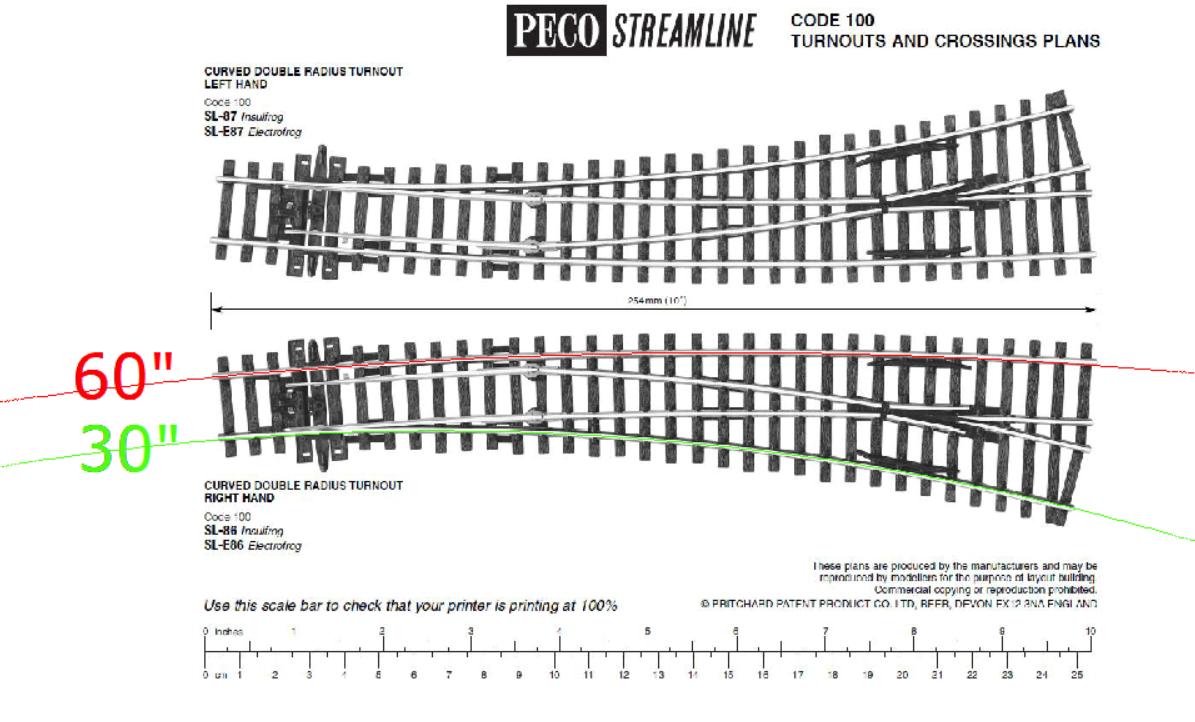
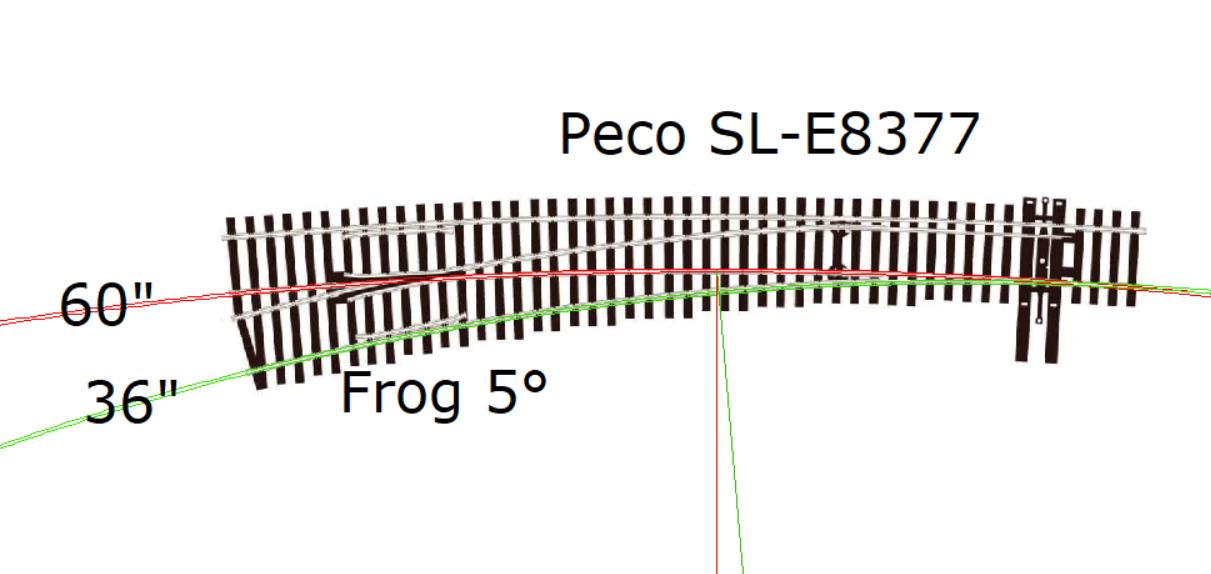
there have been several threads questioning the accuracy of the spec’d radii on commercial curved turnouts.
the need for this understanding is to locate the centers of the curves on the layout the turnout is expected to lay on.
i’ve suggested that the curves of the turnout don’t both start at the same location which i believe can explain the radii measurement, the location of the frog and the frog number.
Yes, I own two of the PECO Code 83 curved turnouts and they do have a large disparity between the outer and inner radius. The larger the disparity, the shorter the overall length of the turnout and the point rails. Peco tends to be more compact than other producers, and I’d wager that the overall length is shorter than their #8 straight turnouts.
However, I find that its difficult to use the 60 inch outer radius curve.
By contrast the Walthers curved turnouts are very long, due to the smaller difference between outer and inner radii.
For me, the 26 inch inner radius of the Atlas product is not useful in my situation.
Thanks Mel. I’m using the Peco code 83 #7 curved entering the staging yard and wanted to keep a good minimum for all the traffic going in and out at that point.
The Atlas inner radii would only be useful for me going into a spur maybe.