I have a rather long duckunder planned. It spans four feet and is an s-curve of two 32 degree bits.
On either side are the code 83 approach tracks on top of 2 " of foam and a cork roadbed.
My "traditional’ version of this would be a sturdy six-inch wide slab [a parallelogram actually] of 3/4 ’ plywood with more cork roadbed. Or a quarter-inch plywood base with a slab of more 2 " dense foam on top and cork roadbed on that…that would match the the rest of the layout and approaches.
Neither, however, would look especially interesting.
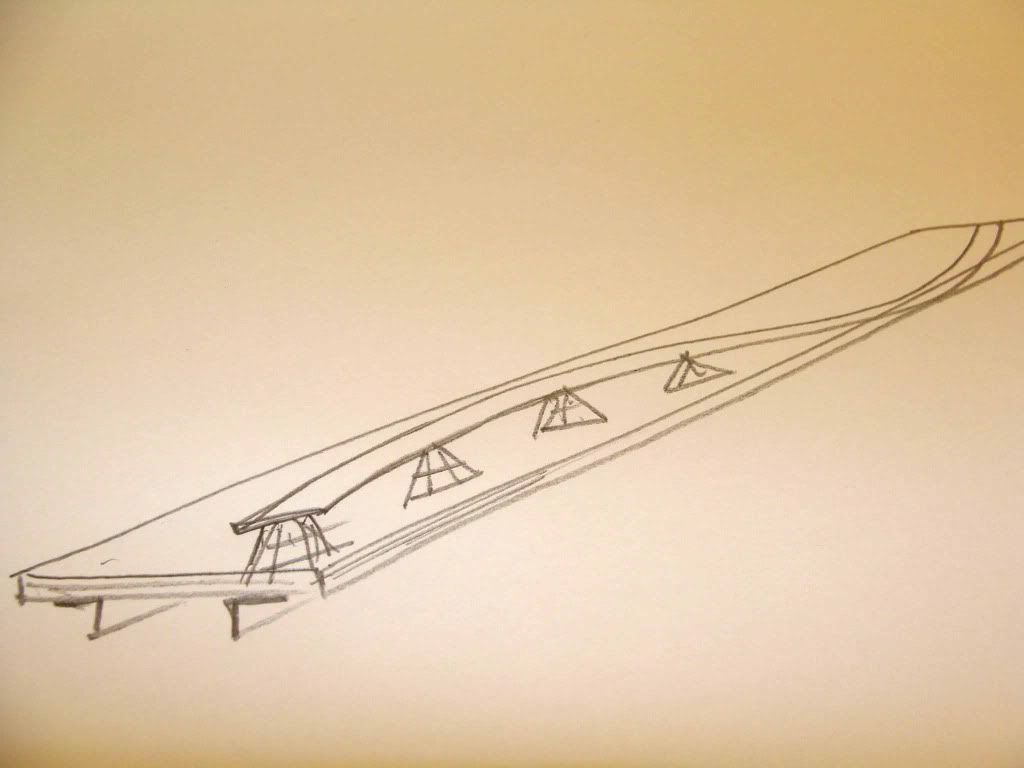
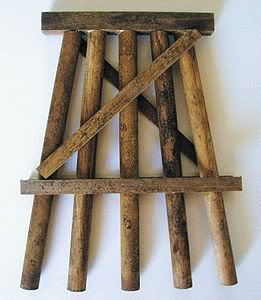
Far out thinking has led me to sketch this instead. How about a six inch slab of plywood on metal L girders, below a quarter-inch cutout of plywood following the S-curve and supported by 10 of these wooden pier supports from Walters. I could actually add some metal posts and conceal them if need be to stiffen the support of the cutout.
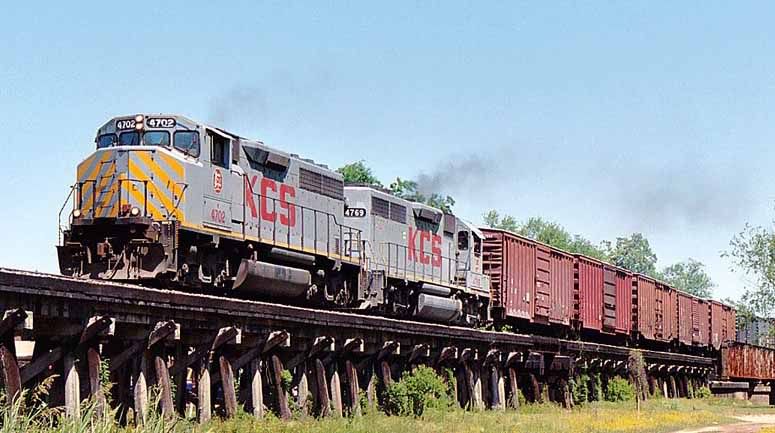
Or would it be too prone to disaster. I know it would be more susceptible to wobble is I touched it from below when moving underneath. But I was thinking I could get it to look like the photo below of track over a bayou.
Hasty sketch for your comments.
these are real wood and could be cut down from 3 to 2 inches
to get something like this on a six inch wide base across the span
If you build it like I did this, it won’t move when you bump your head. I welded 1" angle iron together into a rectangle and dropped two half inch cement boards in it. You could of course just used plywood where I’ve used cement board. I since painted it black and it looks good.
I built my one and only duckunder on the top deck of my three deck railroad. It is at the entry point of the railroad room(s) and is built in rock solid. I know!! It is at 5’ 9" in height and few people have any problem. The one exception is Tom “Tiny” Stolte, owner of Odd Ball decals. I cringe everytime he “ducks under” , but so far no skull fractures or hospital calls. Oh, Tom is close to 7’ tall.
Very interesting so far. However, my concern is not so much with the under plate in my sketch, as I know I could make that really solid. I am wondering about the elevated track on the piers on top of the base plate of the duckunder.
I am thinking that the wooden piers could be glued on quite solidly with capenters glue.
Has anyone out there ever put an elevated track of some sort on a duck under?
Brent, your example there is fascinating, considering it looks of welded metal over the fireplace. But it seems really more like a shelf than a duck under and looks like it would be really solid, with the base plate fixed as it is to one side and no possibility of someone moving underneath. Nevertheless, that looks like really smooth work, Brent.
I am always in favour of new concepts as long as nothing stands out that might make it a non-starter. So far, I like the initial proposal (it has an artistic flair to it). I like the idea of making it robust, and its anchor points at each end, too; they’ll take a lot of any knock that wants to dislodge the duckunder.
My only concern is with the suggestion of foam and thin ply. I can’t be certain, but I would not expect even 2" foam of that length to be able to sustain its grade profile for long, not even with 1/4" ply below it to protect that surface. I would still want at least one angle iron under there. Two would be better. I know, it’s not a seven foot length we’re talking about here, but I would make the effort to make this important component idiot proof. I’m the idiot, of course…
Point taken. That foam would be stiff enough…I have been working with it for the past two months with good sucess…it is what 3M calls 300 version Celfort…extra dense so to speak. But you are right, I would use the angle irons under both the foam and the heavy plywood to be on the safe side, especially in case of bumps by my butt. [:$]
This will have the effect of making the duckunder itself thicker than absolutely necessary (to allow for the trestle bents, scenery, and supporting framework below). That might amount to 3" more, 5" more, whatever.
In turn, that means one will have to bend over lower to go under. If you are young now, perhaps no problem for you. Maybe an issue for some of your visitors and/or for you as you age.
There is a reason that most people make duckunder benchwork as thin as possible. The back of your skull and shoulders (not to mention your knees) will illustrate that reason to you eventually. [;)]
The idea of the low trestle over wetlands is a good scenic angle. You could leave one or two pilings long and anchor them in holes drilled in the ‘swamp bottom.’
But, would it be possible to make your duckunder into a swinging gate?
Advantages:
No thickness contraints. Even double decks of track are possible.
No potentially damaging collisions between the structure and the anatomy.
No restrictions on tall, clumsy or inflexible guests. (I score 2 out of 3.)
Disadvantages:
Requires a clear area where the gate can swing open.
Somewhat more complex engineering at hinge points and anchor/locks.
Electrical complications - powering track on the gate, killing approaches when gate is open.
IMHO, the advantages outweigh the disadvantages; but, then, I am not as nimble as I was (insert #) decades ago, am about as flexible as a concrete tie, enjoy designing and building ‘gadgets,’ and consider complex electricals to be fun. Not necessarily a typical layout builder.
My half-a-garage layout was going to have either a bascule bridge or a gate. Then I was given title to my wife’s half of the garage and the need went away.
I avoid duckunders at all cost. As I get older, I don’t bend as good as I used to and neither do my friends. This is the same reason for having the lowest part of my benchwork at 48 inches. It is tough to work on electrical projects on my back side or worse on my knees.
I would opt for the swing gate, if it is possible. Just because it will swing does not mean you have to use it as such You can duck under unless you need to get something or someone through that can’t duck.
I like the idea of the trestle, looks nice. If you used one layer of 3/4" plywood, you could run a screw up into the bottom of one pole on each or at least a few of the bents to hold them in place. It does add a little depth to the duckunder, but the height would make a difference if that matters much or not. If the roadbed and base were fairly strong, with the trestles screwed in place, they might act some like the web of an I-beam giving you strength, not sure. Just a piece of 3/4" angle iron attached to each side of the 3/4" plywood base would add a great deal of strength, without adding more than the thickness of the angle iron to the depth.
Another thing I have seen is the duckunder/lift out designed to look like a plate girder bridge. The angle sides act like the prototype to offer strength.
Is there any reason not to make this a lift-off section instead of a fixed duck-under? At 4 feet long, it’s getting a bit big for a swing-out, lift-up or drop-down, but any of these options could be designed to open in seconds.
During the construction phase, you will be going in and out of the room, or around to the back section of the layout, many times a day. If you’re not actually running trains while doing construction, which we mostly don’t do anyway, you’re going to hate having to duck under that section. So, having it out of the way most of the time will be a blessing.
A swing-out section would likely have more structure below, but either a lift-off, drop-down or lift-up arrangement would still be “duckable” if you chose not to open it. So, you’d have the best of both worlds.
Ah, Friday is a good day to ask questions. Lots of good ideas coming in. Thanks all.
Yes, Mr. B, the idea of a lift out is becoming more appealing. In fact that was my first instinct and I have already bought some shelving pins and drilled out some of those threaded tap in-leg thingys to receive the pins as locator pins for the lift out. I just am leery of ill-matching track points at the margin…although I have done this sort of construction before.
I have a duckunder that is about 4’ long and 2’ wide and has a triple curved chord bridge on it. I haven’t had any problems with the bridge, just hitting the back of my neck when I come up on the other side. the clearance is about 4’ from floor to underside of duckunder, so you do have to ‘duck’.
My duckunder is 44.5" high and about 30" wide. I can still make it without a problem at age 56. I love my duckunder because it’ keeps my inlaws away from the control panel because they are too lazy to “duckunder”.
When I had a duckunder 2 layouts ago the underside was 56.5 inches high and that section of the layout was 6 inches wide and two 3/4" pieces of plywood laminated together over a 3 foot span. It was fairly easy to get under, but I still banged my head or shoulder from time to time. So IF you gotta have one, make it as high as possible.