I am in the process of designing a COG By-Product plant. This will include coolers and benzol washers which can be very tall. I have some fexibility in how tall but my target is 15" to 20".
These will need ladders and I want to use ones with safety cages. I know that Tichy, Plastruct, and Walthers have them in HO scale. While I have the lenght of the Tichy and Plastruct I do not know the length of the Walthers, either the plastic or etched brass version. I intend to make my structures a height that works best with the ladders I choose.
Is it safe to assume that with Tichy and Plastruct you can glue sections together to make the length you want? Hopefully gmpullman will see this and comment on the dimensions of the Walthers ladder he used for this building:
If there was one thing that I could not stand working on our gravel plants was the caged ladders. Especially when you had a harness on and trying to carry equipment and parts. Our cages started at about six foot from the bottom opening and your hard hat always hit it. Some were sectional about six feet in length with a foot gap between sections. Others were the full length to the top. I guess it was up to the installer. If it was available I would take the stairway even though the trip was longer. But most was unavoidable. MSHA were very strict about the ladders and we always had laborers to make sure they were clear of hazards.
I’m sure if you go to the websites of OSHA and MSHA there are regulations on the use and installation of caged ladders.
I forgot to mention that MSHA made us install self closing gates at the top and on any landing intersecting the caged ladders. Some of our ladders had platforms for machinery maintenance under other platforms. Some of the gates were a hazard in themselves. Slam shut while you’re trying to maneuver through or snag your harness and lanyard. Like squeezing through a fast spinning revolving door.
MSHA and OSHA will have different rules for the same thing sometimes. Our garage lunchroom door is a perfect example. The door used to swing into the room. OSHA said it was an intrapment hazard in case of fire. So we switched it to swing outward. MSHA came around and declared it a hazard for someone walking past. So now we have no door on the lunchroom. Glad I’m retired from that BS.
I can’t begin to count the things I would be dealing with if I hadn’t retired. The government regulations and HR ruined the appeal of working.
As for the safety ladders I could build stairs (the prototype I am trying to represent has that) but I figured the ladders would be much easier to do. I am by no means a rivet counter and if something isn’t quite right/legal I don’t care as long as it looks OK to me.
Caged ladders in some naval applications are designed to be completely free of the ladder rails, and the ladder support brackets are inboard of the rails, so that people wearing gloves can ‘slide down’ the ladders in an emergency. The size of the cage needs to be ample for employees wearing certain types of likely PPE, including fall protection, and as noted there will often be a requirement for a closable ‘platform’ or door at the top (so that someone working at the top doesn’t accidentally stumble into the ‘hole’).
Probably the easiest construction will be, as noted, to use discrete segments separated by a small gap, going up. My guess is that most physical construction of continuous runs would be via butt-welding and grinding, which is not going to be very strong even with soldered wire without special preparation. An alternative construction would be to use some kind of sleeve between the cage ends, which ought to be providable via a slit piece of appropriate wire insulation full of appropriate cement.
I remember at one of our yearly mandatory safety meetings. The discussion was falls and injuries from our insurance rep. Our sister company had a plant worker fall while getting into a 28 foot caged ladder. It was winter with wet snow and ice on the platform. During his fall, one of his legs caught between ladder rungs and jammed him roughly half way. It took fire and rescue several hours to extract him. They ended up cutting the cage away with their saw. His leg was broken in several places and a whole bunch of other injuries. Needless to say, the cage probably saved his life.
I can check my Walthers stock (I believe they used a Pola or Kibri original) for measurements. I generally use the Walthers product for ‘quick & dirty’ structures that will be toward the background. My favorites are the Tichy models. They are fussy to build but once you have a method for their construction they go together well.
I’m not exactly sure when the caged ladders became a ‘thing’ but they were prevalent on a large plant addition done in 1958 at the place I worked. Some ladders that were not cage protected were written up during several safety reviews of the plant and rather than add the cages the company, in their infinite wisdom, simply removed the ladders. This made some things miserable for us maintenance workers. Access to cooling towers and such became impossible and after a few gearboxes failed, at great expense and downtime, new, caged ladders finally began to appear.
Years ago I visited a farm that had a 90’ tall silo. I climbed the handholds straight to the top. My arms were really tired as I started to descend. Safety cage and landings would have made it a lot less scary.
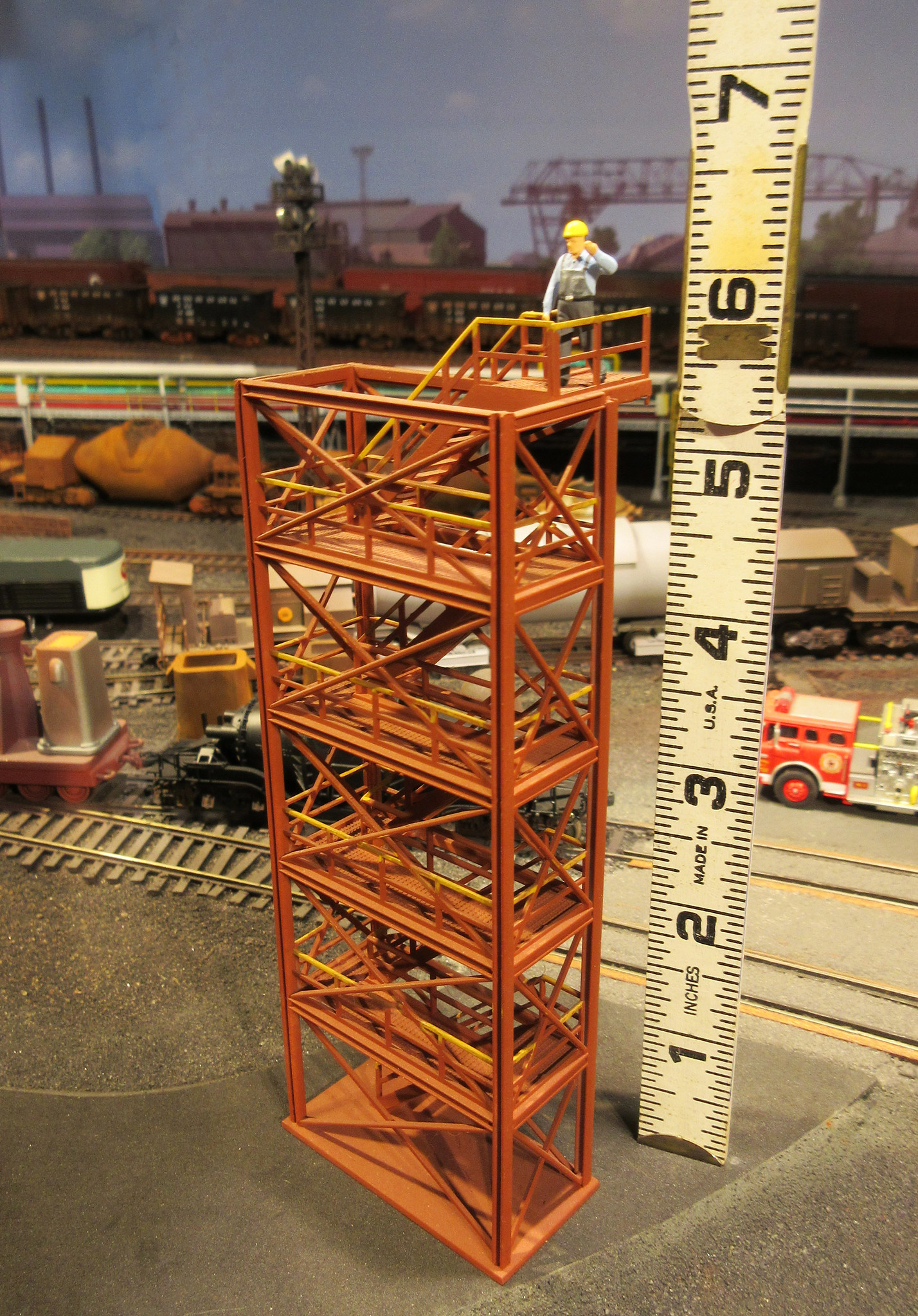
That is a great idea. I could use that stairway instead of the ladders. Can you tell me how tall it is so I know how many kits to get?
Edit: I found the footprint for the ethanol tank kit on the Walthers site and it shows the tanks as being 6 1/4" high so since the stairway is designed to go to the top of them that is what I will work with.
Another possibility, IF you can find one*, is the ladder and stairway add-on for the Blast Furnace. It has a nice zig-zag stairway made to mount alongside the skip car tramway:
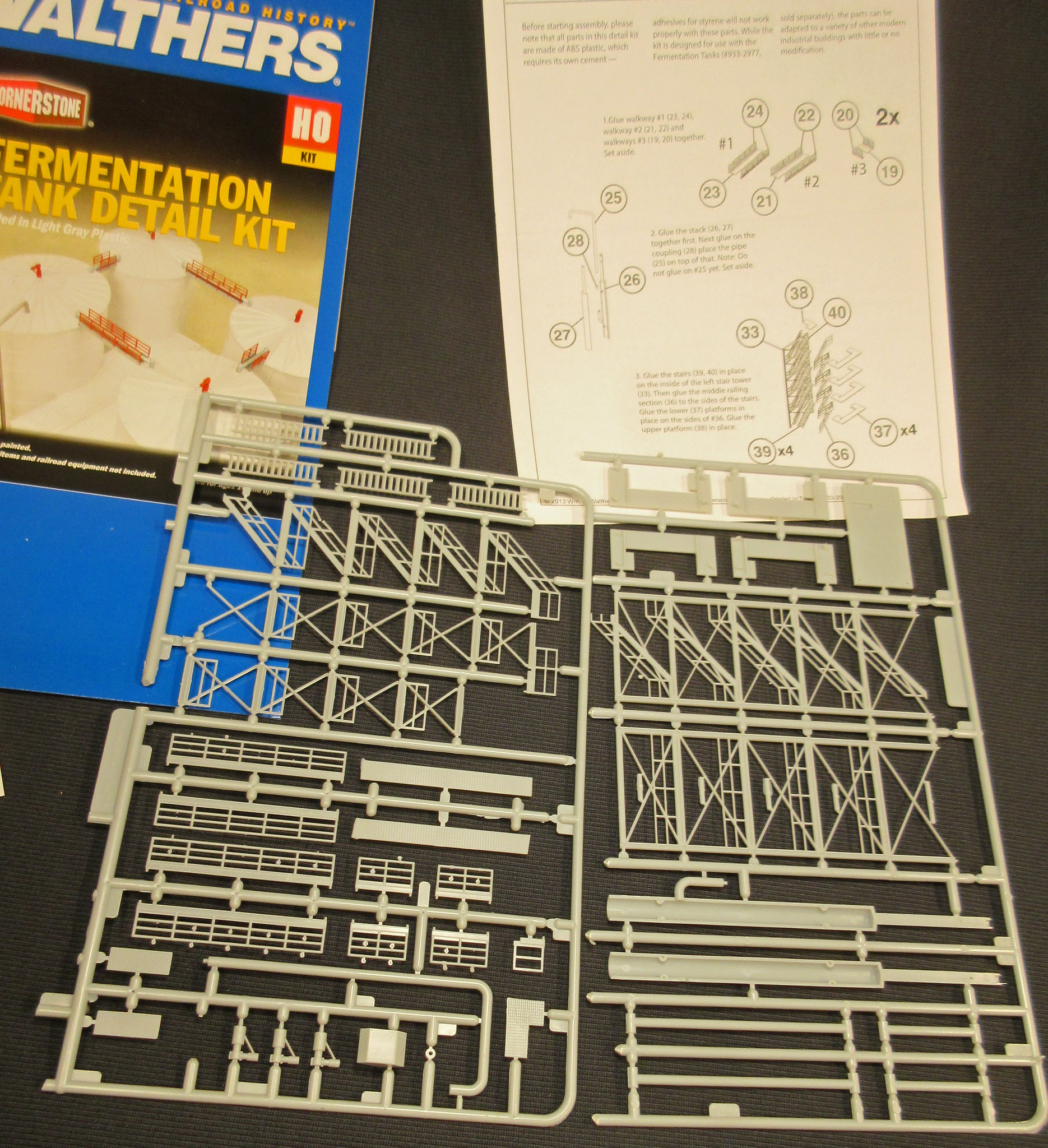
Thanks, Ed. Turns out that the Fermentation Detail Kit is also discontinued and sellers think they are worth gold. I guess I am back to the ladder idea or bite the bullet and build stairways. I was trying to avoid that because I didn’t want to put that much time into this project.
I used the Plastruct caged ladders for My scratch and bash lift bridge project. They are pieced together have to be assembled. From rail tie to top is 11’'. Don’t remember the cost. But it’s a mute point…seeing as how the base kit starts out at 320.00…just to sit and collect dust…hahah…
I did pick up a pack of the Walthers ladders and put one together. Assembly was easy and it will work fine for my application. I decided to make the benzol washers the height at which two of these sections will reach the top via a platform midway up.
When my mind is idle I think of stupid things and here are two.
why do most large oil tanks have stairwells curving around them instead of ladders?
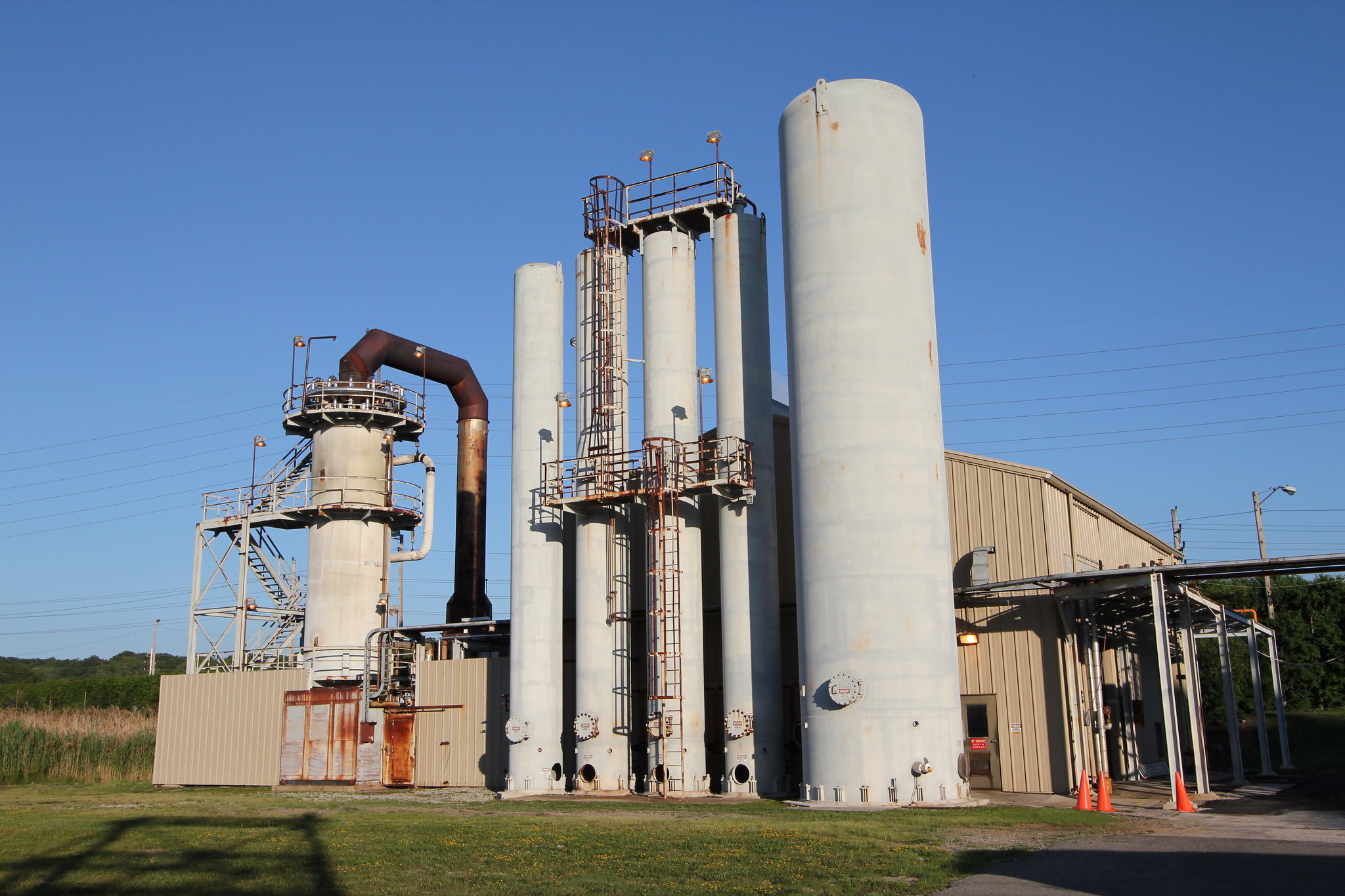
why do you even need to get to the top of these structures once they have been installed? In this picture some of the towers have access to the top while two do not.
Workmen need to carry fluid level measuring tapes and sampling equipment to hatches in the top of the tank. Sometimes seller and buyer will both go along to witness the measurements.
Those towers probably have internal structures for processing. There may be sensors, valves, baffles, etc., which may need access and maintenance.
Three of those ‘tanks’ are catylitic gas reformers. They are filled with a honeycomb-like structure inside and use a nickel or platinum coated ceramic catylist to ‘reform’ the hydrogen. There are three because one would be in use, another on standby and a third being ‘regenerated’ with steam heat. The ‘stoves’ of a blast furnace are similarly cycled through a process like this, too.
Sometimes the catylist has to be renewed. When times were good, financially, GE would bring in a crane to hoist the drums of new catylist to the top.
When the budget is tight we hauled the 400 bags of catylist to the top with a rope and a bucket.
The primary reformer on the left has stairs because employees would have to climb to the top at least once each shift, more when there was trouble. There were several instruments, thermocouples, flange gaskets, valve packings and sight ports that had to be attended to as well requiring more than simple ladder access, especially when carrying tools and equipment.
To the right was the ‘off-gas’ storage tank and it was just a big reservoir. No real need for quick access on the top.
Not to hijack but help others, what types of industrial buildings would use them?
I have an HO scale grain silo and cement plant for an 1980s layout. The other tall structure, the coal mine, has a ladder but does not go to the top. Just wondering whether to add them and to what building(s)?