As I start planning my next layout. I know I want to have plenty of staging, trains need to have someplace to go and come from. I do run some long trains like intermodal and autoracks/parts so I’m thinking I’ll need at least 10-12 feet and six or seven tracks (HO scale).
What are some different techniques in using staging yards on layouts? Please post pictures of different staging yards. On layouts that using staging, is there also a working yard on the layout? What are your thoughts about staging yards?
First, congratulations on recognizing the need for staging and planning for it. Well done.
I built my layout without staging. Realizing my error, I expanded the layout and built a visible staging yard, but I built scenery as well and stopped using it for staging. The next staging, which I never finished, is hidden.
Even that staging is wrong. It is unfortunately single ended, and requires a long and somewhat awkward backing procedure to properly return a train to staging. If there’s a next time, it will be double ended.
There are no turnouts in my hidden staging, just at the staging yard throat which is visible and accessible. Even with indicator lights or video coverage, hidden turnouts are a derailment waiting to happen.
Yes, I do have another yard on my layout. I also have a carfloat, which can be used as a casette to create “portable” staging.
I have a single ended staging yard of seven tracks. But it can be enter from to different points so serves as both the north and south end of the layout.
I also have a switching yard, so a freight comes in and is broken up, then the locals go out.
Passenger trains starting staging and finsh in stageing, the 0-5-0 swither move engines to opposite end for a second run. Iron goes grom the staging to the mine, switches, and returns. Thru freight passes thru, reversed between sessions.
I agree with Mister Beasley about needing staging yards. Great thing to have.
On my railroad, I have 9 staging tracks on the lower level which can be entered from both sides. I also have a freight yard on the upper level which handles locals as well as freight cars being dropped off from another destination (staging) or a train heading to another destination (staging).
I run 15 car intermodal trains with a pair of 6 axle engines and it sits on a track that is a good 20 feet long. My auto rack train has a pair of 6 axle engines and 10 auto racks. Based on the types of trains you want to run, those intermodal and auto rack/ auto parts cars won’t be that long since you state the lengths of the yard tracks are 10-12 feet.
Are your staging tracks stub end or have the ability to enter from both ends? Are you leaving the engines on the train or just leaving the cars on those tracks? Engines take up space and you may need to leave just the well cars or racks on those tracks without engines.
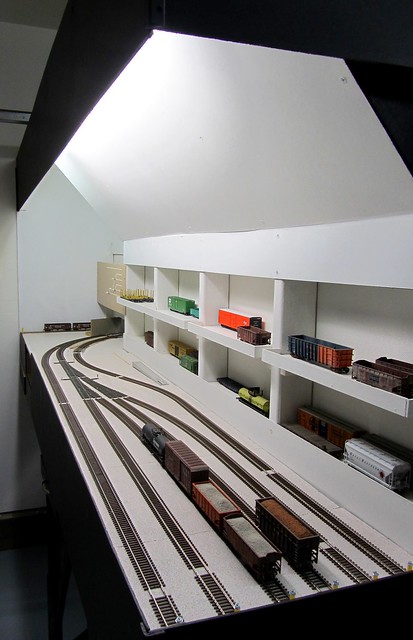
Here are a couple pics of my staging tracks below…
I’m sure you will need longer tracks if possible especially if you’re going to run long trains…
With a small switching layout I was hesitant about committing space for a staging/fiddle yard, but sure glad I did. The fiddle yard serves a few valuable roles; drill track for the visible working yard, spurs for a few off-line non-modeled industries and storage. My static carfloat scene is the layout’s interchange and the fiddle yard allows a hands-off exchange of outgoing with incoming cars between operating sessions.
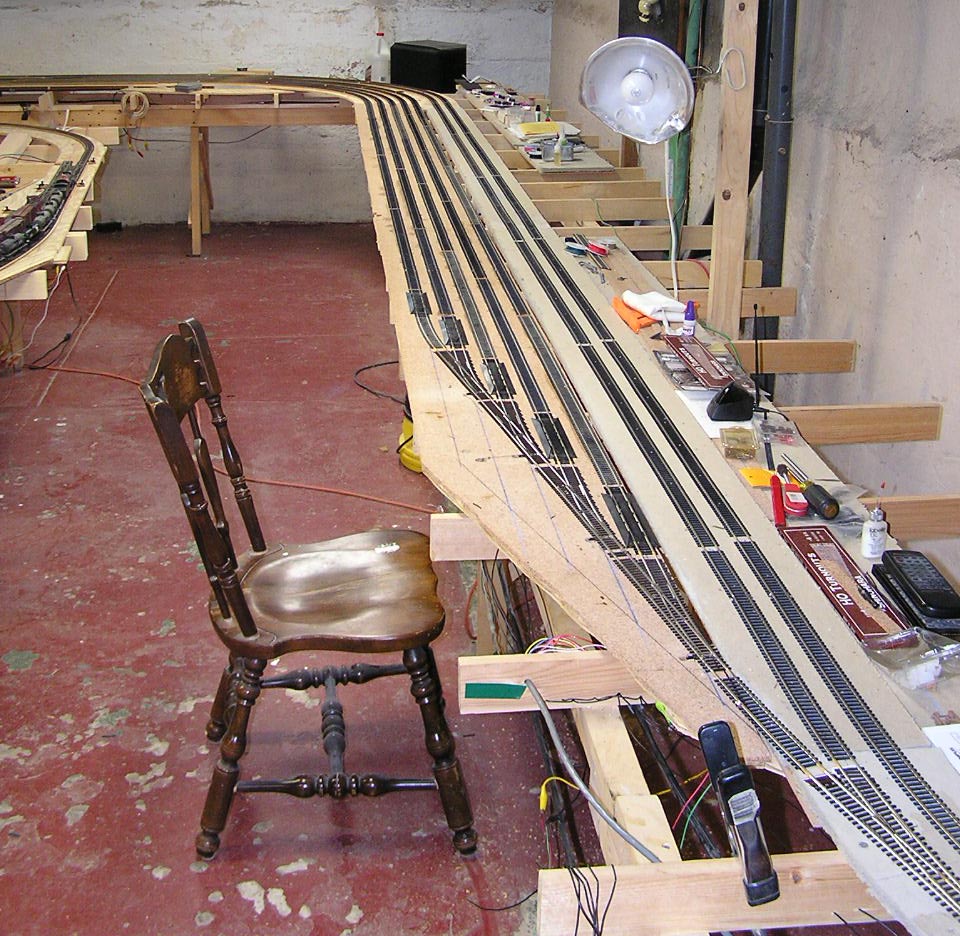
My layout is under construction but the staging yard is about done. I wanted lots of capacity so this one has as much as I could squeeze in:. 11 track that can hold trains ranging from 17’ long to as much as 24’.
Each track will be fully isolated to allow power to be disconnected as DCC is all tracks live all the time. Some have advised the ability to isolate so there isn’t the potential for power drain if you have too many sound equipped or light equipped models in storage.
On a layout I built in the early 2000’s, I had planned four staging yards. I got two fully built. One represented Seattle and the other represented Minneapolis on the Northern Pacific. They larger of the two could hold 45 car trains. Here’s a shot of Seattle, the smaller yard at three staging tracks:
And the larger one, Minneapolis, with five staging tracks:
They were designed to be hidden under other trackage. I actually began building above Minneapolis before the layout came down due to a work transfer:
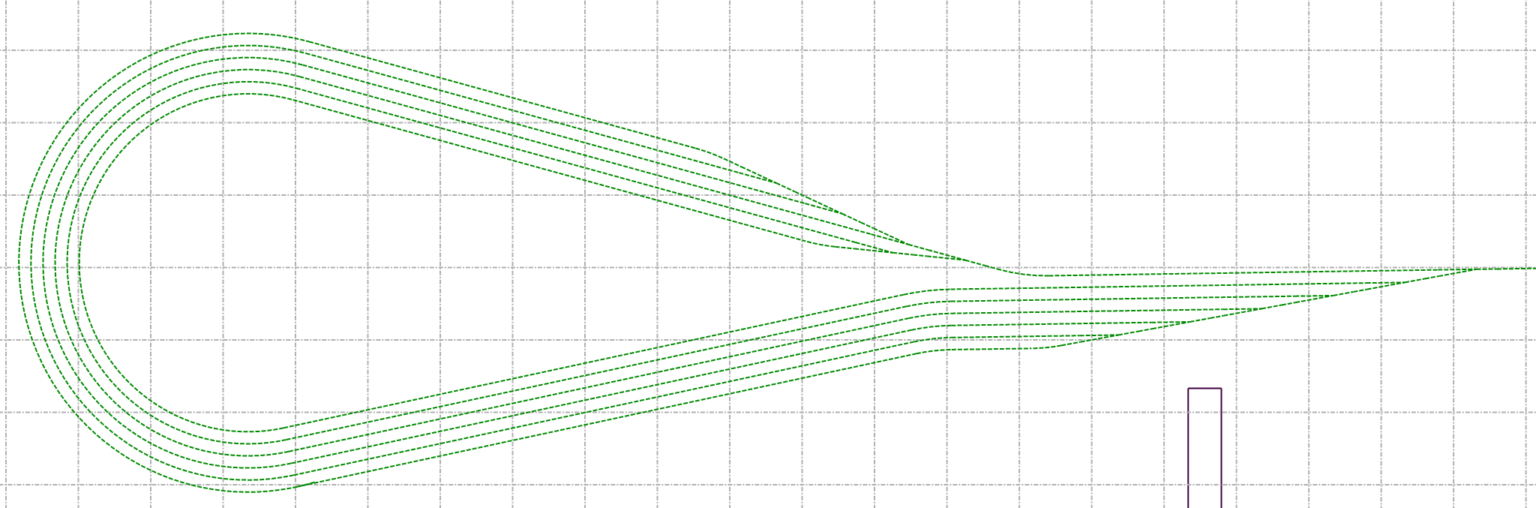
Ever since then I’ve planned for staging, because it connects the layout to the “real world.” One very space-efficient way to do staging (because it allows for long tracks), and which you’ll see often, is staging in a reverse loop under a “blob”. This is the main staging yard designed for my current layout:
This will hold 50 car trains on each track, but will generally be used to hold two trains of 23 cars or less on each track. It’s pretty big - the innermost radius is 28 inches. The gray squares are one foot each. This is hidden under a peninsula.
All of my layouts have “working yards.” Staging is used to do three things:
Bring trains to the working yard to be broken up and rebuilt into new trains;
Provide run-through trains that will traverse the layout and return to staging, stopping only for crew and engine change at the working yard; and
I think double ended staging is best if you can manage it. I have seen some layouts that use a helix at each end to reach a double ended staging below the modeled portion of the layout and that seems to work well. Personally, I am model a shortline and a small portion of a class I (Conrail). I use a loop to model the Conrail portion to have trains in both directions to deliver cars for the shortline to switch on it’s branches. I am still developing the operations and building the branches. I got this idea from MR’s Carolina Central layout. Good luck with your layout and happy modeling.
“Staging yards” as a phrase describes so many different situations and uses. Some early track plans such as Linn Westcott’s famous “If I Had a Million” had “staging” but did not use the term - they were holding tracks, a place to hold a train where it cannot be seen to effectively “lengthen” the run, meaning the time it takes to reach an ultimate destination. This is still a valid part of track planning and operation in my view.
In more recent decades I think the major planning distinction has become less about hidden versus visible staging, as it is between active and passive staging. Until the owner died I was a regular operator on a very large and “finished” layout that had multiple staging yards, but all were hidden (no scenery) and all were purely passive, in that nobody touched the trains. He also had at least three “real” modeled yards where trains arrived, departed, were assembled, were sorted and taken apart. One had a car float as almost its own yard.
His car forwarding system was such that a train that arrived in staging would be a train that departed at the next session. In other words visually the track plan looked like continuous run; in actual operating terms it was point to point. Only for layout tours and shows did it run continuously. His computerized car forwarding system “knew” what length of train to send to staging – each track could hold two complete trains.
Some guys do not like that re-use of a train that has arrived at staging because it might lead to the dreaded “I’ve run this train before” feeling, but fortunately that very large layout hosted multiple op sessions every month with different crews, so the chance of taking out the very train you took into staging was virtually nill.
And best of all, the moment an op session started you knew you had trains made up and ready to go for the crews.
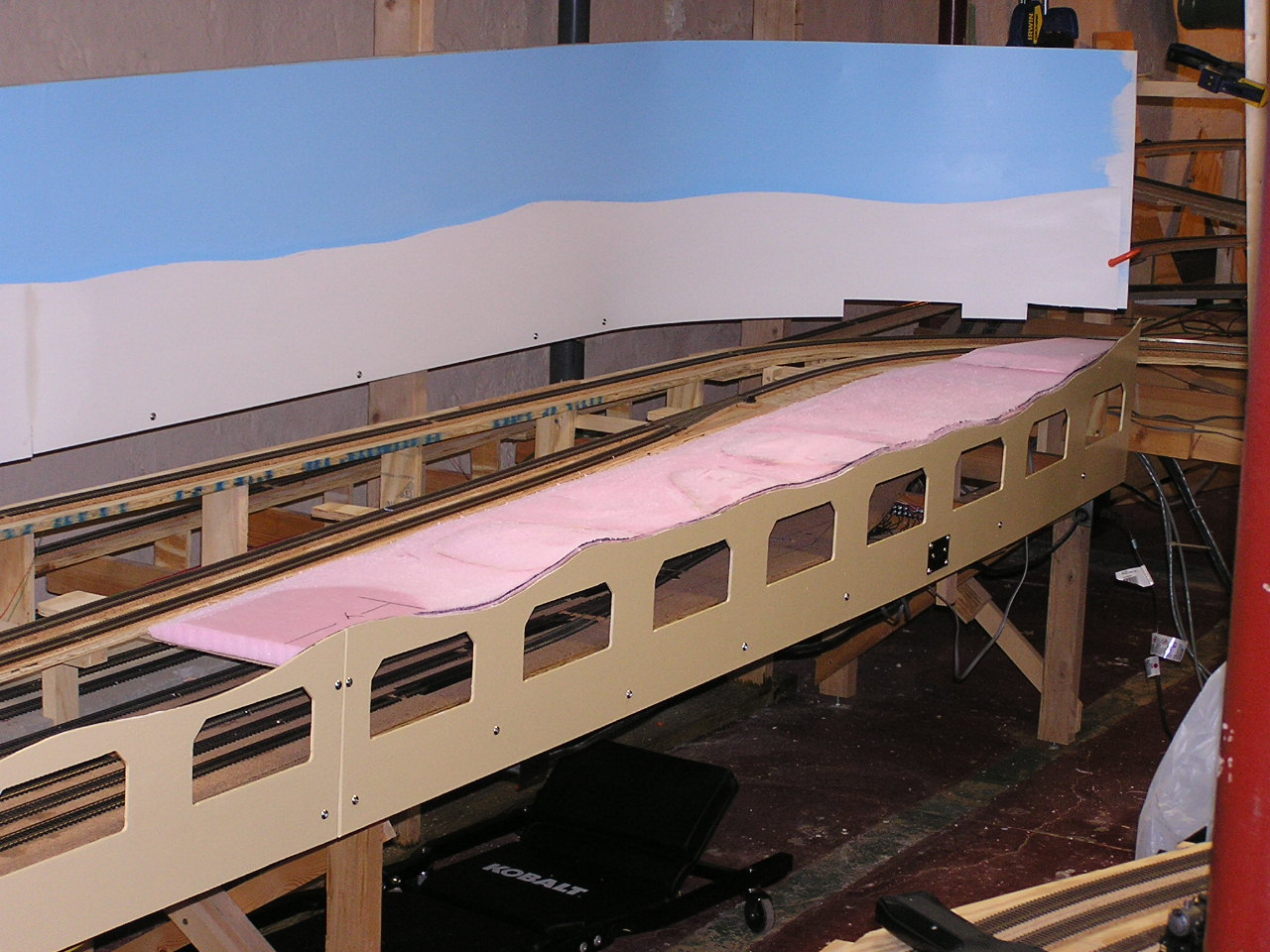
I’m curious what your separation is between the upper and lower decks is. My layout is still firmly in the planning process, but I know that I’m doing an unsenicked staging level. Looks like your upper deck is 1x3s too?
I have 12" separation between the top of the plywood of the lower level to the bottom of the plywood on the upper level. I did use 1"x3" for my framing. I can reach the back as the depth is 30" and all turnouts are Atlas with top mount switch machines for ease of change.
Also, since my staging tracks are long, they’re split in 2 electical sections and I have toggle switches on each section to kill the power if I have sound engines on them.