I assume that connecting an led with reversed polarity does no harm since it is a diode and just requires the polarity to be reversed. What happens if an led is connected with no resistance? Does it blow the diode or is it reusable? Thank you
If you are lucky it briefly lights for the final time. If not, wear safety glasses, people have posted that they have had them explode.
use a led calcultor to determine resistor value … they vary depending on led color, and -most- run at 2 volt to 3 volt …
if you run a current dropping resistor then they can be switched side to side with no damage , if you don’t run a dropping resistor they -may- flash once, but then it’s time for the garbage bin
Some have reported the LED blew apart. When you move into DCC, you better know the basics.
Some have smoked a pricey decoder because they did not know what they were doing.
http://www.members.optusnet.com.au/nswmn1/Lights_in_DCC.htm
Rich
You should Google LED and then Google diode.
Two different devices.
Rich
I do a lot of LED work and have done my share of dinging them. Over the years I have heard them pop but most don’t even flash with high current.
It’s the current that takes out an LED, most have a maximum current of 20ma. I rarely run any of my LEDs over 5 or 6ma. Pretty much using a 12 VDC source if you go with a series resistor above 600Ω an LED would be in the safe range. I run many at or below 2ma using 6000Ω or 6KΩ resistors.
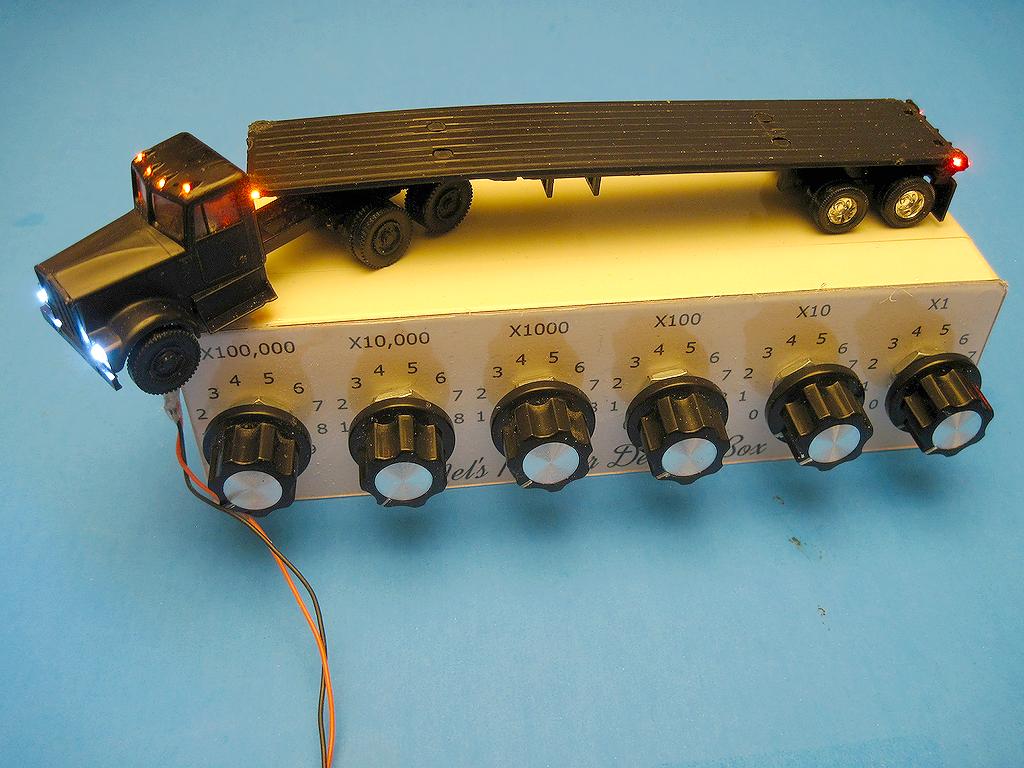
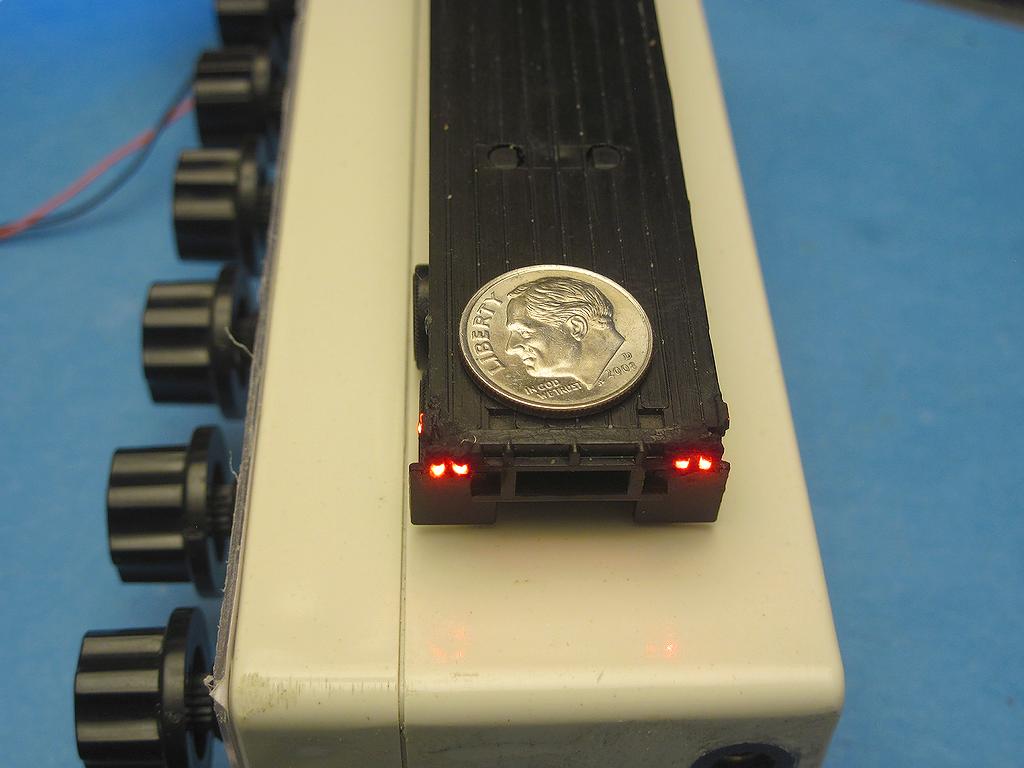
The marker light LEDs in my 18 wheeler trailer below is running 400ųa using 30000Ω or 30KΩ.
I finished the lighting on my HO scale Kenworth tractor trailer yesterday using 1206 and 0603 LEDs for headlights, marker lights and tallights.
This link should help you for measurements. I have four because I misplace them. One in the car. They are accurate. I made longer leads. I have more expensive meter but these are rugged.
http://www.trainelectronics.com/Meter_Workshop/index.htm
Rich
i often put a led and 1k resistor across DCC to check for power or frog polarity. (diode do have a reverse voltage limit)
As long as the voltage is not too high it just does not light w/reverse polarity.
I have bi-color LEDs in the DPDT output to my Tortoise machines. The available circuit voltage is 12v DC and the LED (whichever one is lit) uses about 2v IIRC and the Tortoise (when not moving, at stall) about 10v. When the DPDT is thrown, it just reverses the outgoing polarity to the (in series) LED and Tortoise. Only red or green lights up, depending on the polarity. The one not lit is not harmed by the reverse polarity, and does not burn up at that reverse voltage.
When the DPDT is thrown and the Tortoise is moving (before stall, with the points closed), the LED is a bit dimmer. It then brightens when the Tortoise is finished moving / at stall. Perhaps someone can explain what’s happening then. The circuit voltage drop is constant (the power supply is regulated) at 12v. Something is going on with the current and voltage drops I presume the Tortoise is drawing more current to move than when at stall, so it has a higher voltage drop, leaving less voltge drop for the LED, so it is dimmer??? I’m getting confused!
When two things are in series, like the LED and the Tortoise, the same current flows therough both. Not a sum total of current. The Tortoise draws LESS when moving, a LOT less, so the LED gets a lot less current, and is dimmer. When the Tortoise stalls, it draws about 15ma, so the LED also gets 15ma, and glows fairly brightly.
Voltage in series adds - that’s why when you apply 12V tot he circuit, the LED drops 2, and the Tortoise gets the remaining 10.
Those two concepts are Kichoff’s Current Law and Kirchoff’s Voltage Law.
Always remember - current is DRAWN by a load, it cannot be PUSHED by the supply - a Tortoise at a max of 15ma will work just fine on a 100 amp power supply. It won’t melt (assuming it’s a 12 volt 100 amp power supply). The danger is if something shorts out. A short circuit is extremely low resistance. That means it draws more current. If there truly was a 0 resistance short (there’s always some, even if it’s miniscule, resistance in the wire) the current draw would be infinite.
If voltage is constant, but the resitance goes down, the current goes up, and vice-versa. If you know any 2 of the three, resistance, current, or voltage, you can calculate the missing one - this is Ohm’s Law. E (voltage) = I (current) x R (resistance). Plug in the two you know, you can calculate the other. By combining Kichoff’s Laws and Ohm’s Law, this is how the typical use of a 1K resistor with a white LED on a DCC decoder is arrived at.
The function outputs on the decoder are at a little below track voltage. Let’s say 12V. A typical white LED is around 3V. By Kichoff, if the supply is 15V, and the LED drops 3V, the resistor must drop 9V, because it is in series with the LED.
Now, the MAXIMUM current of the LED is typically 20ma. One thing about electrical and electronic devices is, you almost NEVER want to run them at their absolute maximum values.
Kichoff also says the current in the resistor i
Randy, thanks for the through explanation.
My problem is that when I went to school, Ohm’s law had long been around, but Kirchoff had not yet come along. Either that, or I forgot a few things! [;)]
Gustav Kirchoff (1845) – wow, you must have been in school a long time ago
Sucks Greg I’m lucky to remember who I am let alone Kirchoff.
Mel
My Model Railroad
http://melvineperry.blogspot.com/
Bakersfield
i remember the equations and principles. i rarely remember their names; Newton’s 2nd Law
A LED is a Light Emitting Diode. If you connect it without a resistor, you will have a Darkness Emitting Diode, or DED. The bad news is that creating a DED is irreversible. The good news is that LEDs are cheap.
To answer the original question - connecting in reverse won’t harm an LED as long as the voltage is not higher than the Vrev max.
Connecting in correct polarity but without a current limiting resistor will ALWAYS blow it. Its not the voltage that drives the LED, its the current. If there’s no resistor, hence, there’s nothing to limit the current, hence…
Its easy to find out the correct polarity, its usually marked, and I’m sure you have enough advice by now. I would bother troubleshooting it. Just replace with a new one and good luck!