Leeds Sovereign Street & Clarence Dock - a UK based layout

Hi LSM.

Thank you for your kind comments. They are much appreciated.

The Light Railways Act.

https://en.wikipedia.org/wiki/Light_Railways_Act_1896

The line to Leeds Sovereign Street was built to main line standards, but ran with the use of 0.4.0 and 0.6.0 like a light railway. The same with the Leeds, Scarcroft & Wetherby Railway (LS&WR) (which I will deal with later.).

In 1922 the Lancashire & Yorkshire Railway amalgamated with the London & North Western Railway (LNWR).

They in turn became part of the London Midland & Scottish Railway (LMSR) in 1923

The line to Leeds Sovereign Street became a secondary route remaining open as already mentioned. Staying open well into the diesel era. [:D]

Thereby depending how I feel, I can run ‘old’ little steam engines 1914/1919 style.

Run diesels 1970s time.

When the grandchildren are here, they run whatever. [(-D]

Sovereign Street can be operated on its own.

Clarence Dock likewise.

Crown Point Yard as a separate identity.

All with a time and reason and still correct (to a point). [:)]

I have in essence five individual layouts in one. All run properly and to a timetable. No chance of being bored of the same old thing. [8D]

David

The line from Leeds Sovereign Street Station to Wetherby.

I did try to find a map of the route of the line, but not successful.

Therefore the route in words.

As mentioned previously the aim of the Lancashire & Yorkshire Railway (L&Y) and Great Northern Railway (GNR) was to have a route to York. With the advent of The Light Railways Act 1896 the two Companies financed the building of the line - first to Wetherby with plans to build to York.

A new Company , The Leeds, Scarcroft & Wetherby Railway was formed.

The line would leave Leeds Sovereign Street Station and head north. Stations were to be built at the (then) little villages of Oakwood, Shadwell, Scarcroft, Bardsey West, East Keswick, Linton arriving at Wetherby. A distance of 13.8 miles.

A boost to the line was the opening of Blackburn’s Aircraft Factory. Blackburn Aircraft was founded by Robert Blackburn and Jessy Blackburn, who built his first aircraft in

The Building of Leeds Sovereign Street & Clarence Dock

List of what had to be on the layout before a piece of track was to be layed

A) Able to be operated by one person. I would be the sole operator when others are not there

B) Fun to operate when the grandchildren visit. They would be able to run what they like (within reason. I have special items that I run.)

C) If they break anything do not get upset. ‘Do not get upset over small stuff’. A funny rule that, as it is only me that has broken things. [:-^]

What must be included on the layout.

I have many interests other than railroads and they have to be included.

  1. A Dock. I love ships and shipping and really is my main interest. The City of Leeds is a long way from the coast, so Clarence Dock is the next best thing.

  2. A Canal. A quiet canal scene for ‘Clarice’ the canal boat. (I am a member of Boat & Canals in the UK.)

  3. An Industrial Park. I have a small number of industrial Units for my road transport vehicles. I have been heavily involved and been around road transport for over 65 years.

  4. Farms. Dawn’s family are farmers in Cumbria and Northumberland.

  5. A Scrap Yard. Pictures of scrap yards fascinate me. Unkempt, filthy and messy. Yet everything has a place.

  6. A Street Scene. Little cameos of street life that have nothing to do with railroads.

The Railroad Scenes

a) Steam & Diesel. Able to run Steam and Diesel locomotives in different timefra

That is a very clever and appealing layout exploiting the space without including too much track. I see three point to point layouts and two continuous running loops available. In 11’x8’. Marvellous.

I’ve got 12’x13’ but our prototypes are at least 50% longer in most cases so your example will be useful for me, especially when I’m tempted to add too much track. Need I add that our prototype distances are, ahem, somewhat longer also…

Nice explanation of the layout’s backstory, David. Thanks!

For some reason I was unable to post anything until now.

Thank you LSM for your comments. Not so long ago I looked to see if I could improve the track plan in any way on a paper exercise. Whatever I did I came up with the same one; no matter where I put Sovereign Street etc.

Mark. Thank you also for your comments. Having the backstory and staying true to it, gives the lines credibility etc. and can stand the test of time (imo).

Next I shall explain how the working of trains are done.

Thank you for reading.

David

Now I had the plan of the layout and had included all I wanted in it, how it all comes together in operation?

Here in the UK we have what is called fiddle yards. Basically they mean the rest of the rail network not modeled. Here rolling stock can be lifted off the track and other stock put in its place.

Looking at the plan the bridge is the fiddleyard.

Trains leaving Sovereign Street on to the bridge are going to either Leeds New/Central Station for passengers or LNWR Goods Yard for goods traffic.

At the other end of Sovereign Street Station, trains taking the right turnout and passing Crown Point Yard are going to Dewsbury or south towards London. Mention of locomotives to Stourton Freightliner Depot or Balm Road Quarry Sidings; both places although not far away in reality are found in the fiddle yard.

Taking the left turnout past Roseville Station those trains are going to Wetherby or Seacroft/Barnbow northbound to Newcastle or Edinburgh.

It can be seen that both north and south lines join just after Marston’s Scrap Yard then go to the bridge. That section brings a little variety as trains may have to wait for clearance whilst another train is in the section.

More to follow. Thanks for reading.

David

When running diesel locomotives in 1970 the lines have become secondary and the trains seen are mainly ‘local ones’. Diesel Multiple Units (DMUs) run from Leeds Central north to Wetherby four times a day (and return), and south to Dewsbury Market Place and Wakefield Kirkgate (both three times daily (and return)). A Class 121 (Single Diesel Unit.) runs from Leeds Central to Seacroft and return every two hours

A diesel locomotive and two carriages travels from Leeds Central to ROF Barnbow and return to connect with starting/finishing times at the factory. (Three journies.)

A locomotive with two carriages travel from York to Leeds and return twice a day.

A similar service is operated from Castleford (South of Leeds) to Leeds Central twice a day.

The main operation on the layout is locomotives arriving on the Main Lines from all regions, Refueling at Crown Point Yard. Locomotives required (details taken from 1967 timetable)

The following ---- thruout the day.

Six to London Kings Cross - Six return

Nine from Liverpool or Manchester – Nine return

Nine to Newcastle - Nine return

One Thames/Clyde London St Pancras to Leeds - One return

One Thames/Clyde Leeds to Glasgow - One return

One Thames/Forth London St Pancras to Leeds - One return

One Thames/Forth Leeds to Edinburgh - One return

One Leeds to Plymouth - One return (Devonian)

One Leeds to Cardiff - One return

One Leeds to Edinburgh - One return (North Briton)

Plus Six locomotives from Stourton Freightliner Yard

The above post explains (hopefully) how the operation of diesel trains and locomotives are run.

How did the running of little steam locomotives come about? My grandsons’ (then 4&5 year old) wanted to run trains. I had a small number of little 0.4.0 locomotives collected in a job lot purchase. A few small four-wheeled wagons and all was well. The rolling stock was easy to handle and the granchildren could ‘join in’.

I also enjoyed the sessions with anything goes. So much so I began planning how to run the steam locomotives when the grandchildren were not here.

When I lived in Leeds was told by my teachers about how the City was a ‘large war manufacturing machine’ during the Second World War. I began to wonder what did Leeds do during the Great War.

The building of The National Filling Number 1 Factory at Barnbow.

Blackburn’ Aircraft Factory near Oakwood.

Kirkstall Forge & Leeds Forge Factories.

Fairbairn Lawson’s and many other Companies switched to making Arms and Ammunition.

A timetable of 1914 to 1919 was settled on.

More to follow.

Thanks for reading.

David

The running of steam trains (when the grandchildren are not here. I have five now all wanting to run trains. Three boys and two girls.) set in the timeframe is more relaxed. I run what I like when I like.

Freight to Barnbow and Blackburn’s.

Companies at Sovereign Street to supply –

T&J Harrison, Small Arms & Ammunition

Fairbairn Lawson, Ammunition

Town Tailors, Military Uniforms

Smith & Butler’s, Printing Literature

Hudson Ward, Flour Millers

Hey & Humphreys, Bottlers of Ale

The coal trains

Troop Trains

Other Freight Trains

Then we have the local passenger trains.

Getting staff (mainly women) to work on time. Getting the return journey home.

When I have the ‘crew’ here and they want to ‘get serious’, then we also run trains to Clarence Dock.

So there it is. Two Railroads in the same place on one layout set some 55 years apart. Both are great fun to operate. It has taken just over five years to build. Family (mainly the womenfolk) buy me things that have to be added. So i guess the layout will not be finished. [:D]

The grandchildren and I shall continue to have fun. At least Dawn knows where we are. [(-D]

A freight train passing Leeds Sovereign Street Station. It originally started its journey in the land of the North British Railway and is going to Leeds LNWR Goods Yard. It wil be remarshalled and sent South.

Thanks for following.

David

A journey around the layout.

Class 56 56035 has arrived on the scene from Balm Road Quarry Sidings on its way to Crown Point Yard to refuel.

It is behind the Coach & Horses Inn a 18th Century coaching inn. In days gone teams of horses would be changed here. A meal would be provided for stagecoach passengers.

Being interested in the Postal Service of days gone, when I saw the model (ready built) it was a must have. I gave the model a distressed look reminding me of the one I saw in Yorkshire.

The small Hunt scene of huntsmen and dogs once again a scene seen every New Years Day in our village.

The other side of the Coach and Horses Inn. A regular scene before the technology of Sat-Navs. A man is giving directions to the lorry driver. Mildred Murray is on a visit to someone.

Across the road from the Coach and Horses is Albert Vinnerd’s Garage. An old plastic kit that has been altered slightly. It is in need of a new nameboard. To the right is Anne’s Cafe. Must be good food there as a queue is forming. The obligatory red post box and telephone box.

Not seen from viewing areas. The rear of Anne’s cafe. The building is made up of ‘odds and ends’ from the plastics box. Things are not perfect in life. The broken guttering was not deliberate, but it has been like that for over four years.

Another view not s

Thanks for the great tour David.

I will be back for more.

-Kevin

Coaching Inns were the first post stations. In addition to feeding and watering (or dewatering) passengers the Post Hotel or Coaching Inn supplied replacement horses.

When mail was taken over by government they used the same infrastructure and the post system originally refering only to the horses became generic for mail delivery.

In the UK the system is a Postal Service which delivers the post. In the US and Canada the Postal service delivers the mail. Go figure.

I called those public collection “mailboxes” Pillar Boxes as a child.

That is a great model. I love all the character it has.

Nice find.

-Kevin

Kevin. Thank you for your comment. It is much appreciated.

The journey continues.

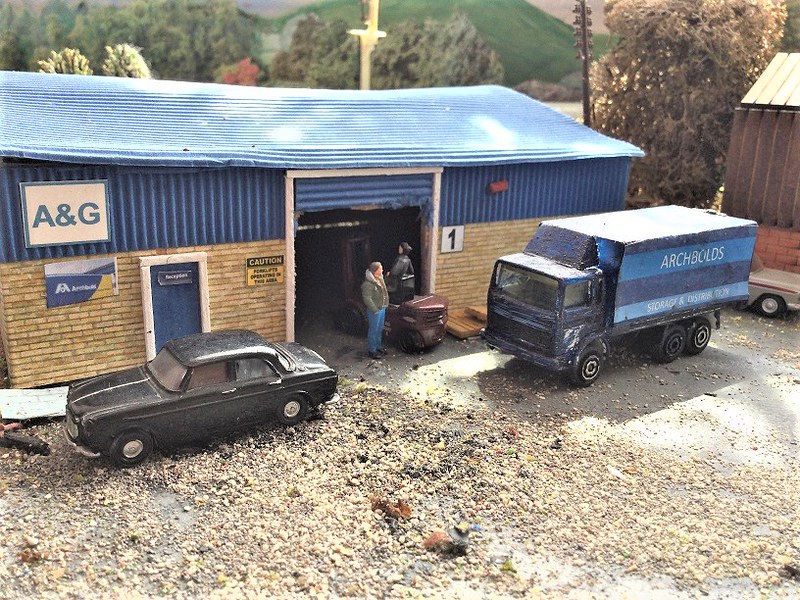
Road haulage has always been huge in my life; from being taken to Liverpool or Hull, to spending 31 years in the business, then afterwards. Two Companies that became part of my life were Archbolds Storage & Distribution of Gildersome (near Leeds), and W.A. Glendinning of Shotley Bridge, County Durham. Both Companies are no longer there now; although Archbolds have premisis in the Birmingham area.

I have combined both Companies into one - Archbold’s and Glendinning’s.

Here is D.K. (Archbold) having a word before leaving.

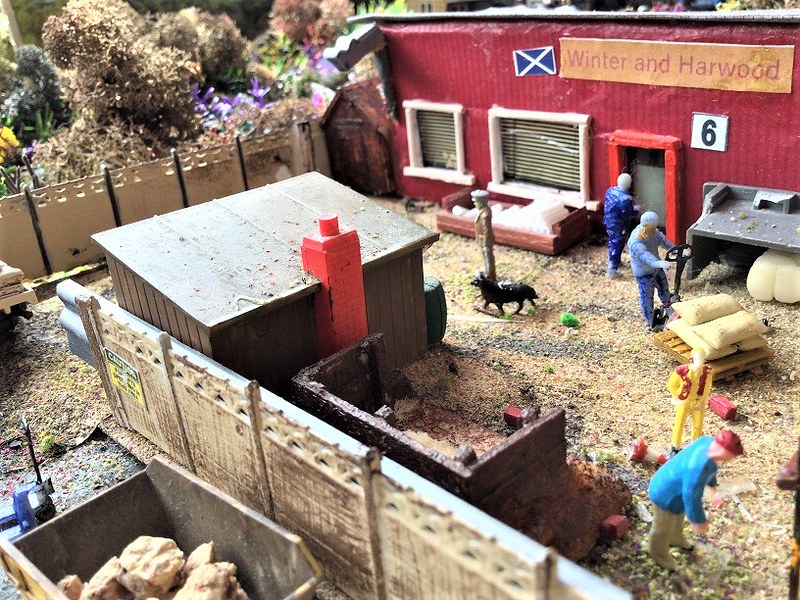
Scenes around the small Industrial Park. My eldest grandson likes this area and often gets his vehicles out and plays here. ‘Life goes on’ with the little people oblivious to any trains.

The Class 56 locomotive is now at the junction. A picture of my son on the quad bike is seen ‘rounding up the sheep’. On his days off work he is often seen on a family farm at ‘Longstruther’ Northumberland. His picture is on the backscene. The sheep are not. A bird is on the fence.

Looking at the scene from the control area. The roof of the locomotive can just be seen. I dislike the 'prim a

The journey onwards.

56036 is at Crown Point Junction. Behind is Ash Farm Fields and ‘the lake’.

New track is required here and ballasting down.

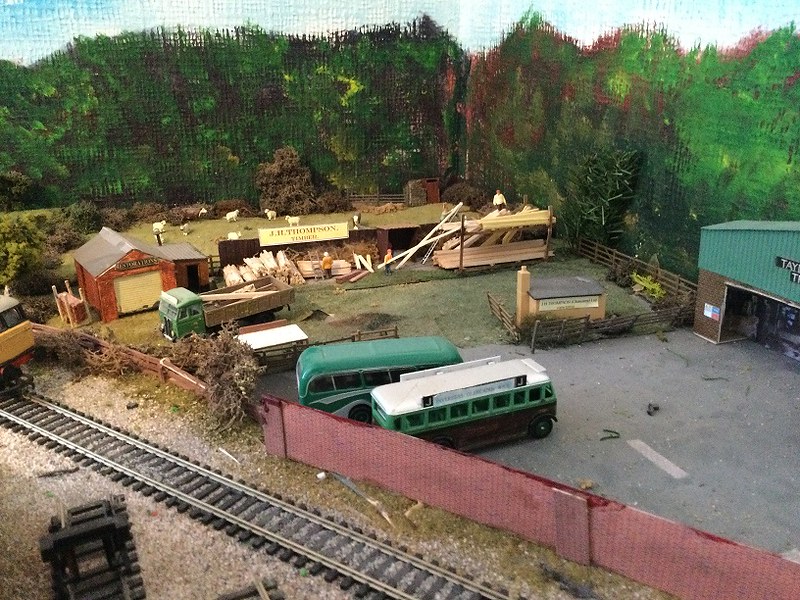
J H Thompson Timber Merchants. When I saw models of timber merchants they were all the same. I wanted mine to be different and with little people working there.

56036 at the locomotive fuelling yard. To the left is John King. He has a Yard Pass giving him permission to take photographs. Michael Caine in ‘The Ipcress File’ is being shown at the Forum Cinema.

A scene on Crown Point Road. The blue buses are in Samuel (Sammy) Ledgard colors. I was a regular passenger on the real ones to Otley or Castleford. The cream colored one at the rear is a Wallace Arnold touring bus. Another Company bus we traveled on.

More to Follow.

Thanks for reading.

David

The weathering on the scrap locomotives is remarkable.

Great scene.

I have collected a lot of models of WW2 German equipment to populate my eventual scrap yard.

-Kevin

Thank you once again Kevin. I just played around with colors of paint until I got what I wanted.

I like your idea of a WW2 German equipment for a scrap yard. Be different to others. People notice and remember.


A Leeds City Corporation bus is turning to go up Swinegate. The Crown & Anchor must be open as a young couple are entering. A train must be about to leave Leeds Sovereign Street Station as the signal is at go.

David

The journey has arrived at Leeds Sovereign Street. There is no train yet, so let’s take a look around.

There is a light snowfall. Something I am trying out, just to be different. [:)]

Fairburn Lawson’s. In both wars they switched production to arms manufacturing, so have place on the layout.

Hey & Humphreys bottling plant. As a young lad of 9 to 11 years of age, to earn some money, I used to put empty H & H bottles in crates to return to them.

Some barrels of ale have arrived to be bottled.

Smith & Butler’s printer. It was here I started my first (official) job. They taught me so much.

Town Tailors. My dear Grandmother was a (very good) tailoress. Working from home, every week suit material would arrive at her house and by the end of the week a number of suits would be made. Family members gave her little business the nickname of Town Tailors.

That was on top of running a house and feeding the family. She also made clothes for the family. We always wore good clothes. Grandmother is no longer with us, but at family get togethers we youngsters’ still mention Town Tailors.

Cases of uniforms ready for despatch on the dock.

T&J Harrison. Small Arms & Ammunition. Still going and trading well.

Hi David,

I’ve said this before but it deserves repeating. Each of your buildings and your scenes is enthralling! I could spend hours studying your work even without trains running. There is so much character.

I look forward to every one of your layout posts.

Cheers!!

Dave