I’m in the process of designing a rail yard with a round house. The problem I’m having is “What length Should I have for the rail Lead coming off the roundtable to door of the roundhouse stall?” I’m modeling the late Sixties in the Middle Seventies. I would appreciate any Help that would be provided.
The size of your turntable and roundhouse, it purchased commercial models will determine your lead track length. I have a 130’ Walthers tt and roundhouse kits and the lead track is very short, not what I was hoping for. The roundhouse kits on the market are designed for a preset degree of track spacing which limits your options. It you scratch build your roundhouse you can make it to suit your needs or preferences. I would like to see about 6-9" of lead track but with my choices of equipment I only have about 4". Most roundhouses are set at 10 or 15 degrees spacing but you can modify them if you are creative with kit bashing. A smaller tt of say 90’ will allow for a much longer lead track. You will have to decide what your needs are and play with a layout of them; you may find you don’t have too much choice, depending on what you use. Good luck with your layout, but remember that a turntable and roundhouse are usually the jewels of your layout.
‘How Big is a Dog’? There is no firm answer here. The lead length from the Turntable to the wall of the Roundhouse will be dependent on two factors:
-
Diameter of the Turntable
-
Size of the Roundhouse
This is one of those thing you will need to lay out 1:1 if there is no documentation with the TT or Roundhouse. I installed a Walther 90’ turntable and a Atlas roundhouse. I used the template Walthers supplied and laid out the 3 stall tracks on the 1/2" plywood base. I then cut the whole for the TT and laid roadbed. I had to manually adjust the roundhouse back & forth to get all of the stall tracks aligned.
Jim
Key factor is degree of indexing.
If you are working with a kit or assembled roundhouse, this degree of indexing will already be set, and you will have to adjust the distance to match the structure. Most turntables also come with a set degree of indexing.
In HO, my 65’ turntable (this is a very small turntable) is from Diamond Scale and the roundhouse is an old Model Masterpieces kit. The indexing seems to be about 10 degrees, and the distance from the turntable pit to the roundhouse is seven inches. As mentioned previously, fitting these things out in 1:1 scale is usually needed unless the turntable and roundhouse are from the same manufacturer and designed to go together.
For sketching this out at the planning stage, I think that you need to go ahead and decide just how big that turntable is going to be. This may likely entail looking at the commercial offerings and picking what best fits your needs. “Generally” in model applications, and this is a big generally, the distance from the turntable pit to the front of the roundhouse will be roughly similar to the length of the turntable itself. These structures take up a great deal of space on a layout, and it would be best to leave a little extra space in your plan for fitting. Good Luck
Bill
The distance is determined by where the turntable leads intersect the center of the turntable. For example, the Port Costa roundhouse has stalls with an 8+ degree angle of intersection, so it is set a scale 61 feet from the edge of the roundhouse to the edge of a 75-foot turntable. If it was a 105-foot turntable, the distance would be 46 feet. And so on.
Mark
This picture may help visualize the situation:
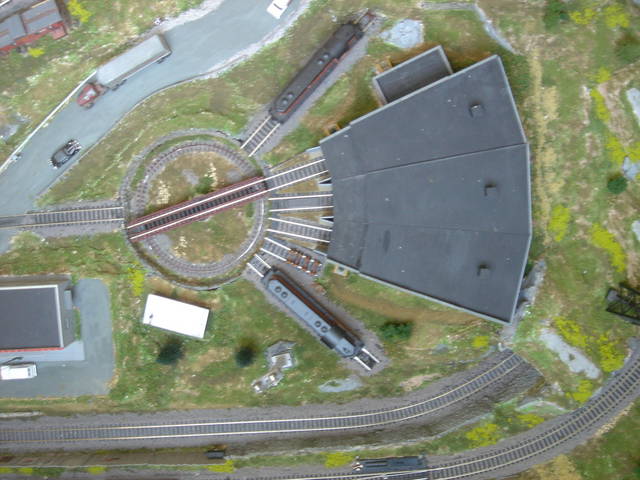
The turntable and roundhouse are from Atlas. This is in HO, and the turntable is 9 inches across. This works out to about 66 scale feet. The turntable has fixed indexing of 15 degrees. The roundhouse comes with an “apron” which positions it exactly with respect to the turntable.
If you maintain the 15-degree indexing, then you would have to make the roundhouse stalls further apart if you moved it away from the turntable, or closer together if you moved it towards the turntable. Similarly, if you reduced the indexing angle to, say, 12 degrees, you would need to bring the roundhouse stalls closer together. You would also need to change the angle of the stalls with respect to each other.
Bottom line…you have to make it workable. You erect the roundhouse and place lengths of flext in the bays so that they overlap someplace at an intersecting point. Now place a carboard template representing the the turntable under those intersecting bay tracks and see whacha got. You can slip forward and backward, but what will that mean for the bay tracks as they attempt to be centered, over very nearly so, as they enter the bay doors? Beware the clearances for steamer cylinders!
My solution, because I was mixing two different manufacturers, was to slightly curve the outer two bay tracks as they left the bridge. The curve works out to about 70" radius, so of almost no consequence by the time the tracks enter the bay, but necessary to get the clearances right. With that arrangement, I have about 6" between the bridge end and the bay doors…not much. In the images I have seen of the prototypes, there was usually enough room to almost get an entire Mikado length betwen the bay doors and the turntable, and in many there was lots more than that.
-Crandell
Mister Beasley, you need to send out a crew immediately to install signage and protection where that busy road crosses the turntable lead and erect some fences to keep the curious out of the engine terminal. [swg]
Mark