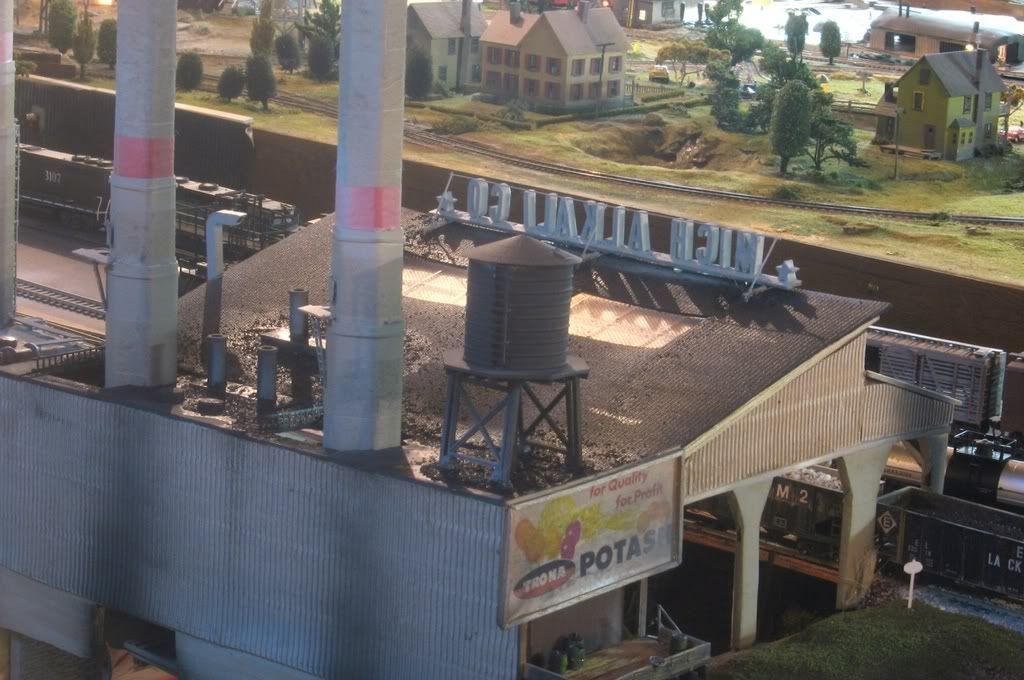
One of the things I admire most about some of my favorite model RR’s is the panoramic effect and depth of scenes. Gorre & Daphetid and Franklin & South Manchester come to mind. To a lesser extent Paul Dolkos creates some amazing depth on his RR which is amazingly flat as far as profile goes. The one thing that I notice is he controls this effect via the height of objects (structures) etc…So that when you look at his RR from track level everything is proportional to the horizon…
What I don’t like (no offense intended towards anyone) are visually obvious narrow shelf pikes. Where track is laid almost clinically parallel to the backdrop wall with geometric precision and carefully laid minimum radius turns surgically double back around the end of a peninsula into yet another razor sharp straightaway of track stradled by 18 inches of “scenery” and a sky blue wall. I can understand how someone whose focus is 90% operations wouldn’t mind this but, to me, it robs the idea of “model railroad” of it’s magic.
One thing I’ve been considering is the reach constraint adapted by so many as a hard and fast rule, never lay track beyond 27" arms reach. It seems that many constrain the scenery to this rule as well in order to maximize trackage in their plans. I’d rather give up some trackage in order to “frame” my railroad properly in order to create the “illusion” which, I think, escapes so many.
With all this being said what are some of the things/tricks/ ideas that go through your mind when planning areas of your pike? How many of you prioritize this aspect of model railroading so that it suffers the least compromise possible?
There’s a reason for this rule. It isn’t arbitrary. If you don’t have access in some easy form to all your track, trains will repeatedly find that spot to derail, and you will eventually damage your panoranic scenery trying to get those train back on the track.
I’ve got a 5x12 foot “island” layout, which works out to 30 inches of reach at the center. It’s awkward to do trackwork and scenery there, but it can be done. But, even with a layout that’s 5 feet across, I still long for “depth” of scene. In my situation, I can’t paint the walls or put up backdrops.
Take a look at Jon Grant’s “Sweethome Chicago” layout. He has a couple of posts this week, including some new videos. He’s got a shelf layout, maybe wider than some but I doubt it reaches two feet in most places. However, he’s made very good use of building flats, modulars and scenic backgrounds to create the illusion of depth. Besides that, he has very carefully detailed the foreground of the layout, to draw the eye into the scene and away from the walls.
Model railroading, like magic, is all about the illusion. Some people use mirrors to create streets and buildings that aren’t really there. Scenic backdrops and photos can extend your layout’s horizon as far as you’d like. Tunnels to nowhere and highway overpasses point to a world beyond the back wall.
Actually, I’ve got one section on the Yuba River Sub where three parallel main lines run in a straight line on different levels and at different grades. 'Tis a conundrum, but it’s easy to fix with scenery and ‘selective compression’. I’ve devised several ‘cuts’ on the lower elevation, a cut or two on the middle (plus two Truss Bridges) and an arch bridge on the highest line. The trees move from HO scale to N and Z on the ridge supporting the whole thing, and the scenery is designed to disguise the whole thing. Very few people have ever remarked that I have three different parallel levels, because the scenery just doesn’t let them know. John Allen did the same thing on his G&D, but in his case, he had about FIVE levels to contend with. And what he did was just let it stand out with a huge canyon and variants on his bridges, so that the observer was so taken by them, they didn’t even notice the depth of the scene was probably only about 10".
BTW, the depth at this point on my Yuba River Sub is much less than 27". It’s about 20".
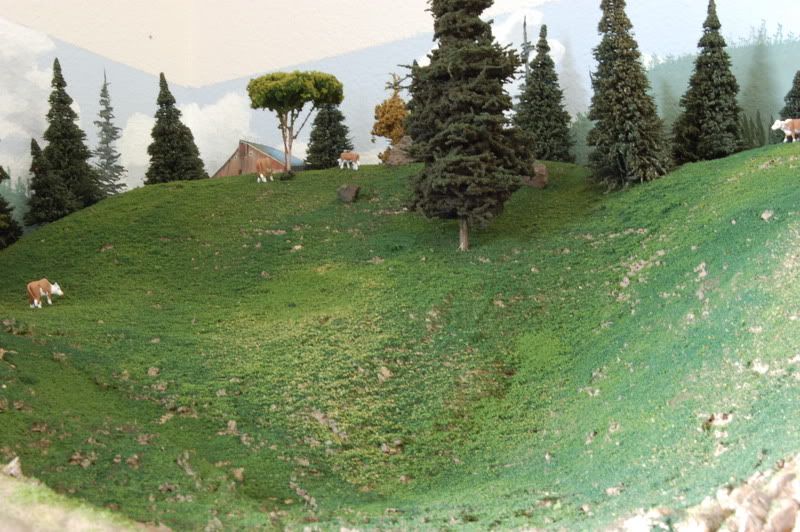
The scene here is about 30 inches deep. When complete, it will be about 50 inches to the edge of the benchwork. It is HO scale but the barn is a photo that is probably smaller than Z scale with smaller trees in the background blending to larger trees in the foreground. There are two tracks and tunnels at different levels with access from below.
We have added more trees and cattle since this photo was taken, but this should give you an idea of how we used selective compression to convey distance.
I didn’t think the “rule” was 27", but 30". In any case, I’ve stretched to 36" in a couple spots in the past, and since my layout is relatively low (for the kids), i find I can reach there…it’s a stretch, you got to be careful, but it’s not awful. In one spot in my new layout I plan put a tunnel at the point where reaching gets tough, and have access underneath the layout, inside the tunnel, in case there’s a derail…the track itself is more accesible than the scenery on top. Generally, I’m planning a 24" to 30" reach in most places.
I know I’m pushing ita bit, but i hate access holes and I also like the depth to the scenery and want to make the most of my small space. If worst comes to worst, I’m making a part of the benchwork detachable next to the far part, if I need to get back there. I’d have to take the joiners out of some track, and mess with the scenery transition a bit before and and after, but it’s a last resort if there’s a real prob and I got to get close…and will help initially scenicking those far areas easier.
I’ll let you guys know in a few months if I made a huge mistake. [:D]
I agree about depth of scene, but I think in an effort to push prototype many have to give up depth to go for the more “realistic” appearance of tracks only going through the scene once, etc. Now this is also a problem with larger scales as dave mentions, however, even with my own “pike”, I have to keep tracks parallel to the edge, but hopefully the scene can be molded around it to keep an allusion to more space. i think that carefull attention to scenery in the foreground is almost as important as having depth further back.
A favored technique in Iain Rice’s (and others’) designs is to let the front edge of the shelf have sweeping curves in it, rather than geometric corners and angles. This can be effective even if the track itself is kept straight. It’s the same principle as keeping the track level and varying the height of the scenery to give the appearance of grades.
After studying many photographs, I’ve come to believe that studying the proposed sight (and reach) angles of a proposed plan is a worthwhile review. The most effective use of foreground scenery seems to be when the scenery deliberately limits one’s view of the layout. The plan review is needed to ensure the layout is fully operable - one can see/reach turnouts and their throws, and can see/reach uncoupling spots for switching - even with limited sight and reach angles.
To a certain extent this speaks to the purpose of the layout and the intent of the builder. To one degree or another we all start out with some objectives for our layouts. We also have to put up with certain givens, like available space. We have seen examples of layouts that were built entirely for operations to the extent that scenery does not mean anything. There was an extreme example of this in MRR a year or so back where scenery was so minimalistic as to virtually not exist. At the other extreme are models that are all about scenery and the huge sweeping vistas that let us truly become immersed in the layout and become a true rail-fan. In extreme cases these layouts have essentially no concession made to operations at all. The extreme example that comes to mind of this is the amazing Chicago Museum of science and industry HO scale layout. It is simply long loops of track set into amazingly deep vistas of scenery. Most of us fall in the middle. We want some operation, we want our layouts to be visually appealing and we want to be able to photograph them and have the shots look believable. But we have to accomplish this with some compromises. As others have noted, N scale lends itself well to long trains curving through sweeping scenery. If that is your emphasis then it is a better choice than HO for modelling in a confined spaces. For others like me, things like structure detailing and scratch building of real places are more important and so HO lends itself better to my needs. But in making that choice I realize that I can never really explore the depth of view like I could with N. Yes there are tricks, yes great backdrops can make a difference, but there is still compromise involved. My particular train room has some real size constraints so I am forced to have narrow shelves. I also want my kids (shorter arms) to be able to get things back on track. My efforts to increase the depth have been
Good subject, and I agree that shelf type layouts are lacking, IMHO.
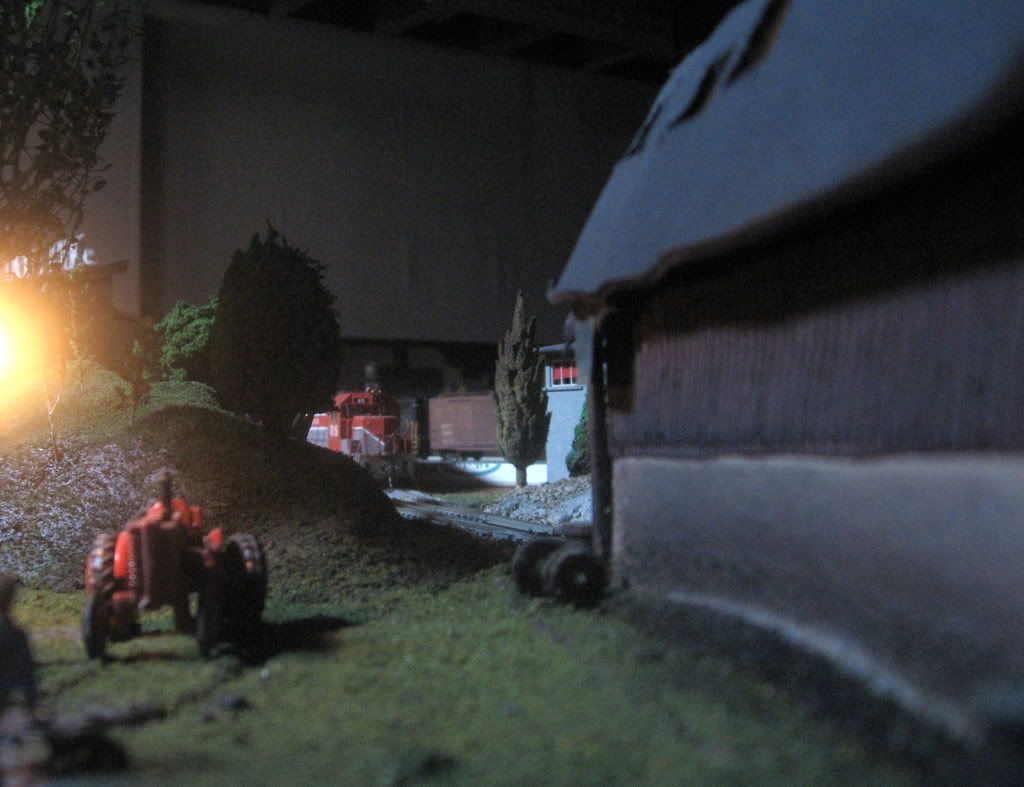
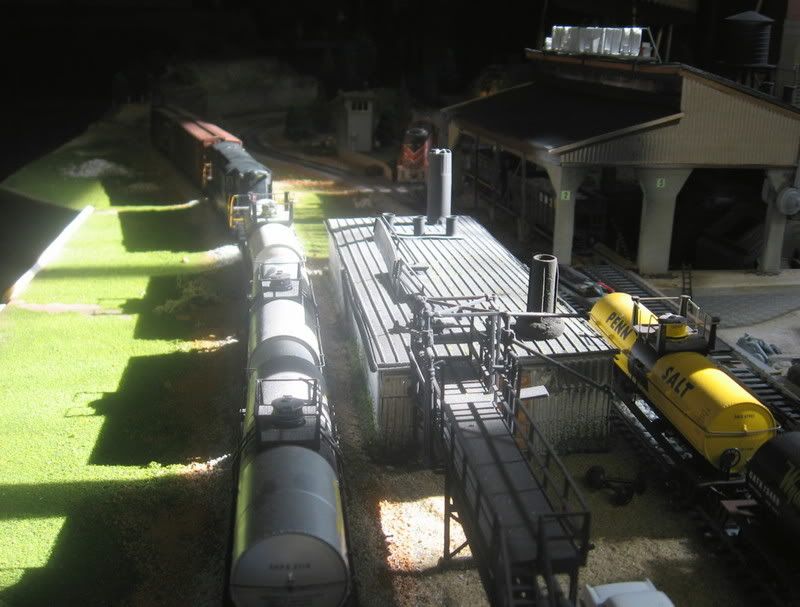
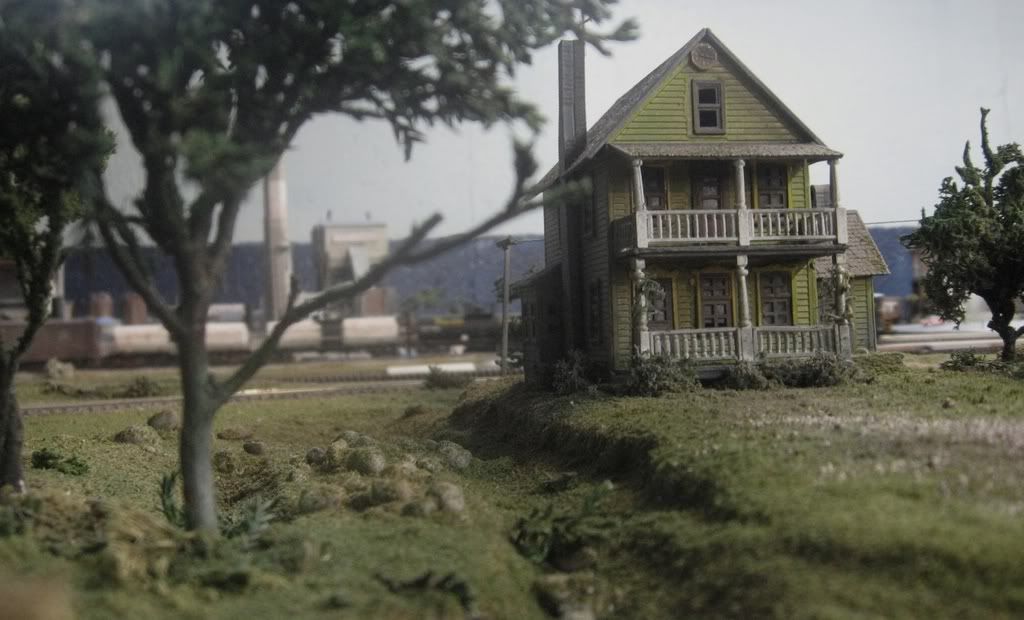
I went a grabbed a couple of photos that show some depth on my layout. Of course, you can do things to force perspective, and I do, but these pics have natural depth.
My layout is arranged so that you can walk around pennisulas and even get a view from one to the other.
Thanks for all the interesting replies folks. Some excellent modeling work in here as well. I’m incorporating a great deal of Iain Rice’s ideas as well. He’s a very talented planner, what I enjoy about his work is that he places as much emphasis on the aesthetic of a layout as well as operations. I definitelt fall into the category of modeler who wants a good balance of both…