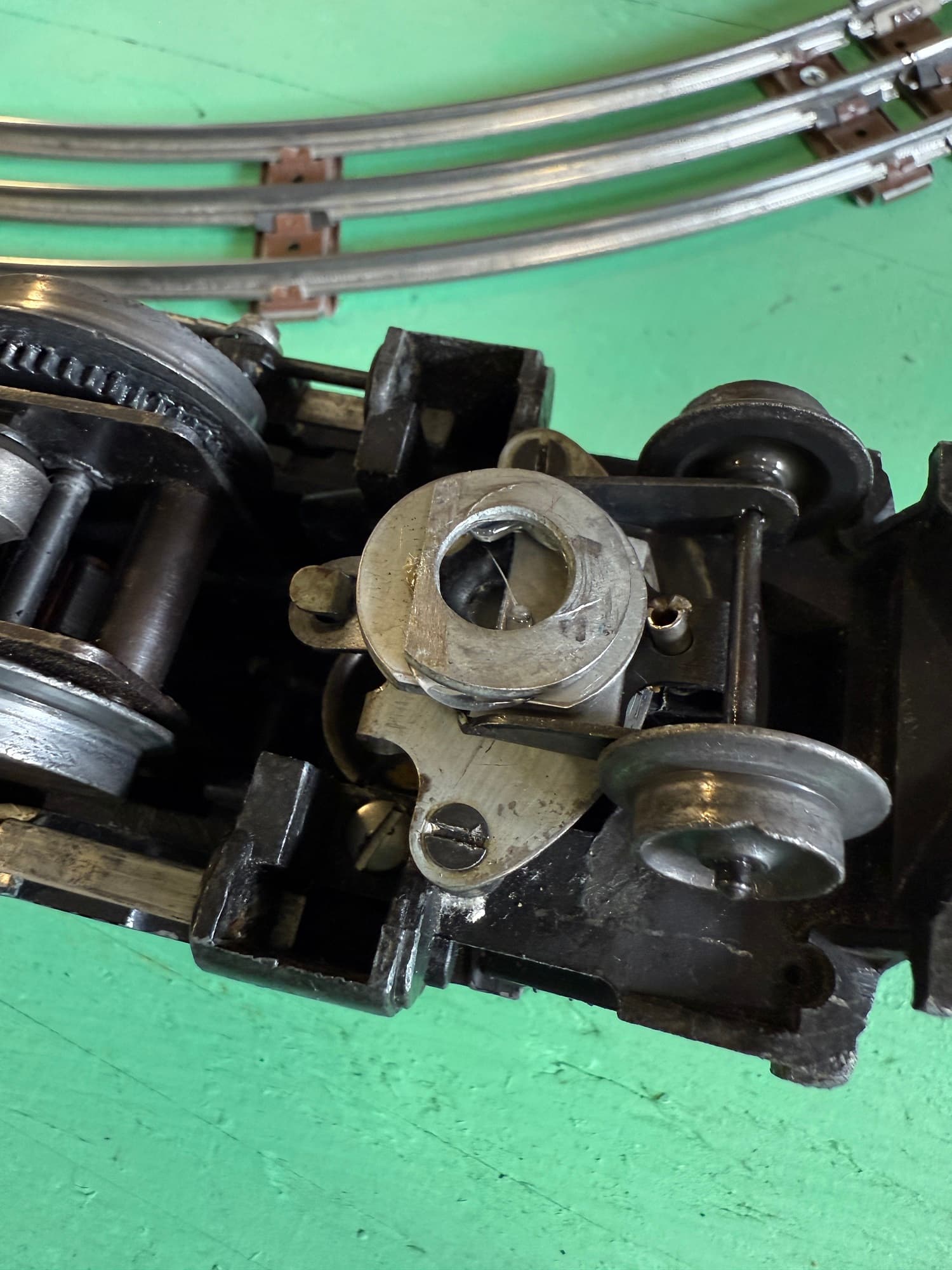
I have a later version (2-6-4) Lionel 2026 engine that runs nice but sometimes the pilot truck derails on sharp curves. When I pick up the engine the pilot truck just flops around like crazy. I see there is a spring in the assembly and it “sort of works” if the pilot truck is lifted above the rails but the spring doesn’t start to compress until the wheel is nearly hitting the underside of the engine. Can someone post a picture of how the engine should look underneath when it is properly set up?
Also, I really don’t like the trailing truck at all. I think the two wheels of different diameters looks unattractive. Would the single-axle pilot truck of an original 2026 drop in if I wanted to replace it?
Those locomotives suffer from an incorrect steering geometry, which causes the pilot truck to oversteer and often derail on curves–the sharper the curve, the greater the effect… If you put the locomotive on an O27 curve, you may be able to see that the pilot wheels are not parallel to the rails, but angled toward the inside of the curve.
The pilot truck should have a longer tongue and should pivot around a point midway between the pilot-truck axle and the middle-driver axle, which is about where the motor’s front crossmember is located. You may get along with a stronger spring or more weight on the truck or both; but, if you’re willing, the real cure is to splice on a longer truck tongue and to create a new pivot at the correct location, as by drilling and tapping the crossmember.
Locomotives like the 2026 described above work fine on 027 track. There is no need to modify the engine. If the front truck is derailing, then something is probably bent.
Spin the wheels and look for a wobble (unlikely, but sometimes the axles get bent)
The little hook on which the pilot truck mount does get bent sometimes.
I know it has been a long time since you posted a reply. The link you provided seems to have gone dead. Subject is Lionel Engine 2026 front truck derailing
WyoJoe, you won’t get a reply from cwburfle, but I hope someone here currently has insight on where that information has gone or where it came from to begin with.
A note for anyone reading the topic: the trailing truck wheels of two different diameters actually a prototype practice. IIRC, the NYC’s Hudsons had trailing truck wheels of different diameters. I’d have to dig out my references to see it was a common practice. On most of the prototype engines, however, the difference was masked by the truck sideframes. If you look at the sideframes of the Hudsons’ truck, however, you can see that there is a “hump” where the rear axle is and that the bearing box sits higher than the more forward axle box.
Olsen’s website went dark quite awhile ago unfortunately. They had a great library of toy train repair tips, locomotive diagrams and online access to pages from the Lionel service manuals. They sold copies of them on CD ROMs that show up occasionally on eBay.
The reason for this was to have a larger-diameter wheel for the booster, which acted only on the trailing axle (no structure or rods under the ashpan).
PS I installed a cast one axle trailing truck on a 2026 once and it lifted the whole rear end about a millimeter. I ended up needing to remove about that much from the truck casting to get everything to work but it still didn’t operate well.
Thanks for the heads up and stepping in. I have a 2026 with problems and a 2036 that is fine. the 36 would derail nearly 100% of the time at a switch/turnout and even a 90 degree cross. I cleaned the wheels but no help. I held the two engines together at the pilot wheels and the 36 seems bit narrower. The tip of the axle that protrudes out the wheel was a bit longer on one side of the 36. The other side looked more like the 26 and the 26 was equal on both sides. I pulled the one wheel on the 36 outboard. The axle protrusions were now equal. I ran the engine and it may derail one in four times through a turnout vs 100%. I then stuffed some tissue to force the pilot wheels down, see photo. I greased the surface of the tissue visible in the photo to allow the wheels to move left to right. I ran it through the figure 8 on my layout passing 7 switches and a 90 degree crossing track. It ran in both directions for many laps by itself and pulling about 5 cars with no derailment. I have read about stronger springs and adding weight. If my fix indicated spring or weight or both will help, what have others done? No need to reinvent the wheel if there are proven solutions. No pun intended.
You could try gluing, soldering or epoxying a metal washer to the truck frame above the axle. Experiment with something easy to remove like hot glue until you get the weight right. Aside from that there are hobby weights available in small rectangular self adhesive bricks.
If I remember correctly, some of the problem can be alleviated by weighting the axle(s) rather than applying ‘springing’ between the main and truck frames for tracking downforce. The way I saw it done was a few wraps of lead-bearing solder around the axle; you could poise the treads on knife edges if you wanted to balance them by gently removing weight from parts of the ‘coil’ with a file or blade.
I hot glued two washer together then used a double backed foam tape to fix the washers to the truck. There is at least 1/8" clearance to the center rail. Worked so well I thought I fixed the wrong car The tissue still stuffed in the truck was the give away. The video of the train running over all the switches was too big to up load. On to the next engine repair. Who would you recommend for parts? I have one or more broken trucks etc., in need of replacement vs repair.
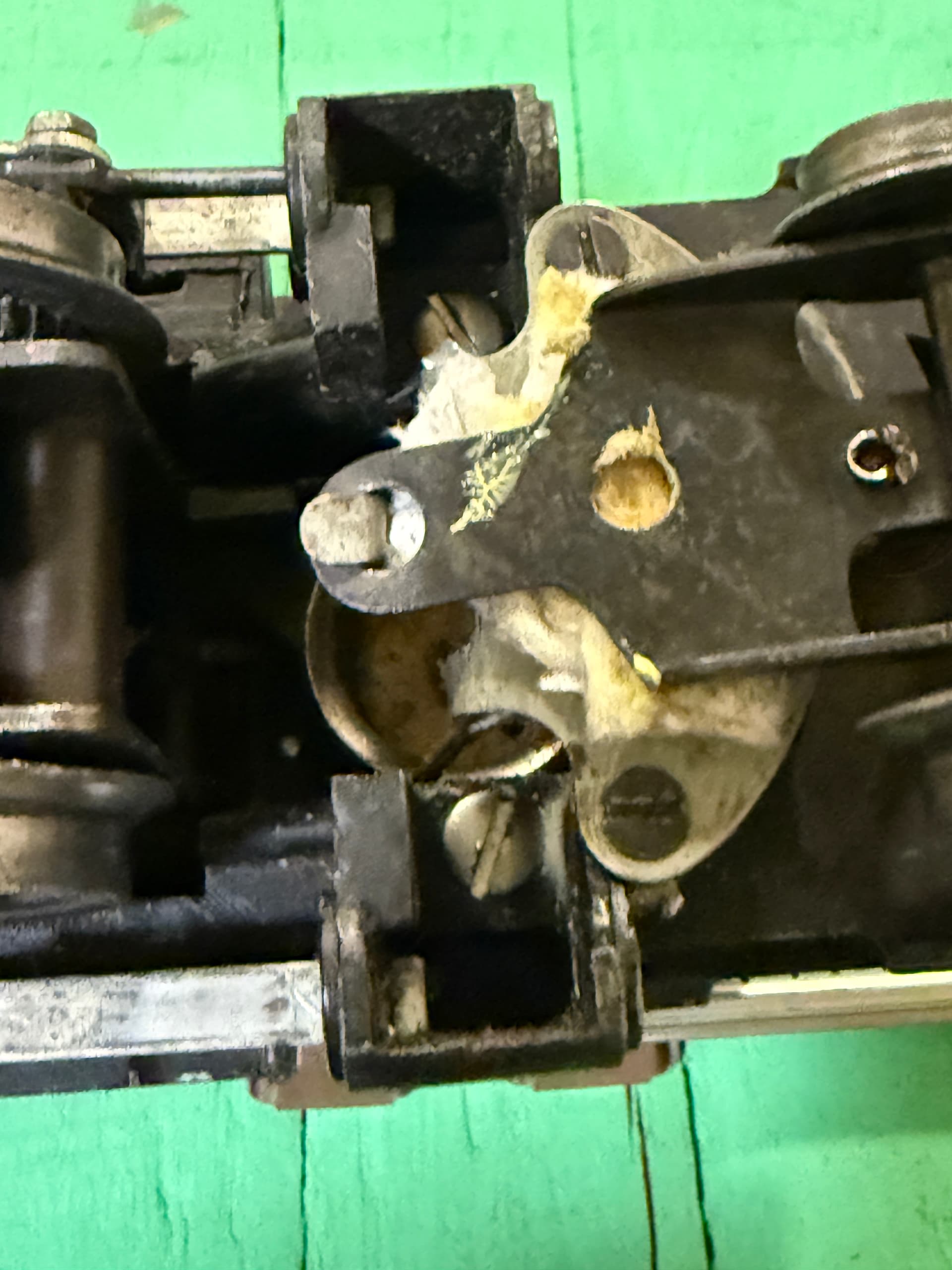
 The tissue still stuffed in the truck was the give away. The video of the train running over all the switches was too big to up load. On to the next engine repair. Who would you recommend for parts? I have one or more broken trucks etc., in need of replacement vs repair.