Is gauge 22 wire adequate for rewiring these that use #53 bulbs that are rated at 14.4v?
Most of the bulbs have about the same level of brightness at around 14 volts but two, which are not marked, as significantly dimmer even when switched to a different post or lit directly. Any idea as to what they may be? I’d guess they are rated at a higher than 14v.
I plan to power these with separate DC 1 amp wall wart transformer at either 9v or 12v. Is there any problem or consideration to be concerned with in doing that?
The replacement bulbs don’t fit. They seem too big because of the electrical foot center “blob” on the bottom of the bulb. Is this common? Is it safe to file it down a bit?
A couple of the R-91 springs are missing or deformed. Is there a do-it-yourself substitute?
Regarding your replacement bulbs: Are you using USA or Imported bulbs?
Many times imported bulbs have longer bases, and will not fit in tight quarters.
I was aware of a problem using imported #51 bulbs in postwar ZW transformers.
I would not be surprised to learn of a similar issue with #71 lamp posts.
You can try filing the contact. Worst case would be to ruin a bulb.
R-91 springs are common and inexpensive, so for me, it’s not worth the bother to try to find a substitue. Jeff Kane sells them for 12 cents each when you buy 25.
Twenty-two AWG is safe for about 4 amperes. Each lamp draws 120 milliamperes at 14.4 volts. Don’t try to run more than 8 lamps from a 1-ampere 14.4-volt source, 9 from a 1-ampere 12-volt source, or 10 from a 1-ampere 9-volt source.
The “blob” is just solder. You can file it if you want; or reheat it and shake some off; or shake it all off and reapply what you want.
Number 53 lamps are easy to find, at Radio Shack, for example.
Any bulbs from Radio Shack, or any other retailer for that matter, are going to be imports.
These bulbs may or may not have the long bases.
As I wrote earlier, appropriate USA bulbs, either #53 or #1445 are readily available from folks that cater to Toy train folks. They show up on Ebay, and are probably available through sellers from the big toy train organization swap sheets, such as TCA, LCCA, and TTOS.
I was just informed, by no less authority than “Joseph L. Mania and the CTT Staff” in the November, 2011, CTT, that “Many of the foreign-made bulbs do not have exactly the same base shape and size as the original General Electric blubs. Some are too short on the center contact side to touch the contact inside the bulb socket.” (My emphasis)
Gee, it was Ralph the Bulb Guy who pointed out the long base problem out to me. While I don’t doubt Mr. Mania’s word, I have yet to run across any bulbs that were too short.
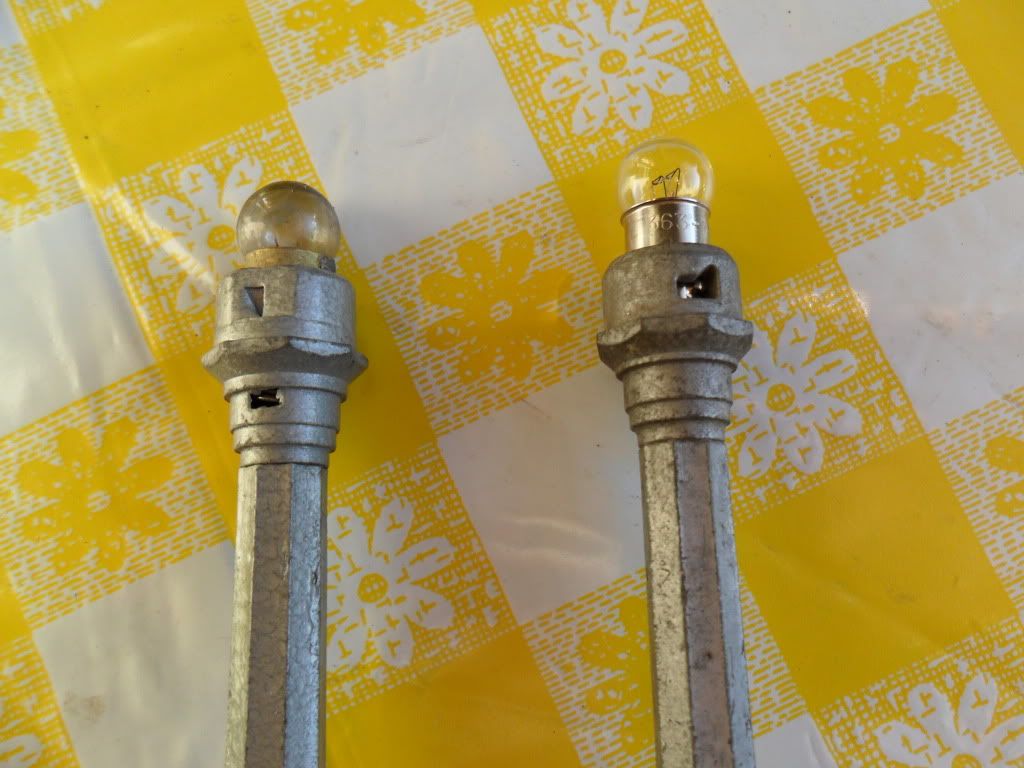
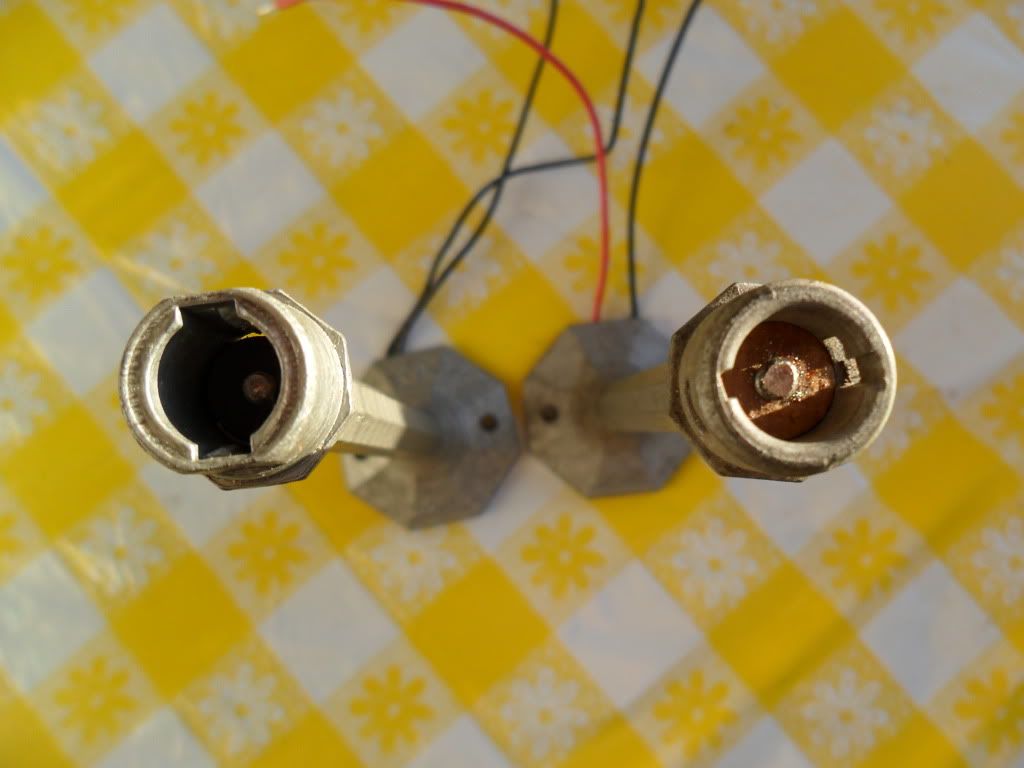
J D Lathbury had the R-91 springs so that part is covered. It is interesting that, while the sockets take the same bulb, they are of different construction. One require a left twist to insert the bulb while on the the other you twist right. The castings are different too. See the photos.
Is one approach an early model and the other more recent or what? Thanks
The Lamp Post No. 71 was available for 11 years from 1949 until 1959. It was made out of SILVER painted die-cast metal. The lamp globe was opaque plastic and concealed a No. 53 12 volt bayonet type bulb. It would light from either accessory voltage, or track current with the use of a CTC Lockon.
Lionel introduced this light in 1949 as a cost cutting measure when compared to the previously used No. 35. They replaced the screw in socket used on the No. 35 with a new one that took a bayonet mounted light bulb (No. L53) that were just coming on the market. To hold this lamp in place they needed to install a spring (Part No. R-91) in the socket. This insured that these lamps would not shake loose during shipment to their dealers. To offset the cost of this new socket spring the plug-in wiring receptacles in the base were illuminated to be replaced by wires. One wire was grounded to the base of the lamp and the other went up the stem to the lamp socket.
The casting was changed after initial assembly problems were uncovered. These changes are not significant enough to note variations. Dimensions: 1-1/4 inch base, 6 inches high.
The Lamp Post No. 71 was available for 11 years from 1949 until 1959. It was made out of SILVER painted die-cast metal. The lamp globe was opaque plastic and concealed a No. 53 12 volt bayonet type bulb. It would light from either accessory voltage, or track current with the use of a CTC Lockon.
Lionel introduced this light in 1949 as a cost cutting measure when compared to the previously used No. 35. They replaced the screw in socket used on the No. 35 with a new one that took a bayonet mounted light bulb (No. L53) that were just coming on the market. To hold this lamp in place they needed to install a spring (Part No. R-91) in the socket. This insured that these lamps would not shake loose during shipment to their dealers. To offset the cost of this new socket spring the plug-in wiring receptacles in the base were illuminated [eliminated?] to be replaced by wires. One wire was grounded to the base of the lamp and the other went up the stem to the lamp socket.
!http://www.tandem-associates.com/lionel/v10_spacer10.gif
The casting was changed after initial assembly problems were uncovered. These changes are not significant enough to note variations.