Lionel trains on DC power

Okay I have one more question for today. How feasible is it to operate modern K-Line and Lionel (1970’s to 1990’s MPC and LTI era) locomotives on DC power? I’m specifically talking about the locomotives with the single or dual can motors. Too be honest I have never liked the Lionel reversing (forward, neutral, reverse, neutral, forward) sequence system. I much prefer changing direction by changing polarity with a switch, like what is normal with analog HO and N scale trains.

How feasible would be it be to completely remove all of the electronic circuitry from K-Line and Lionel locomotives with can motors (mostly MPC and LTI era), and the early MTH PS1 era locomotives? And rewiring everything so it operates on DC current from a DC power pack?

I already know I would need to use the larger more powerful DC power packs meant for LGB and other G gauge trains, because some of those Lionel, K-Line, MTH, Williams, Weaver, etc locomotives can draw a lot of wattage.

Would it be feasible to remove all of the electronic circuits from those 1970’s to 1990’s locomotives with can motors, and rewiring them so they operate on plain DC current? And change the polarity from the DC power pack to change direction?

I ask because I want to build a switching layout on a budget, without going to TMCC, Legacy, DCS or DCC. I want to be able to control the direction myself (with a direction switch), and have smooth low speed control. I don’t want the locomotive reversing when it stops, or power gets interrupted. Yes I know many locomotives have a switch to lock the reversing system, but then it will only go in forward or reverse. I want to build a switching layout, perhaps even a point to point switching layout. And on a small budget, I would be getting the small Lionel and K-Line diesel locomotives, such as the K-Line S-2, MP-15, Alco FA and the RDC car. And the inexpensive DC only Lionel locomotives that Lionel made in the 1970’s and 1980’s. And the other Lionel locomotives with the can motors, but remove all of the electronic reversing and sound circuitry, and power them with DC current.

I could use the classic Lionel 1033, using the B-U posts (0-11 volts) for can motored equipped locomotives, along with a full wave bridge bridge rectifier to convert the AC to DC current. And using the A-U posts (5 to 16 volts) for the postwar Lionel and Marx locomotives I keep.

Or perhaps I can use a strong DC power pack, like they build for LGB and other G gauge trains. To power anything that I converted with a can motor (by removing all electronics inside), to run on plain old DC current.

As I understand it yes. It’s been done by people who had blown boards in their modern locomotives, they pulled the bad boards and ran the locomotives on DC power only. Needless to say you’d need an appropriate DC transformer. And changing polarity will change direction, just like on an HO or N Gauge locomotive.

1 Like

Why exclude the Lionel engines with the old style open frame 3 pole universal motors? They can run on DC track power as well. For those engines with a single wound field take out any electronics or mechanical E units and wire the field through a Bridge rectifier installed at the motor. This will allow a DPDT switch to control engine direction the same as those with DC motors. Some Lionel engines with universal motors have double wound fields. These are a bit more complicated but can be used on a conventional DC layout.
For clarification, no postwar engines used AC motors, only accessories that required a constant speed independent of voltage had AC (induction) motors.
The newer engines with can motors are more efficient and require less current to run than the older universal open frame motors. Incandescent light bulbs draw a lot of current, be sure to allow for that. 150ma/bulb is a good place to start for bulb usage.

1 Like

While feasible, I would not attempt what you are trying to do for various reasons.

  • With some exceptions, 3-rail trains were designed to run on DC. The internal circuit boards convert the raw AC to DC to power the electronics and in some case power Can motors.
  • AC Lionel trains will operate on DC however the horn and bell trigger off of DC so if you power the track with DC they will sound continuously and you will need to disconnect the speaker.
  • Most DC power supplies were designed to power HO and N trains with much less power demands. I have not seen a DC hobby supply with the wattage capabilities to meet the demands of postwar trains.

Overall I’m not in agreement with the problem and solution you are attempting to solve with this drastic surgery. Yes you can revisit 1960s tech but the advantages of TMCC control and sound far exceed all the bother to electrically destroy your trains. If the cost of the modern base units are prohibitive, look for gently used TMCC base and control units on eBay.

1 Like

Do I remember correctly that some K Line sets were sold with DC power packs and loco wiring. In the 80’s?, early 90’s?

Sheldon

Thank you everyone that has responded to my questions. I really appreciate all of your suggestions and your experiences. It gives me more to think about.

1 Like

It’s possible but I’m not aware of any. As far as I know K-Line was always interested in the three rail O Gauge market so straight DC products wouldn’t make much sense. K-Line engines did have DC motors but had AC to DC rectifiers for the same.
Here’s the K-Line story for those interested:

The article makes a brief mention of K-Line G Gauge which would have operated on straight DC but honestly I’ve never seen any K-Line G Gauge products (or S Gauge for that matter) anywhere. Of course I haven’t been looking!

Lionel cataloged DC sets as you describe - 3 rail DC to the track - from 1973 to 1991.

1 Like

Very simple. Disconnect the reverse units/boards from the collectors and chassis(2 wires) and motors(2 wires). Don’t rip anything out.

Wire the two motor leads one each to the center rail collector, and chassis. Done.

1 Like

I will just reply to all of the suggestions and advice from everyone together here. I have been doing a lot of reading and research, and thinking about different things. I’m doing this hobby on a tight budget, and I’m restricted in the amount of space I have available. I’m keeping to the low end budget locomotives, freight cars and track systems. Basically speaking the low cost O27 locomotives and freight cars, and O27 type track. I’m just using plain old analog control, not any TMCC, Legacy, DCS or DCC controls.

A few of the locomotives I purchase will be postwar Marx locomotives, and the low end Lionel O27 postwar locomotives. But most of my collection will be the low end K-Line locomotives, and the low end Lionel locomotives from the MPC and LTI eras, with the can motors. I expect the majority of my locomotives will have the can motors, not the open frame universal motors.

I’m thinking about getting a couple postwar 90 watt Lionel 1033 transformers.

I actually want to use the Lionel DC only locomotives, and the various Lionel and K-Line locomotives which have one or two can motors, and the electronic reversing units. Specifically the diesels with the can motors entirely within the trucks. And the little Lionel starter set steam locomotives, such as 0-4-0, 2-4-0, and 4-4-0 locomotives. And the Lionel Industrial Switcher, which came in both DC only, and AC versions (can motor with electronic e-unit).

Most postwar period transformers start off with a minimal 6-7 volts to the track, which will make these small locomotives with the can motors operate with jack-rabbit starts. The Lionel 1033 transformer has a dual setting for voltage to the track. The B-U posts put 0-11 volts to the track, which is more appropriate for those can motored locomotives. When running a loco that needs more power (especially postwar Lionel), I can switch to the A-U posts for 5-16 volts.

When I want to operate my trains on DC current, I could build a box with a DPDT switch (for reversing direction), a full wave bridge rectifier, wired to the B-U posts of the Lionel 1033 transformer. And some vents in the box, and a fan to keep the rectifier cool. Of course when connected like this, I will loose the neutral position, but that is okay with me.

The A-U posts would not go through the little box (with the full wave bridge rectifier), so that A-U connection will continue to provide 5-16 volts AC current, for all locomotives with the open frame motor, and traditional type reversing unit. Such as Marx, postwar Lionel, and the MPC Lionel with the tradtional Pullmor motors.

I know I can operate traditional locomotives with the open frame motor and traditional e-unit on DC or AC current. And operate locomotives with the can motors and electronic reversing units on DC or AC power.

Anything with a can motor (without electronic reversing circuitry) naturally needs to be run with DC power. And any locomotives with a blown circuit board (which have can motors) can be run on the DC current from the Lionel 1033 and full wave bridge rectifier.

Using this method and Lionel 1033 transformer (and full wave bridge rectifier connected ONLY on the B-U posts), I can operate just about any O gauge locomotive available. It doesn’t matter if it’s postwar or modern, has a traditional open frame motor or can motors. Anything that has a traditional universal open frame motor, will use the 5-16 AC current from the A-U posts. Anything that needs DC current, can be run on the 0-11 volts DC current on the B-U posts (and full wave bridge rectifier).

I would also replace the majority of the old light bulbs in the trains, with more energy efficient light bulbs. Especially when I’m operating on the DC power at 0-11 volts, I would be using lower voltage light bulbs in those locomotives, lighted cabooses, and lighted passenger cars, etc. I don’t need the typical 14-18 volt bulbs common in most Lionel type trains. I can get buy with 12 volt bulbs, or even a little less. Because I expect to be operating the majority of my locomotives on the 0-11 volts from the B-U posts on the Lionel 1033 postwar transformer. And I doubt I will be running my trains at full speed very much. I want to operate my trains at slow realistic speeds, like real freight trains, and do lot’s of switching maneuvers at various industries on a layout.

Which means the 90 watt Lionel 1033 will be plenty good enough for my needs, for slow speed smooth control, using the low end K-Line and Lionel locomotives equipped with can motors. And especially because I will be replacing all of the 14-18 volt bulbs with 6 to 12 volt bulbs. The majority of my switches (turnouts) will be manually operated, no light bulbs needed. I will only use electric powered switches (turnouts) where it’s hard to reach.

And nothing else will be powered by the Lionel 1033 transformers. No powered accessories. They will get their own dedicated transformers or power supplies. Even the electric powered switches (turnouts) would be rewired so it’s getting electricity from it’s own separate transformer, not track power. The only thing powered by the Lionel 1033 transformers, will be the trains themselves.

I actually intend to completely remove all of the electronic circuitry (reversing units, sound, smoke units, etc) from those low end budget locomotives (with can motors), and operate them on straight DC power. I want quieter operation, no buzzing, slow and smooth speed control, lower current draw, etc. Many of those low end locomotives are dirt cheap, very few are collectible. Few people want the DC only locomotives Lionel made in the MPC and LTI era. That’s fine with me, they are extremely budget friendly.

I would remove all of the electronics, sound and smoke units, and convert them to run on DC current. I will have plenty of room inside to add some extra weight. I would also try to reduce or eliminate the rubber traction tires. It’s crucial on the Lionel 4 wheel Industrial switcher, to have 4 metal wheels, so it doesn’t stall as much on switches or crossings.

Honestly I got many of these ideas from reading the many posts from the member “brianel027”. He ran these types of cheap locomotives on DC current, with a Lionel 1033 transformer, and a full wave bridge rectifier to convert AC to DC power. I have to give him the credit. I’m just interested in coping his ideas for myself.
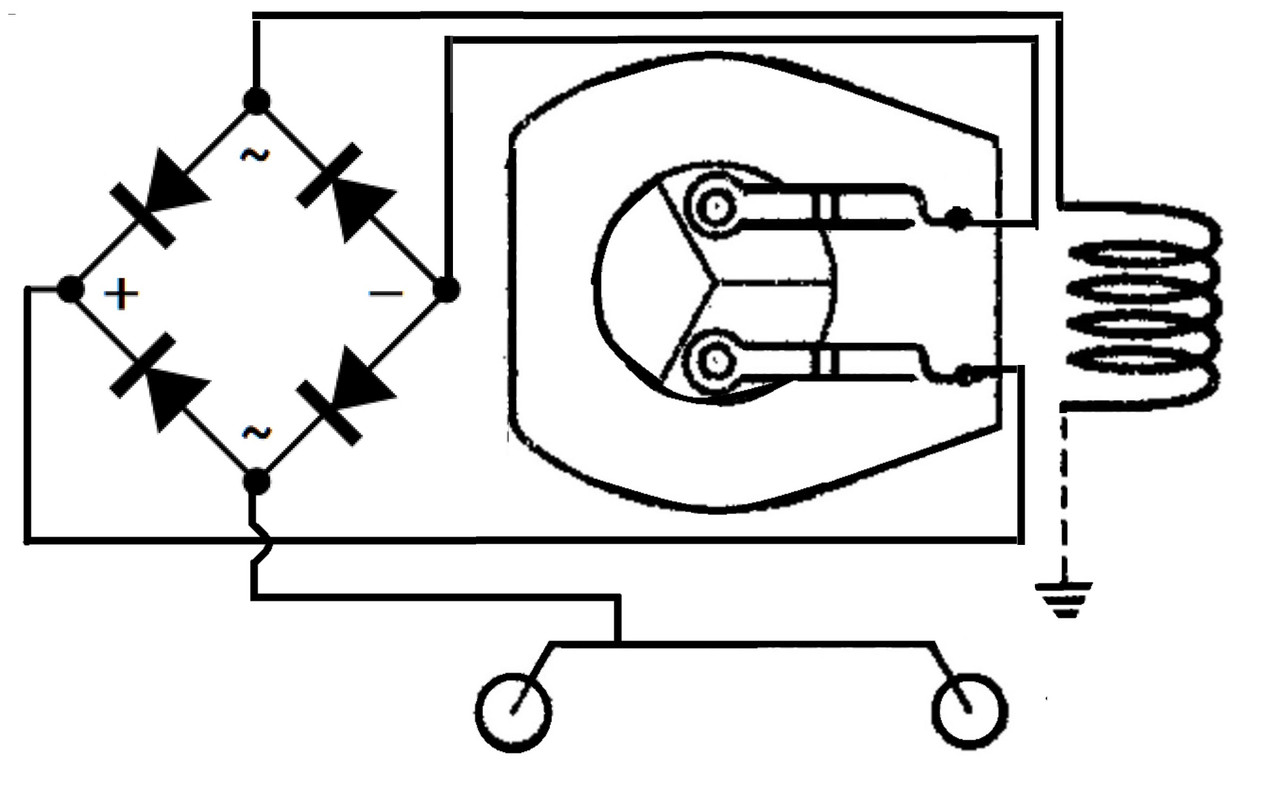
A couple of thoughts. If you plan to run DC track power using an AC transformer what you need are 10A/50V bridge rectifiers. One for each transformer output.They sell for about $33 for a package of 10. They will not need any supplemental cooling.
When I ran my layouts on DC I used center off DPDT switches so I had the option of no power to each block in addition to FWD and REV.
I think you might be going the wrong direction on the bulb selection. Transformers are rated in Watts, but they care about Amperage. The transformer has a breaker in the output that is likely around 8A, some transformers will be higher, some lower. The breaker will trip at its rated current regardless of the wattage drawn. In my passenger cars with incandescent lights I use 24V bulbs with 14V track voltage. The brightness is more prototypical, the bulbs run much cooler and the current draw at 14V is much lower for the 24V bulb than the 14V bulb of the same lumen rating. The reverse is true for lower voltage bulbs. For the same lumen output rating, a 12V bulb draws about 30% more current than the 18V bulb uses. That is because watts is Amperage times Voltage, so if the voltage is 30% less then the amperage is 30% higher to have the same wattage (lumen) rating. Incandescent bulbs are non-linear so this is an approximation, not an exact solution. The better alternative is to put in replacement LED’s. There are screw base or bayonet base direct replacement LED bulbs for all the Lionel incandescent bulbs.In quantity for the passenger cars they are under $1.25/bulb.

1 Like

They are about 1/3 that amount… $11.24 for 10 pieces.

Thank you for the information and your advice AmFlyerTom, I really appreciate it. Yes I would be using a large enough bridge rectifier, such as the 10A/50V like you suggested. And yes that sounds like a good idea, to use center off DPDT switches like you did, so I can turn off power to each block. In addition to the forward and reverse.

And thank you for the information about the bulb selection.

I left out that the one place to use 12V bulbs would be in the locomotive headlight. We usually want that to be bright.

Very true, those 12V bulbs work good as headlights.

When my 6 MTH ProtoSound 2 locomotives “lost their minds” due to battery problems and an incompatible power supply, I removed the circuit boards and wired the motor directly to the pickups. And I’m really bad at soldering so if I could accomplish it anybody can. They ran beautifully but I ended up selling five of them when I moved to a smaller place.

I recommend staying away from MRC power supplies designed for HO trains. I bought an AristoCraft G Scale power pack and it runs my 3 DC locomotives perfectly (1 MTH and 2 Lionel MPC).

I would have done that myself, I would have removed the problem circuit boards and wired the motor directly to the pickups. Usually far fewer problems that way.

And I agree with you, the AristoCraft power packs meant for G scale have a lot more wattage and amperage, compared to the MRC power packs designed for N and HO scales.

Back in the dark ages (1970s) I did that to a couple of Lionel and early Williams engines, using the “Fricko Converto”. Very simple.

If you want to go a bit more hi-tech, you can replace the insides with a Blunami and get sound along with light and motion control.

2 Likes

If reliable slow speed operation is the goal, even if you want low-tech in the locomotives, I’d suggest it VERY beneficial to use a good quality DC pack that offers PWM at least at some throttle settings. Packs meant for 2 rail O scale or G gauge will be where you want to go with this.

Many of the locos being talked about here have tiny motors that have something like a 6:1 gear ratio. This is why they basically jump from stop to warp speed with not much in between.

Low voltage by itself isn’t a solution, as the motors often will cog and otherwise run poorly if you attempt to run them at low voltage. PWM isn’t a perfect cure, but it at least cuts some of the cogging at when you try to run at slow speeds…

1 Like