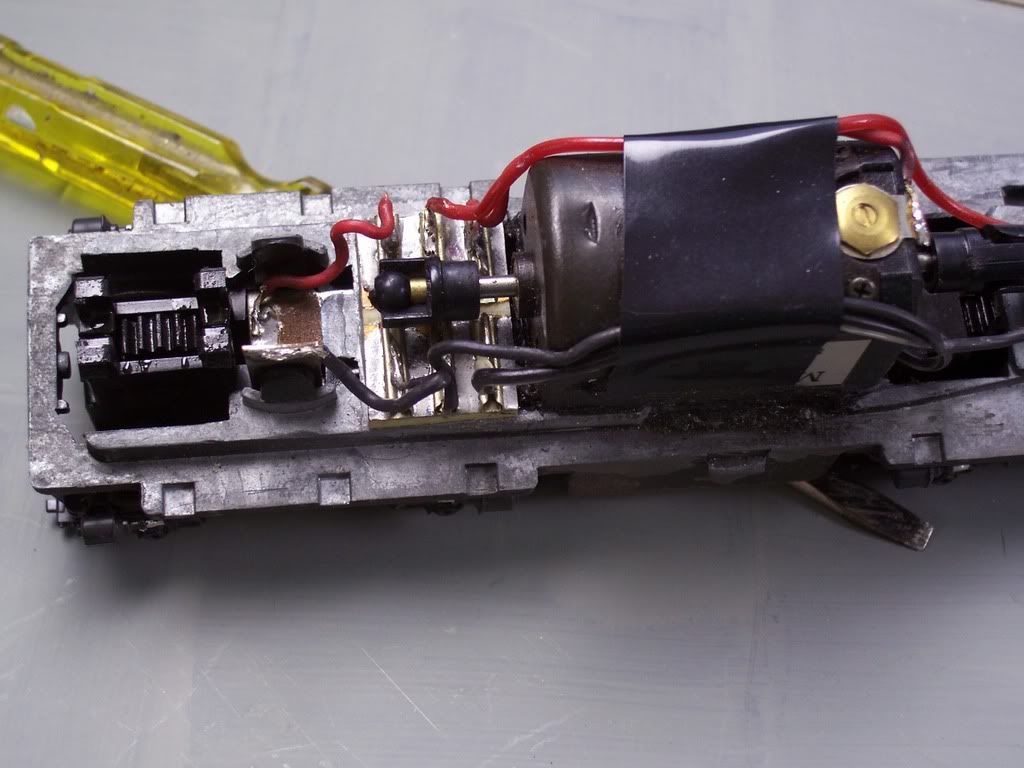
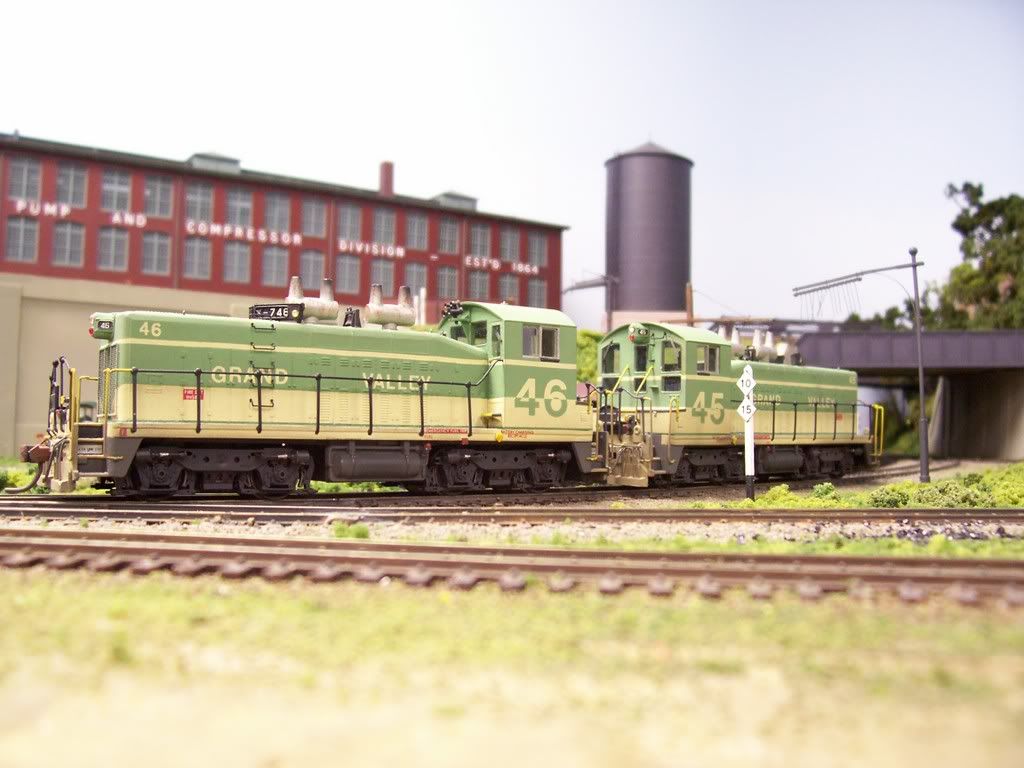
I have an Athearn BB SW7 which stalls in places where it should not stall. If I just gently push down on the locomotive, it will start up and resume it’s route. I have been thinking that this lack of track contact is due to the locomotive being too light. So, I placed it on my postal scale and it weighs in at 7 ounces. All of my road switchers and six axle units weigh in at about 18 ounces. I looked up on the NMRA website for locomotive weight standards, but they have none. Seems to me that a switcher such as the one I have should weigh at least 8 ounces.
I haven’t given it a comprehensive, good cleaning (yet), but I did replace the metal connector clip with a wire. I was thinking that the removal of that clip was enough to make it too light for consistent contact. I’ll try cleaning it up good, see how it performs after that.
How old is the SW7? Does it have metal or plastic sideframes on the trucks?
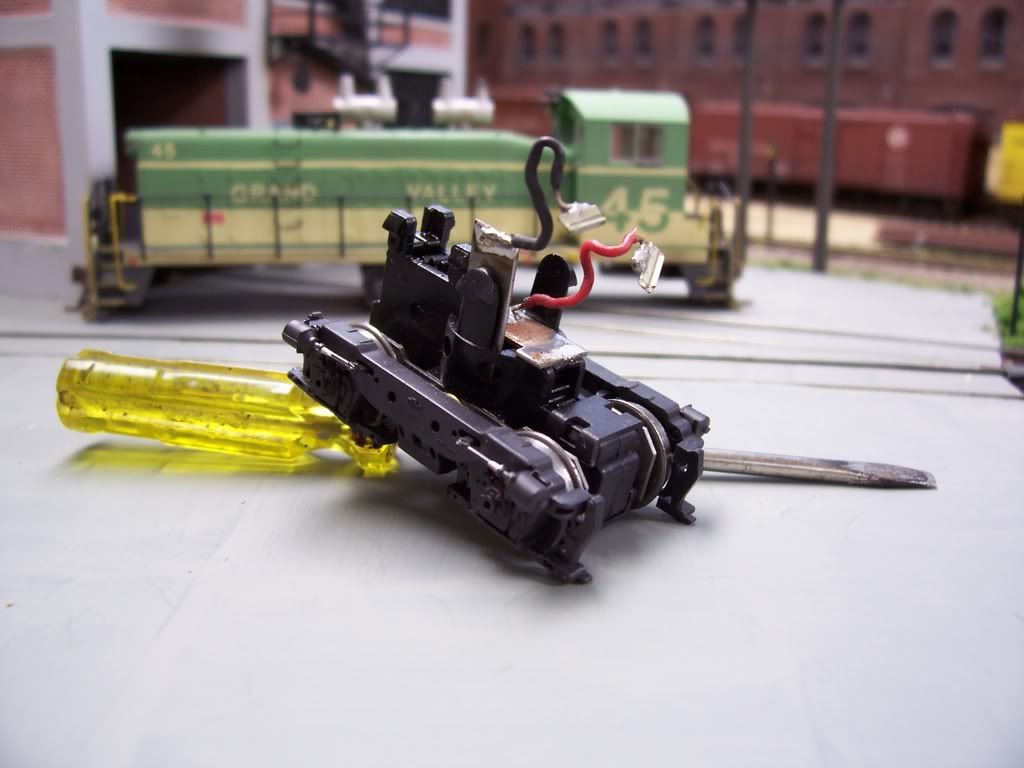
I ask as I used one of the early ones (with metal sideframes) as the basis for one of my On30 loco conversions. Recently, I ironed out some bugs in the power pickup system which have symptoms similar to what you’ve described. If it is one of the early ones, I can walk you through what I did.
Listen to Simon! Simon Says…replace the wheelsets with NWSL items. Inexpensive and a huge improvement in traction and electrical contact. It also wouldn’t hurt to add weight to the engine as they are particularly light engines. Possibly a good cleaning of everything mechanical might help…couldn’t hurt!
Sounds like a pick-up problem to me, too…most likely the one that passes from the centre of the truck through the bolster on the loco’s frame.
I hardwired all of mine through all four contact points, and never had a problem with them stalling anywhere…
My locomotives were originally equipped with the cast metal AAR sideframes with outside bearings, but I replaced those with cast metal Flexicoil sideframes from Juneco. Those, in conjunction with interior weights, gave an over-all weight of 11.5oz. All four had the original motors and flywheels replaced with Mashima can motors, with no flywheels.
When Athearn released the much better-detailed plastic Flexicoil sideframes on their inside bearing trucks, I re-equipped all four locos, and the weight dropped to 10.2oz. [banghead][:P]
Since my layout is mostly curves and heavy grades, I added additional interior weight, bringing each unit up to 12.5oz. These locomotives, still equipped with their original wheels, then became great pullers and very reliable electrically, with never a need to clean the wheels.
In general, the more weight you can fit into a diesel, the better it will pull. It’s more or less the same for steam locomotives, with the added qualifier that the total weight of the locomotive-only should be balanced at the mid-point of the driver wheelbase.
No, mine is a newer release, with the plastic sideframes. I haven’t been “under the hood” on this locomotive in a long time, so it may be mucked up wi all kinds of crud, so I’ll see if that works. I cleaned the wheels on it last fall (it hasn’t been run much since then, as I moved and had nothing to run it on up til now). But, I don’t think my wheel cleaning job was a very good one, so that needs to be addressed too.
Points all well taken Wayne. Although the motor in this loco runs fine, I have, at times, considered remotoring it. I don’t think the motor is the root cause here, however. Having said that, like you, I do think there is a contact problem and the improvement of the contacts from the trucks through the bolsters is a very good suggestion. Also, in light of what you said about weight, I will, for sure, add about 4 ounces to the frame.
Marlon, it is stalling in multiple places, including on turnouts, but not all turnouts, and, yes, I also need to clean the track, although all of the other locomotives that I have tested (and I have tested all but a few of the some 35 locos that I own), do not stall anywhere. I believe this is a problem unique to this locomotive.
BTW, I also have a LL P2K SW9, which weighs in at about 8.5 ounces compared to the 7 ounces that my BB SW7 weighs in at. That loco has no stalling problems.
More is better in the locomotive weight department. HO model locomotives have enough motor power to spin the drivers, and so tractive effort is coefficient of friction time weight on drivers. Coefficient of friction for metal on metal is about 0.20. Rubber traction tires raise the coefficent of friction to 0.75 or so. More weight on drivers, more tractive effort. Diesels with all wheels powered make weight on drivers the same as total locomotive weight. Steamers with pilot and trailing wheels and locomotives with only one truck powered have less than full locomotive weight on drivers.
At any rate, more weight gives more tractive effort. Pack in all the lead that will fit.
That can be a problem. For the SW1200, perhaps some sheet lead fit into the top of the engine hood. Might work if you don’t have a DCC receiver stuck up there. Or to the sides of the engine hood. Perhaps a sheet or two bonded to the cab roof with silicone bathtub caulk. Underneath the front and rear platforms. Underneath the walkways? Underneath the drive shafts under the engine hood?
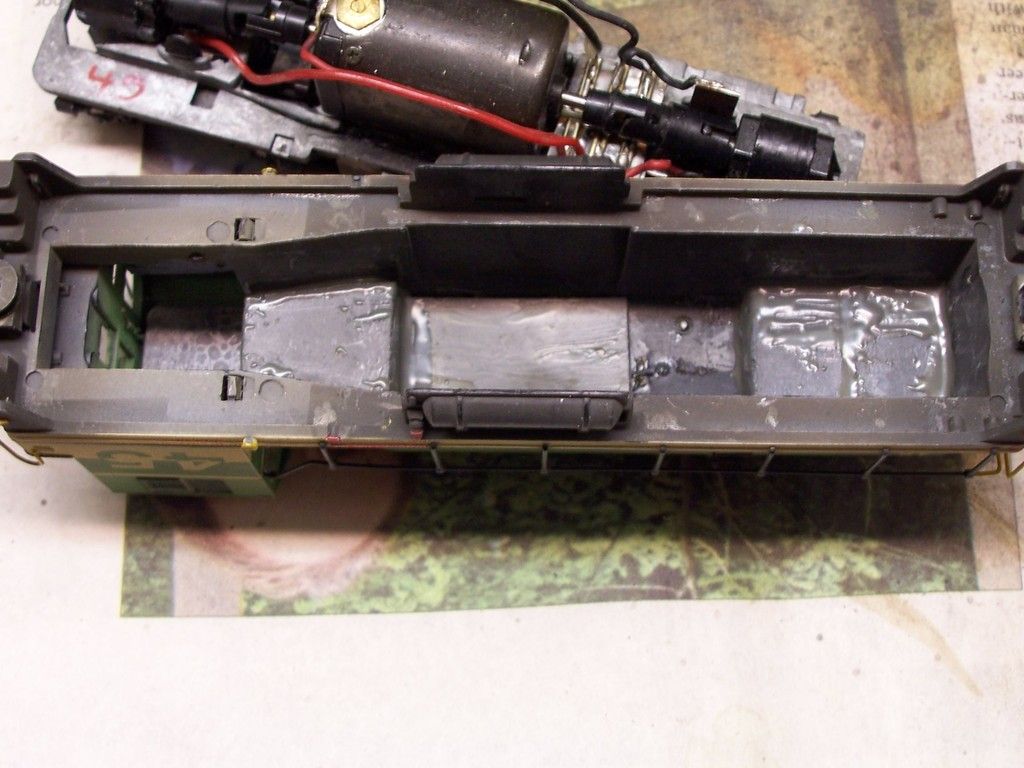
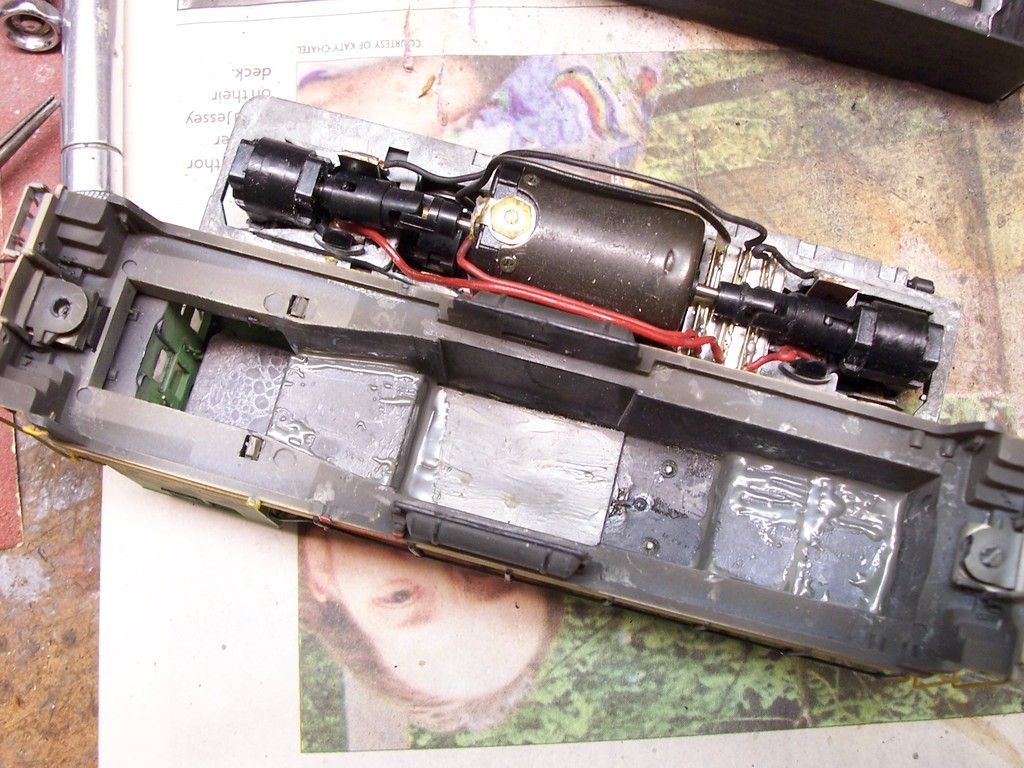
Here’s a look inside one of the SW1200RS locomotives shown earlier…
That’s two blocks of lead at the front of the hood, then some sheet lead over the area of the motor, another custom-cast block of lead where the hood tapers, and another block affixed to the inside of the cab roof.
This view inside the cab shows one of the two blocks of lead which fill the areas inside the cab below window level…
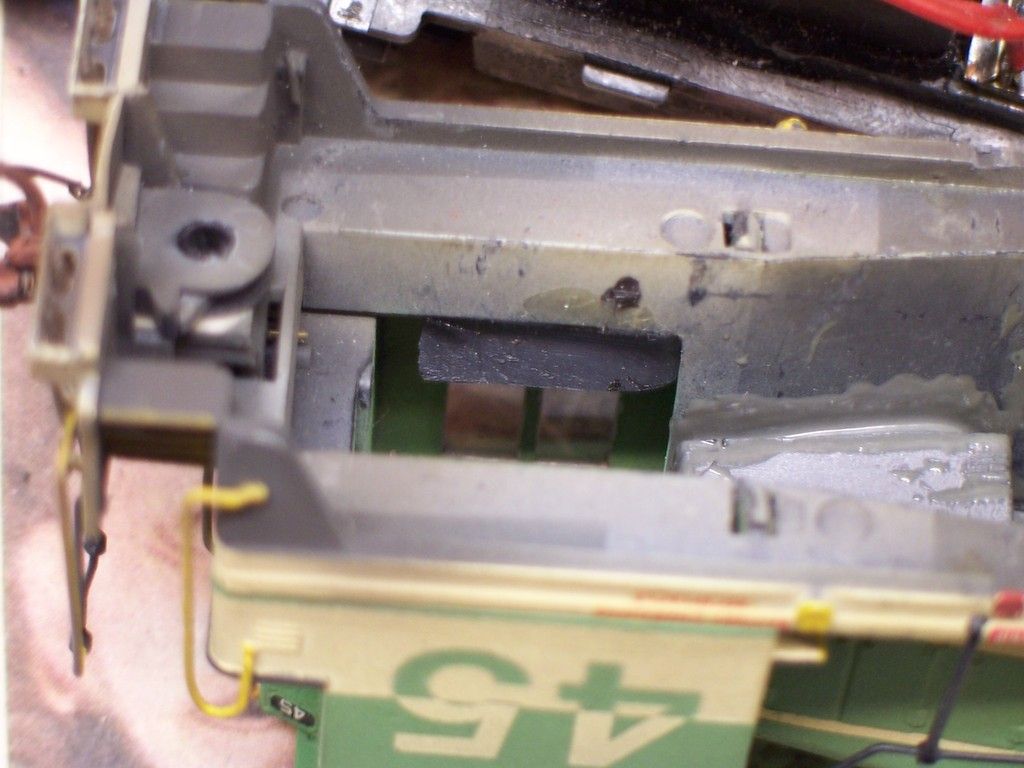
This view of the body shell alongside of the frame shows that there’s room for more weight between the two blocks at the front of the hood and the sheet lead over the motor.
I had omitted it because I didn’t want to have to slice off those nubs poking through the top of the hood (mounting pegs for the number boards and bell). If I still had the other three units that go with this one, I would definitely add more weight there.
I’d also cast weights to fit into the areas beneath the walkway steps - those alone would probably add another 3 or four ounces, plus perhaps 2 ounces for the missing one within the hood.
As I mentioned in my earlier post, the final versions of those four locomotives each weighed 12.5oz.
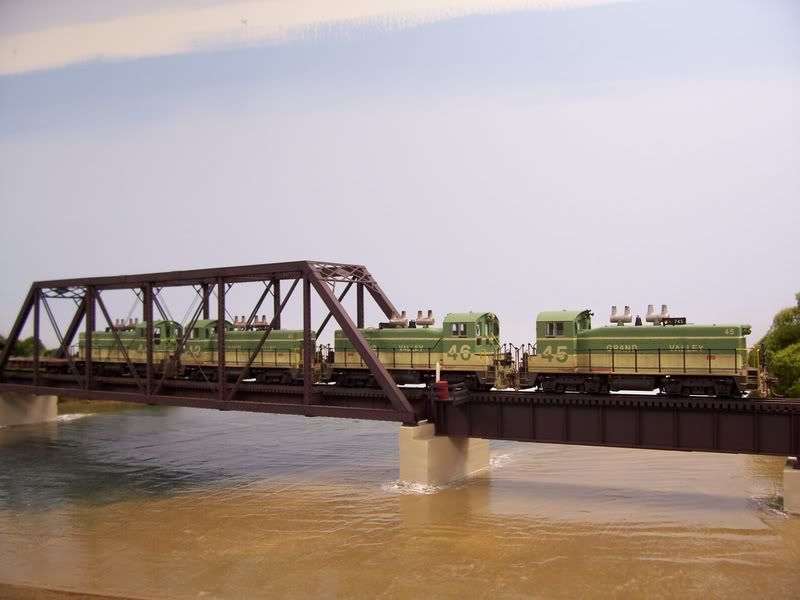
Here’s all four of them on the Maitland River Bridge…
That flatcar trailing is followed by another 70 cars, and while the train is on a slight downgrade here, the same train made it up a 45’ long 3.5% grade, which featured two horseshoe-type curves (in opposite directions) separated by 7’ of the only straight track on that grade. The top of the grade is a series of S-bends.
I’m pretty sure that those four locos could have handled even more cars, as I was able to run the same train on the same grade using four Bachmann Consolidations and again using four Athearn Mikados, neither of which singly were the equal of one of the switchers.
I also ran the same train using four of the three loco types mentioned in various combinations, and placed in various locations within the train - head-end, pushers, and mid-train helpers.
Of the locomotives which I tested, these were probably the strongest…
…although the test was somewhat different and the results not conclusive because I ran out of cars for the test.
I used a different section of track, also on a 3.5% grade, but the grade was only 16.5’ long. Most of it was an S-bend.
One loco could pull most of the 45 car train, which was just over 18’ long, but couldn’t quite make it to the top of the grade. When a second, similar locomotive was added, the train moved easily up the entire grade. Unfortunately, I had no more test cars (mostly two-bay hoppers with live loads, although there were several larger hoppers included. Total trailing weight was a little over 22lbs.
Whatever your contact problem is, it’s not weight. I have an Overland NW5 that barely weighs eight ounces and it runs beautifully.
Also, I must confess I am not a member of the “more weight is better” club. I have more locomotives than I can use already; I’d rather add an engine as needed.