i want info about logging operations, how logs are handled, how sawmills are run, etc. i have The Model Railroader’s Guide to Logging Railroads by Matt Coleman, a very useful book but more about the equipment than the ops. thanks
A lot depends on the era and the locale, for example eastern logging operation might have not only a sawmill, but a turpentine works, a tannery, a spool/dowel/clothespin mill associated with teh logging operations.
You could try searching Google Books for full view books on logging railroads or logging operations. Most of the full vierw books will be pre-WW1.
So, let’s follow a log from standing on what will shortly be a stump to departing on the connecting Class 1:
- Topped by a special crew, to get rid of the crown of branches.
- Cut - dropped in the direction that’s least likely to damage the log.
- High-lined from the cutting side to the loadout.
- Placed on a suitable car (pair of disconnects*, skeleton flat or ordinary floored flatcar) by a crane - often a boom on the spar tree.
- Coupled into a train, which then runs down the logging railway to (usually) a sawmill at the end.
- Dumped into the pond, or dry-yarded if there is no pond.
- Processed into everything from poles, pilings and construction timber to matchsticks.
- Loaded aboard appropriate cars (provided by the Class 1, suitable for interchange service.) and shipped out. In some cases, raw logs with the bark still on will also be shipped to sawmills elsewhere.
In addition to running empties into the woods and loads out, the railroad had to haul everything needed for the operation - people, food, building materials (for everything from privies to bridges) and fuel (both liquid and solid.) Potable water also had to be delivered to the camps. Frequently this was handled in home-builds that would cause a Class 1 carknocker to faint in disbelief.
Also - loggers ran cabeese, often of equally wierd and wonderful design.
As for operation from the point of view of the DS or GM, a lot depended on the size and kind of operation. If the line ran seventy miles into a roadless forest, with several operating sides served by branchlines and several trains on the road at once, it would be very similar to operating a similar shortline carrying coal, corn or canned goods. If it was running one Shay on a frayed shoestring it would be very similar to a present-day `Three men and a dog,’ micro-shortline.
- Disconnects, basically trucks with log bunks and couplers, w
As noted, where and when you’re looking at make a big difference. Here in Minnesota, as with much of the Great Lakes region, logging in the great days of the big pine forests was usually only carried out in winter. The trees were in swampy areas, and the ground wasn’t hard enough to get the logs out until it froze up. Also the flying / biting insects were too severe to allow working there in hot weather.
The sawmill could be tens or even hundreds of miles away. Logging railroads generally used rod engines (2-6-0s were the most common) because the railroad might need to haul the logs 30-40 miles to a spot where the logs could be interchanged with a larger railroad so they could be transported to the cities where the sawmills were. (Sometimes the logging railroads unloaded the logs in a river or in Lake Superior to be floated to the sawmills.) Geared engines would go too slow for this, and generally the terrain was flat enough that rod engines could do the job.
Here’s the DOG on my logger caboose.
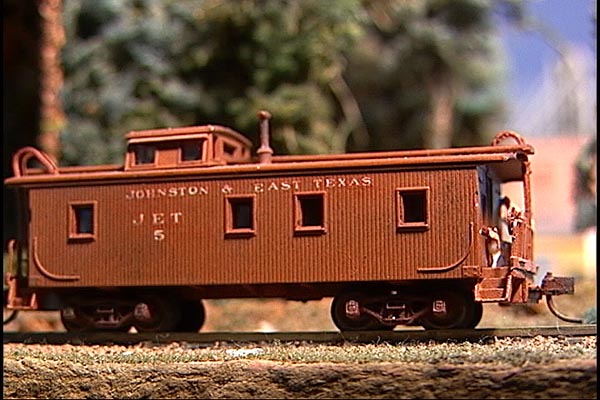
A lot of the Eastern operations dry yarded the logs instead of using a log pond.
A lot of the Eastern operations had veneer mills, cut mining timber and railroad ties.
Some mills sold cut fire wood “slabs” .
Saw dust could be shipped to a mulch manufacturer.
Some Eastern operations had a pulp wood yard as well.
Very little goes to waste at a saw mill.
While living in Kentucky I soon learn you don’t saw logs at a mill…You cut them.The logs are also stored by tree type in the log yard…
I agree with Dave (dehusman) and other notations about the differences around the country. I have dozens of books on logging and logging railroads, but if we had some sense of what part of the country is of interest, it would be helpful in making recommendations. For example, if the “AZ” in “azlogger” is for Arizona, then the book Central Arizona Railroad by Thomas Schuppert (Golden West Books, 1993) might be high on the list.
Bill
Another title - should be very useful on the “operations” aspect. This one is a reprint of a book from the 1940’s or so, written by a forestry professor:
Lumber: Manufacture, Conditionina, Grading, Distribution and Use by Nelson Brown
Still available from booksellers such as Ron’s books.
Bill
Sorry i didn’t say where. Shoulda thought of that. Northern California. Is there plenty of Douglas fir in Oregon? If so, i’ll move up there. A couple of you said “dry-yarded”, how’s that done? also, i understand trees are delimbed before they are cut?
“Dry-yarding” simply means that the logs are unloaded and stacked on land, rather than dumped into a pond. Which is done depends on local geography more than anything else. Two sawmill complexes a few miles apart were served by the Sierra RR. Each had its own rails into the woods. One, at Tuolumne, had a pond. The other, at Standard, had (and still has) a dry yard. At Standard, the stream runs in a narrow ravine unsuitable for development into a log pond. It’s also easier to choose and move logs on dry land, no boats or acrobats with peavies required.
Really tall, mature coniferous trees (including Douglas Fir) have long, limbless trunks topped by a crown of greenery. Think Christmas tree on top of a short telephone pole, then multiply by four. Those trees will be “topped,” which removes all of the small growth and reduces the possibility of damaging the main log when it’s cut.
Second-growth trees with limbs lower on the trunk will be dropped whole, then de-limbed once they’re on the ground. However, during the heyday of railroad logging, most trees were mature.
Chuck (Modeling Central Japan in September, 1964 - cutting second-growth cedar)
Okay, Northern California it is. As to “process”, recommended would be the Lumber book mentioned earlier:
Lumber: Manufacture, Conditioning, Grading, Distribution and Use by Nelson Brown
The books below are primarily “railroad” books which will focus on equipment. Still, the photos and maps can reveal plenty of detail about the nature and order of the process. The first two on the list are highly recommended.
Mallets on the Mendocino Coast: Caspar Lumber Co. by Ted Wurm (Trans-Anglo Books, 1986) Locomotives from dinkies through shays to large articulateds. An operation that offers many modeling possibilities.
Pino Grande: Logging Railroads of the Michigan-California Lumber Co. by R. S. Polkinghorn. (Howell-North, 1966, but I think this one has been recently re-released). This line featured a cableway to carry loaded log cars across a ravine - 2800 feet worth!
Matches, Flumes and Rails by Kent Stephens. (Trans-Anglo Books, 1977) Amazing that an entire logging operation would be built around making wooden matchsticks (Diamond Match Co,)!
And also of interest may be any of the books by Hank Johnston: Thunder in the Mountains; Rails to the Minarets; They Felled the Redwoods; and Railroads of the Yosemite Valley.
While some are out of print, they should be available through inter-library loan.
Bill
Douglas fir is Oregon’s state tree. It is the predominant forest tree in Washington and Oregon, though there is also hemlock, Sitka spruce and, in the eastern parts of both states, Ponderosa pine. In western Oregon and Washington the forests are extremely dense due to the maritime climate’s heavy rainfall. These trees can be enormous and a flatcar might be able to hold only three or four logs.
Logging railroads in this region had to cope with steep (VERY steep) mountain grades and difficult weather, including heavy mountain snow.
I understand what dry-yarded means, but how is it done? Thanks for the book suggestions!
I was the log yard supervisor for a medium-sized mill in western Montana for over a decade. Part of the job was to watch the logs going thru the mill to note defects, and in doing so i got an intimate familiarity with workings of the mill, kiln, and planer. I also worked several years as a forester for a private land owner. I pretty much know the entire operation from stumpage (standing timber) to finished product, including all by-products. If you need more info you can contact me at stanford.flat@yahoo.com I’ll be more than happy with to help with anything I can.
Railroad Logging in the Klamath Country by Jack Bowden discusses logging train operations in Northern California and Central Oregon. That book is available from Amazon. It has maps and photos that give a good idea of the rail operations.
There’s a five episode silent video series on YouTube from the Washington State Archives about the Schafer Brothers logging operations ca. 1926. It might help answer your questions because the entire logging operation is shown, from the early survey crew all the way through sawmill operations.
http://www.youtube.com/watch?v=BcHO2UzJr7w&feature=relmfu
There’s a free download called You-Tube Downloader that can be used to save these files to your computer’s hard drive.