I installed a LokSound 5 Micro decoder into an N scale, Atlas GP-40 Silver series with a built in speaker. It was a drop-in install; no soldering. It ran fine on my home layout. But, I put it on our club layout, and it immediately smoked and fried to the extent that it melted the top of the loco shell. I pulled the decoder out and put the original analog board back in, and it ran fine. So, I am not sure what happened and if it is a warranty problem that LokSound will cover. The loco and decoder are brand new. Any advice is appreciated.
1 Like
Could it have been a short (like a derailment in a turnout, etc.) that went undetected and did not trip a circuit breaker? I would definitely call ESU, especially since it was a 21 pin drop in that required no wiring by you and the motherboard is still good.
Regards, Chris
1 Like
Do you know if the club layout using a higher voltage? I tried using what was listed as an “N-HO decoder” in a small HO engine. It ran fine on my little circle of test track, using 12 volts, but regularly stalled out from overheating on my regular system, which is 15 volts.
ESU gives a 24-month warranty (see the last pages of their manual), so I would try to contact them.
1 Like
It could have been a short on the section of track I was using. It fried as I was putting it on the track.
1 Like
I will contact ESU. They have been on vacation until September.
1 Like
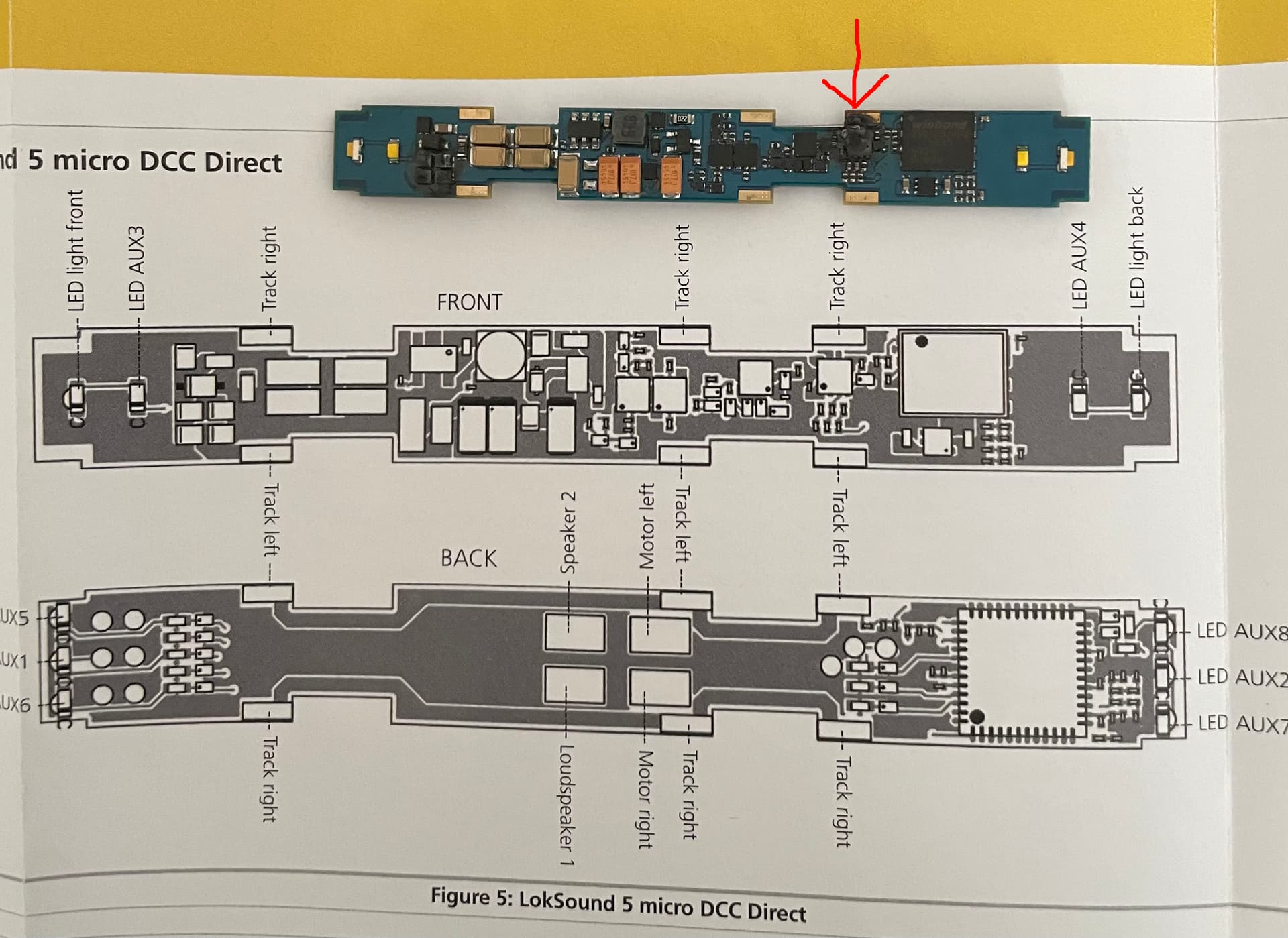
If it were a short, I’d think circuit breakers would trip. Do you have a picture of both sides of the deflicted decoder, and the socket it was installed in?
If this were DC, there shouldn’t have been substantial, if any voltage applied to a track where you’re placing a locomotive.
1 Like
The place it fried is indicated by the arrow. I suppose it could have contacted the frame on the underside.
1 Like
I wouldn’t be surprised if it wasn’t a short caused when you putting the engine on the track. It’s correct as noted earlier that you’d think that would have tripped the circuit breaker, but it might have only taken a split second - especially if as I mentioned earlier, the club layout uses a higher voltage DCC on their tracks.
Although I don’t really need them in DCC (except for reverse loops), I like to divide my layout up into blocks, each with their own on-off switch. That way I can turn the power to a block off while I’m placing an engine on the track.
1 Like
I have 7 power districts on my layout, each protected by a circuit breaker, but I have never turned off power to a district before placing a locomotive on the track. There is simply no need to do so. That’s what the circuit breakers are there for.
I don’t see where we have a definitive answer as to what caused the LokSound decoder to fry.
Rich
Since even a brief short can fry a decoder, I figure why take the chance that the circuit breaker kicks on a fraction of a second too late.
It may be a “drop-in” install. However, is it possible that the underside of the board was shorting to the frame? I always check for clearance when installing decoders. If clearance is sketchy, I add a Kapton tape “shield” to that portion of the board.
Tom
1 Like
Tom, very good advise.
Regards, Chris