I have two modules total 12’ long, I want to turn the corner and build a loop. It’s box construction with 2-3" of foam on 1/8 plywood.
Previously I built L-girder and cookie cutter plywood. It had square corners. In the days before the Internet, my cardboard webbing had hydrocal dipped paper towels filled in the space but did not provide a level surface for structures.
I realize radius in of itself is a controversial topic. My longest car will be a Roundhouse Harriman coach and my longest engine will be a GP-7. I will settle for 28" radius curves.
My questions are:
How do I build it, using open grid and foam to have a curved fascia? I’m thinking the narrow part will be one module and the turn around section will be another.
Assuming I want a station or an engine house or some other track work within the turn around, how to scenic the space I won’t be able to reach? The red line is a wall.
I’m thinking I need an access hatch to complete construction, how big does it need to be for an average size American? 6’ 200#, maybe less than average[:D]
Without giving it a lot of thought right away, I dug up an old drawing that applied to something like you’re talking about that gives the concept of it.
No matter how you frame it with one by fours supported. If you wrap 1/8 inch Luan or 1/8 inch Masonite around the ends of your framing, that always works good in construction. The support does not have to be round and can have much less of an overhang as this one does
My access to my attic (actually truss space) on the far side of the house is a hatch 18 by 22 inches. I can squeeze my 6’7" 300 pound body through it, but it is not pretty.
I would use that size as my minimum. You might be able to get by with something a bit smaller.
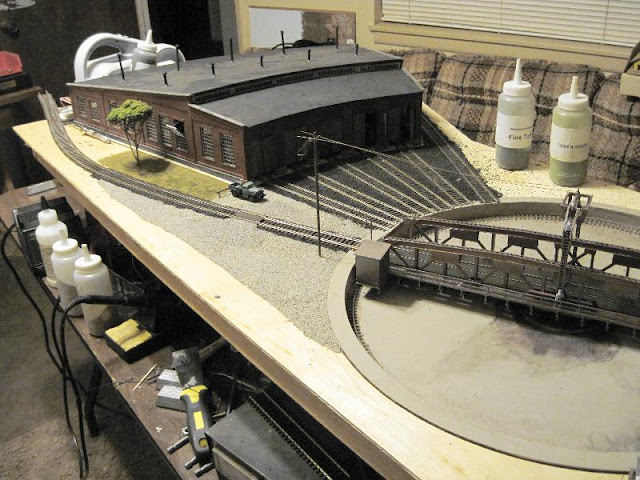
I would suggest considering a different approach to determining the hatch size, shape and exact location. I would first decide what structure(s) that you want to have in the area where the hatch will be, and build the hatch to accomodate the buildings and the scene. In other words, the structure(s) would not be sitting half on and half off of the hatch. We did this at my old club. The hatch was a bit bigger than the size of a locomotive/machine shop which sat on top of it. This is the shop:
The hatch was made large enough that the bigger guys in the club could use it comfortably. The structure was not going to be permanently attached to the hatch. The plan was to hold the structure in place with magnets so that it could be removed before the hatch was lifted. The theory was that there was less likely to be catastrophic damage to the structure if it was handled separately, and the hatch would be much easier to handle too. If someone forgot to remove the structure before lifting the hatch it would be less likely to be damaged as well.
I went to the drawing board and made a quick freehand drawing on how I would frame it out.
You could get by with 4 posts and 45 degree cantilever supports from the legs
There is always more than one way to do anything and I can always appreciate more than one way.
P.S. That’s a really impressive building Dave[Y] Such a great idea. My railroad host Gary had hatches on his layout that popped out and popped back in and you didn’t even know they were there viewing after they were back in.
Mine is foam on open grid except for the round end where I put a square sheet of ply for strength. To cut the plywood to round I tapped a nail in the plywood and tied a string from the nail to the circular saw and cut a perfect half-circle cutting through the 1" x 4"s as well. It will be an easy matter to attach the hardboard facia at some point.
I used 2" foam on the open grid and 1-1/2" foam on the 1/2" ply so they matched up.
I have a hatch I rarely use but it does come in handy and I sometimes need to stand on a stool under the hatch on the floor. I have kept the piece of foam I cut out and it fits right in. Once I get the track ballasted in that part of the layout I will likely never need to use the hatch again. I will make a pond for cattle to water at with bushes around to hide the crack and it will lift out as one unit if need be.
I made my TT/RH on a removable piece so I could take it to my desk to work on it.
I don’t know that I want to comment on “how to build it”, I’m not a foam user and my bias there would control my opinions.
But I will offer some basic thoughts.
Roughly 20"x20" should be a good hatch, bigger if possible, 24"x24".
28" radius is more than acceptable for the equipment you mentioned, but I would go larger for appearance alone if you have room. I’m the guy who runs mostly 72’ passenger cars on 36" minimum radius…
I have track mounted on foam and while it is just fine for sidings and spurs, for future layouts the mainline will be mounted on something more solid. I experimented with foam and spline and I am sold on spline for roadbed.
I find foam ideal for terrain for many reasons and would certainly use it in that application again.
Since you are building this in two modules or sections, I wonder if an access hatch is necessary at all?
I have a similar setup on my HOn3 layout under construction, with almost the same dimensions. I seperate the sections, and slide the “loop” section out from the wall as I’m working on the back side. It easily slides back into place when I just want to run trains. The sections are doweled and bolted together from underneath, and I use automotive trailer plugs to connect the wiring.
For this to work, your sections need to be able to slide easily on your floor. Mine is laminate, and the “feet” on my legs (4 feet total on each section) are actually hockey pucks with felt glued to the bottom. Kind of like the furniture sliders sold at the big box stores.
I hadn’t intended to ever move the modules apart, once assembled, but I’ll give that idea some thought. It would be easier than crawling under the layout.
Larry Puckett showed some adjustable feet on one of Youtube videos. He has expanded away from just DCC topics
I wish I could give credit where due, but this is one of the many things I picked up on this or another forum years ago.
Come on, man! The 2020 Stanley Cup champion Tampa Bay Lightning are practically in your back yard![:D] But there’s a first time for everthing - I had never drilled a hole thru a hockey puck before this.
I suppose this could also work with low-profile casters on different floor surfaces.
I have been to hockey games. I had season tickets to the Florida Everblades for two years, and one of my friends has a box in the arena. I have only been to one Tampa Bay Lightning game.
[:D]
I meant I had never seen one in a retail store, sorry for being unclear.
WOW, you can buy 50 hockey pucks for less than $60.00 with shipping. They cost less than golf balls!
I bought a dozen from an eBay seller. for the layout feet At 67 years old, I don’t have much interest in getting hit by hockey pucks any more.[:'(] Ouch.
Henry, I didn’t plan to do this either. I made the layout in the 2 sections just to be able to move it to a new location. But I’ve found it very useful to be able to separate the halves as I work.
Her’s an overview of my setup - you can see the section similar to yours on the right. They connect where the scenery work and the painted fascia ends.
It’s roughly two 4x8’ sections laid out in an L shape (4’ being the loops - remember, I’m in HOn3. The areas with straight fascia are not that wide). With the “puck sliders”, I can slide the entire layout around, even bolted together, pretty easily. Piece of cake with two people.
It’s funny being a carpenter for a living how many years it took me to learn that. If a radius is not too extreme Mike you can set the depth of the blade just slightly past the thickness of the material you are cutting and a circle saw will cut a radius quite well. Way faster than a jigsaw.
Great looking modeling here and a lot of great ideas. I really like the hockey puck one.
My benchwork is on carpet with casters. The casters that flip are kind of a pain though. They resist when they’re turning around when I reverse direction. I think I’m going to replace them stationary casters that don’t swivel since I just pull the layout straight out and back in to the wall.