I have an IHC 2-6-0 Mogul that’s a little too modern for my era. I was thinking that I would replace the boiler and cab and bring them lower (the IHC model has the boiler pretty high up). What is a good way to go about this? I looked to see if anyone else had done something to this model of engine, but I couldn’t find anything relevant. Any information on changing the boiler would be helpful. Thank you!
No suggestions for the boiler but I think you will need a smaller diameter motor. Possibly a flat can motor to be able to lower the boiler.
There are quite few on ebay. 27mm x 12mm x 15mm that would work. Many have a 1.5mm shaft.
I have some of those. Some might have 2mm shaft.
I assume you mean the standard 2-6-0, not the Mother Hubbard 2-6-0?
Rich
Wikious:
That sounds like an interesting kit bash. I have no insight to offer you however I did address the opposite problem in a old Roundhouse 4-6-0. The prototype I was trying to model was a very early Grand Trunk #320 that had a whole bunch of air between the boiler and the frame. To get the same sort of appearance out of the Roundhouse kit I moved the motor back and put the geared axle in the last position instead of the middle. (CORRECTION: November 5th - I just looked at the engine and realized that I moved the driven axle from the front to the middle, not middle to rear). The result was that the previously visible drive gear was now mostly hidden inside the fire box. That gave me the appearance of space between the frame and the boiler that I wanted. I put some NSWL spoked wheels on the leading truck and at first glance the thing looks to be 20 years older than the model was intended to be.
Please keep us posted on your project. Pictures would be good! (I apologise for somewhat diverting your thread.)
Dave
I’m not sure which version I have, but here’s a picture of it (I can’t find it in my workshop to get a current picture)

The way it’s modeled now, it’s closer to a 1900-1910 build date. My goal, at the minimum, is to get it closer to a 1870-1890 build date. From what I can tell from my research, a big part of this is eliminating the ‘hump’ at the rear of the boiler. Most engines from my period had straight boilers.
If you want to change the cab, Precision Scale has a wood replacement cab which might be appropriate for your era:
http://www.walthers.com/exec/productinfo/585-31154
As far as the straight boiler goes all I can suggest as a start is trying to find something the proper diameter, i.e. a copper pipe, and then cutting the boiler off just behind the smoke stack. If nothing pre-made is available then you could form brass sheet into the right size by wrapping it around a dowel. If you can’t salvage the larger pieces like the steam dome from the original there are replacements available. Again, Precision Scale is a good source. They also offer all the piping, valves, brackets, drain cocks and whatever other details you will need to detail the engine. If trying to mate the front part of the existing boiler to a new rear half is problematic, then just scrap the whole boiler assembly and start anew. The front face of the boiler could be cut off for re-use but there are also replacements available for that too.
You can order a steam era parts catalogue from Precision Scale here:
http://www.precisionscaleco.com/
As was mentioned by a previous poster, you will have to make sure that the motor will fit into the smaller boiler. If not, as was suggested there are lots of replacement motors available.
Just some suggestions.
Don’t forget to change out the front wheels for ones with spokes. You should have a ball with this project!
Dave
If you wish to make it look older, that piston-valve cylinder casting needs to be changed to a slide-valve type, and the style of the sand and steam domes is also too modern. You could easily build a new straight boiler from brass or plastic pipe - re-use the existing smokebox to take advantage of its moulded-on detail. although that headlight might need to be replaced. Older style domes are available from PSC.
That tender should probably be backdated, too. I’m not sure when oil-burning locos first became common, but the flared top edges on that tender denote one which was originally built for a wood-burner. I’d remove the oil bunker and model a full open one, but you could make-do simply by removing the visible upper portions and replacing them with a pile of wood. That would then necessitate replacing the stack with one more suitable for that fuel. An alternative would be to keep the existing stack, and creating a coal pile in the tender. The low arch of the cab roof is appropriate, but many older locos had more window area in the cab sides - an easy modification to make.
While many older locos did have straight boilers, probably just as many had ones with an even more-pronounced hump than your loco.
My problem was a Mogul which was too old for my '30s-era layout. With slide valves, low-arched cab roof, arched-top cab windows and a limited-capacity tender, I needed to modernise it.
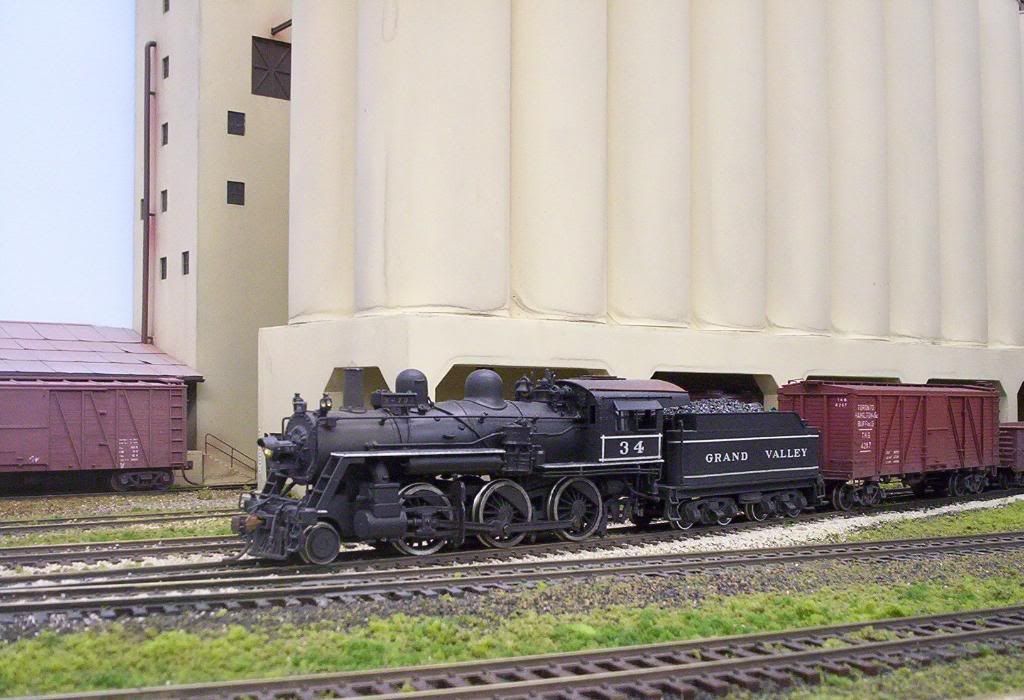
I re-built the cylinders into piston-valve ones, replaced the cab with a more modern one from a Bachmann Consolidation and added some new piping:
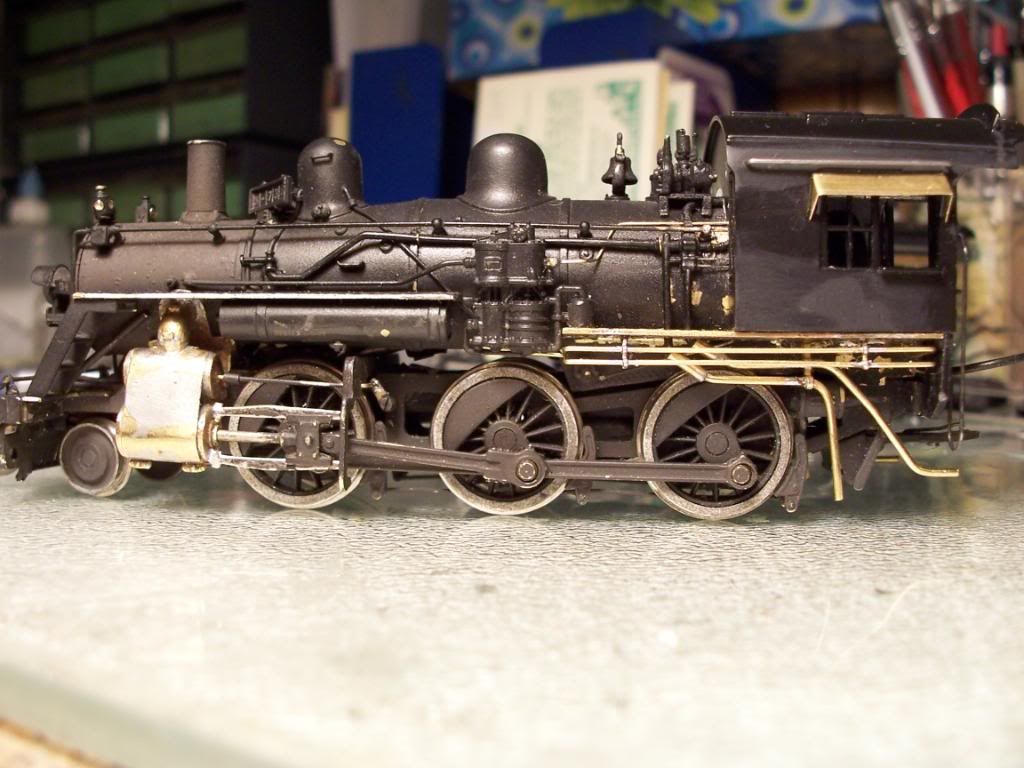
The tender got an extension on the bunker to make it into a clear-vision type:
Personaly I like the look of a straight boiler over the stepped on. What era and reason was this changed?
Ok, getting picky. Air pump would be on the driver’s side for that era, not the fireman’s side. I have a a bunch of books and photos of locos in that era.
Rich
The cross-compound air pump on the IHC model is too modern for a loco in the 19th century anyway. However, if you wish to have a 19th century locomotive which is operating in the 20th century, the existing pump might be okay, depending on your chosen era. I couldn’t locate the date when that style of pump was introduced, but doubt that it was prior to 1910-or-so.
Wayne
Thanks for showing us your project, Wayne- you got some good results on that. Kinda funny- same model, different problems. [:)] I probably will wind up re-using the front of the boiler, since I think using styrene is my best bet. I haven’t really used brass so I’m hesitant to use that instead. I’ll also take a look at the parts catalog, though that seems like a steep price to pay for it before I even buy anything.
Here’s an option for the boiler tubing:
http://www.specialshapes.com/round029.html
A benefit with going with metal tubing for the basic boiler is strength. It makes a good armature to build on. For the rest, plastic should work. Except maybe the walkways. They’re kinda out there, so flimsy isn’t a good way to go. Anchoring them to the boiler will take some good design work.
Ed
The IHC model is based on a Southern Pacific M-4, which were built between 1899 and 1901. Originally, they did have slide valves, but most were rebuilt over the years with piston valves and superheaters. The M-4’s are contemporaries of the B&M B-15 series 2-6-0’s like Doc Wayne modernized for his layout. Personally, I don’t really it’d be worth the trouble to try to backdate the engine beyond its build date (e.g. the end of the 19th/beginning of the 20th Century) due to its oversize drivers (63" - most Moguls built in the 1870-1890 era had drivers in the 50-56" range).
The closest engine to what you want in terms of prototype would probably be the now out of production Arbour Models 2-6-0 which represented an 1880 era engine. The next best thing would be the Ahearn/Roundhouse 2-6-0 which, if nothing else, has the advantage of currently being available. It does, however, have an oversized boiler for an engine built prior to the 1890’s. OTOH, it’s perfectly cylindrical, which is what you wanted.
As far as boilers go, the IHC 2-6-0 has an extended wagon top boiler. Wagon top boilers were very common during the 19th Century and actually more common than straight (i.e. cylindrical) boilers as on V&T #20: http://www.rr
The boiler, even if it was lowered, would be a pretty large boiler by 1879 standards. And indeed the drivers would seemingly be large for the 1870s for a Mogul – not large perhaps for a 4-4-0 but large for a Mogul. Do you have plans or photos of a particular Mogul you are trying to either copy or approximate?
Dave Nelson
For 1870 you need different cylinders, different valve gear, smaller tender, different headlights, probably smaller drivers, wood cab instead of steel, different tender trucks, and a different pilot.
I understand that you’d like to make use of the loco which you already have, but Bachmann’s Ten Wheeler (low or high boiler) is a good choice for the late 19th- and well-into the 20th century. They have suitably-styled domes, slide valves, wood or steel cabs, and small tenders with the proper tender trucks. If the existing headlight is too modern for your era, replace it with a more suitable type. It does, however, still have the wagon-top style boiler.
Here’s one that’s “in-progress”. The headlight is missing and I’ve already changed the valve chest to a piston-type, but it’s otherwise just as it comes from the box. These are smooth runners, too.
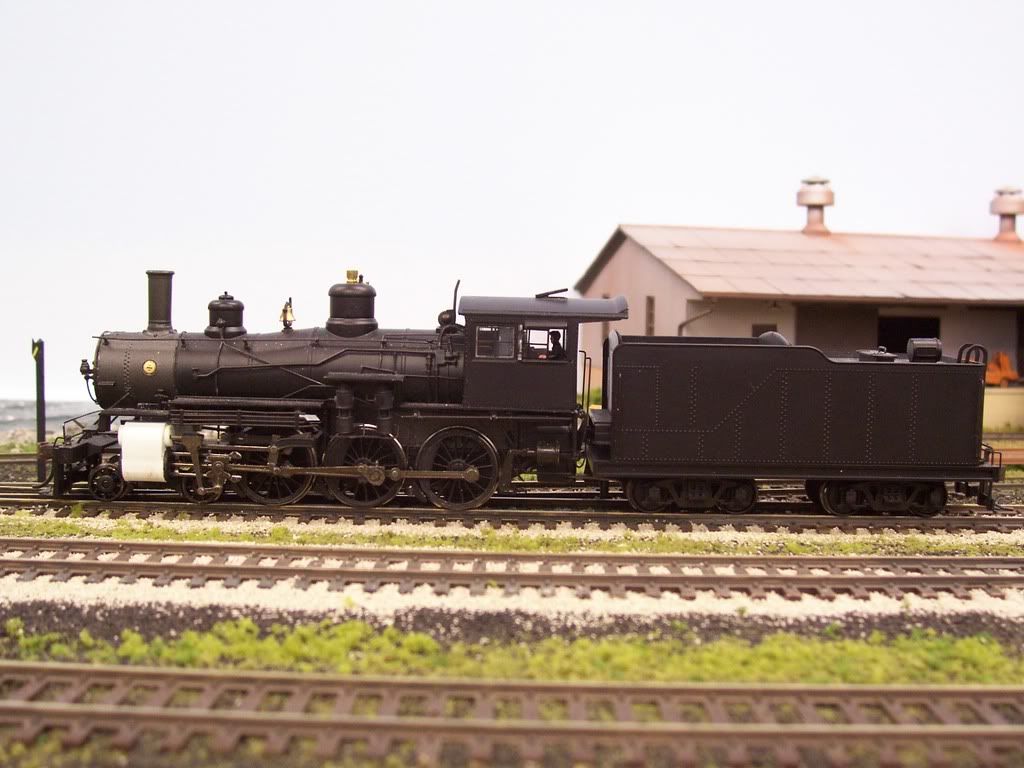
…and here’s a hint of what’s in store. The boiler is from a Varney Ten Wheeler, while the cab is from a Bachmann Consolidation. I have two under construction.
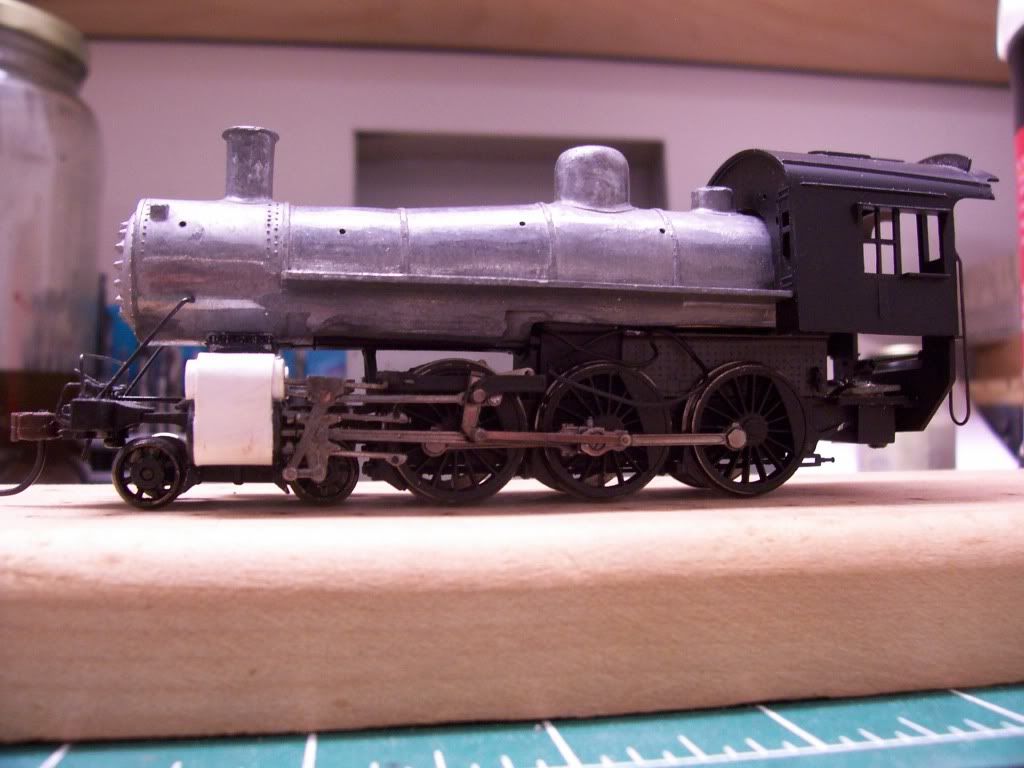
Wayne
I do realize that I’ll have to change quite a few parts with this project; my main goal was to keep the drivers and motor I already have. I suppose that if I was going to try to change the size of the drivers at all, it’d be easier to just buy something else.
And I should say, I don’t have a specific prototype in mind. I’m trying to make it match a fictional railroad of the late 1880s, which is doing somewhat well but still using older equipment in many cases. I do see that Bachmann (I think?) sells older style 2-6-0s and 2-8-0s but there’s just something about their molding that strikes me as a little toyish, hence why I’d like to modify this one.
And thank you for the additional replies. Some of the things you guys have mentioned I wouldn’t have thought to change, like the pistons. It’ll help me make this more accurate, but I’m still not sure there’s much I can do about the drivers.