I’ve been thinking about buying one of those adjustable lamps that features a magnifying lens in front of the light, for use in building model kits etc. They’re not terribly expensive, but I’m still hesitant to buy one without knowing a little more. I’ve never used one of these before, are they really all that helpful? Some magnifying lenses are so curved that most of the subject is distorted. Any brands/models you would recommend for or against? Thanks.
I have such a lamp fastened to my work bench. It has a 4" 3 diopter lens and a 5"round flourescent lamp. I do not use the magnifier as it hampers my hands and arms. I do use it as a light source together with two different magnifications of the OptiVisors. Your own vision will determine what you can and cannot use. Try and use one before you buy.
I have got one and couldn’t get along without it! My brother gave me one he got at a military surplus auction and was laying around in his garage for about 4 years. It was one that clamped to the edge of a table, the clamp was broken so I made a roll-around stand from the bottom of an old U.S. Government Surplus desk chair. I like it better than the clamp because I can roll it anywhere I want, even around the layout when I need to see something close. As far as the brand, I can’t help you there, but they are great for things like replacing couplers. Mike
I like the magni-visors better. Your not locked into just using them at your work bench with an electric socket. I’ve got a cheap $5 pair that work great.
I got mine at Office Depot, it too has the large magnifying lens with the surrounding circular flourescent lamp.
It took some getting used to, but I find it very helpful when placing small parts. It is helpful to make sure the project you’re working on is secure and properly oriented so that you can adjust the lens to the point where it gives the best magnification.
Rick
I have one of those ‘clamps to the edge of the table’ models with a small head - one twistybulb, not a curcular flourescent. Most of the time it’s a suitable sub for a gooseneck lamp, but I do use it occasionally when I want good magnification and can accept its almost zero depth of field.
If I could only have one, I’d take an Optivisor over the magnifying desk lamp in a heartbeat.
Chuck (modeling Central Japan in September, 1964)
I wouldn’t be without mine either! I have an Optivisor clone, found it restricted my peripheral vision too much, like looking down a tunnel. And it got sweaty on my head after a while. I had several similar lights before, with incandescent bulbs, but they got hot and weren’t as comfortable to have so close to my head. The fluorescent one is a lot better, softer light too.
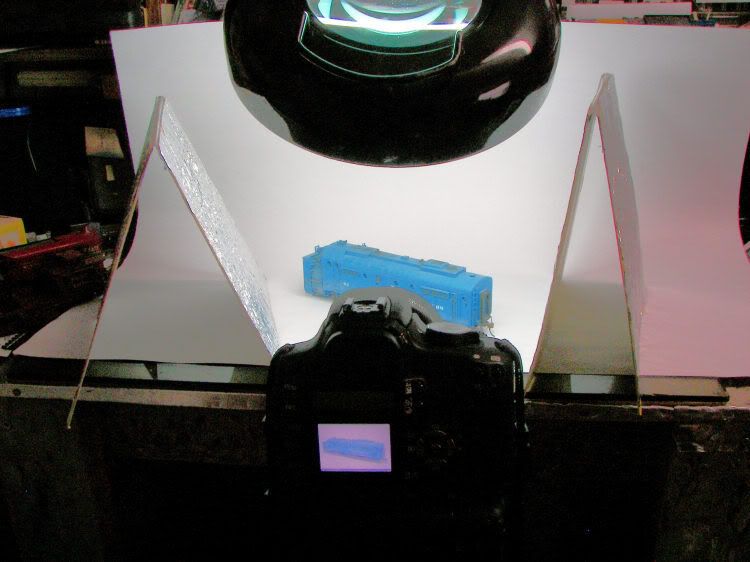
I use mine for taking photos of individual models too, provides a nice soft surrounding light:
If you’re only going to buy one, I guess it comes down to personal requirements.
I prefer the Optivisor for most uses, however I did modify mine by using a Dremel with a cutoff disc to remove most of the “roof” to regain some of the natural field of vision - I don’t have to constantly flip the Optivisor up and down.
I hardly ever use the lamp, the lens has too narrow a field of view that is not distorted.
BTW, has everyone changed to the flourescent bulbs in their desklamps? They last longer, give off a lot less heat and cost less to use.
That was what I was referring to when I used the term, “Twistybulb.” The lamp was originally fitted with a 75 watt incandescent bulb, and would get hot enough to brew tea.
I’ve converted all of the incandescent bulbs in my house to twisty flourescents, which has a double benefit. Not only do the bulbs use about 20-25% of the power, but that power is usually delivered to the room air as heat. In a climate where air conditioning is more life support than comfort, the less heat to be removed, the better. I figure that the total savings are almost twice as much as the comparative wattage ratings indicate.
With electric rates high and rising, that’s a double winner.
Chuck (modeling Central Japan in September, 1964)
Those lamps are good for closeup work. However, I would advise spending the extra money on the all metal type. I went through two of the ones with plastic arms and mounting bases. The mounting base couldn’t stand the stress when the arm was stretched out horizontally and broke off. Now I use an Optivisor and a strong light over my shoulder. The only thing I don’t like about the Optivisor is that I have to get in very close to the work to have it in focus. Its depth of field is very limited. I have no problem with looking around the Optivisor for normal vision. I lower it only to the point where I have to tuck in my chin a bit to look through it and if I want to look under it, I just tilt my head upright. Sort of like bifocal glasses in reverse.