I’ve recently read that compound steam locomotives stopped being built beginning around 1910 after the incorporation of superheating into new locomotives. But, I see plenty of modern steam locomotives with two sets of cylinders and pistons on both sides of the loco. If these are not compound steam locomotives, how are the extra cylinders being used?
Compounding is the use of steam two times. Most steam locomotives were built as ‘simple’ where the steam was only put to the driving cylinders one time and then exhausted through the smoke box and out of the locomotive.
When you see a articulated locomotive while most were built as simple, some such as the C&O 1309 - the last engine Baldwin built for a US carrier were built as compound engines. On compound articulated locomotives the front engine is normally the ‘low pressure’ engine, and the rear engine is the ‘high pressure’ engine. Steam gets routed to the rear engine first at the normal operating pressure of the boiler, after that steam has performed its duty in moving its piston it gets exhausted to the front engine at a lower pressure than it entered the rear engine. Because of the lower pressure of the steam entering the front engine, the front engine’s pistons are larger in diameter than the rear engine. Once the front engine has used the steam to move its piston the steam is exhausted into the smoke box and out of the locomotive.
The Big Boy UP 4014 is a articulated locomotive and both its engines are simple - they use the steam and exhaust it after use. In most cases, if you look at the top of a simple articulated locomotive you will see two separate stacks -one for each engine. On the C&O 1309 that is being restored to operation by the Western Maryland Scenic th
Jerry, I hope you see this, so late.
Compound engines, often called “Mallets” after their chief designer, were made right up to 1952, as far as I know. The last main line steam locomotive erected and placed on the rails in the USA was a Y6b #2200. It was called for by the Norfolk & Western Rwy, and built right there in its own shops in Roanoke, VA. Balt has provided you with a great response, but I wanted to add a little history to your 1910 factoid.
Someone wrote a duff essay if you read it and recall it correctly.
Easiest way to identify compound loco is to observe the piston diameter. If all piston diameters are equal, it’s not compound.
1 Like
Traditionally, three reasons have been given for the transition from “compound” to “simple” articulated locomotives: (1) high-pressure joints were developed. (2) maintenance of intercepting valves was difficult. (3) the diameter of the low-pressure cylinder exceeded the maximum allowable width of the locomotive.
However, the advantage of high efficiency of “compound” is enormous. Modern steam turbines for generating electricity have three stages. I can’t help but feel that another fundamental reason is being overlooked.
1 Like
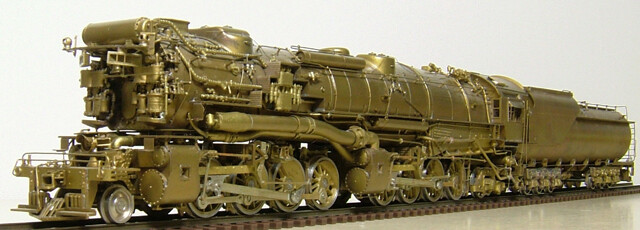
That is one spectacular brass locomotive.
Rich
Compound articulated locomotives were great in slower speed drag service think like coal or slower freight service on steeper grades were they could use all the power the steam could produce. Now the simple expansion articulated units were used on faster service trains and on grades were we didn’t have extra capacity for slower trains. Sherman hill was the perfect example in WW2. Millions of tons of freight had to get over that hill in a hurry an expansion articulated could do it but not as fast as the big boy did.
1 Like
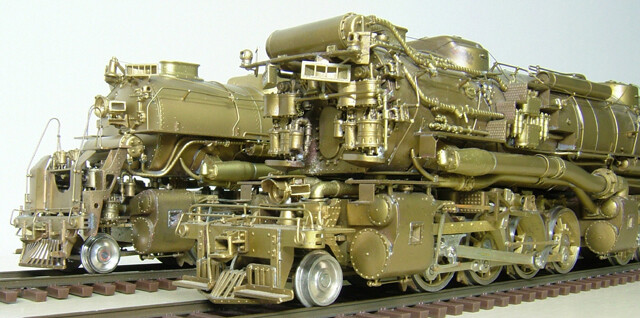
That brass loco is a model of a C&O H-7 2-8-8-2, the only 2-8-8-2 articulated locos on the C&O. Built in 1923 and 1926 they were the first in the trend to simple expansion articulated locomotives. They had 45 of these monsters.
All the rest of the articulated steam on the C&O were the H-1 thru H-6 2-6-6-2’s and the H-8 2-6-6-6 Alleghenys. The Allegheny is also a simple expansion locomotive.
Sheldon
1 Like
The thing you’re overlooking is atmospheric exhaust. Typical achievable back pressure on the LP engine of a compound locomotive might be 22 or more psi, dependent on required draft effectiveness. The only real way around this is with expedient condensing, which for a wide range of technical reasons is difficult enough to avoid on general-purpose locomotives. Even the arrangement for the ACE 3000, which is the most sophisticated design I know, would have been dangerously close to choking even under typical Northeast conditions – let alone doing sustained heavy work in the West or Southwest.
In addition, there are severe balancing issues between HP and LP, exacerbated at quicker cutoff. The ‘best’ American solution (the so-called booster valve on N&W Y6s) was good for reducing appalling mass flow imbalance into the LP engine at slower speeds, but did little if anything for either balance or DBHP at speeds above about 30mph (if I remember correctly, a NYC J3 Hudson made more horsepower than a Y6b at any speed above 35mph or so).
The actual answer to this goes against general notions of ‘steam simplicity’; it was originally developed by Andre Chapelon. That is to modulate flow of superheated boiler steam directly into the IP reservoir, such that the thrust at any degree of LP engine rotation matches that of the HP engine. This is of course a smaller net mass flow of high-pressure steam, with the problem that a very complex modulation with very quick valve travel may be needed to produce the desired effect (and note that this is entirely separate from the actual valve gear controlling admission and exhaust events on each engine).
The interesting thing here is that the N&W propaganda about the Y6 being a suitable locomotive for all purposes could have been achieved with this arrangement – it could easily increase the operating horsepower curve out past 40-45mph which is where most of the ‘time freight’ on the N&W ran. That in turn would free up more As to be rebuilt with the thin-section roller rods and used in developing TOFC intermodal service (following up on parent PRR’s TrucTrains) from the early Fifties on…
One unfortune consequence of Wiener’s publishing Articulated Locomotives in 1930 is that he almost completely missed the revolution in high-speed simple articulateds that Baldwin started with the 2-6-6-2s and reached early apotheosis with the Seaboard and N&W 2-6-6-4s. These applied the lessons of the ‘second SuperPower revolution’ to larger locomotives in only half a decade or so – with the only serious new compound construction being improvement of ‘legacy’ designs.
Sheldon: the T1, a rigid-frame 2-10-4, was far superior to the H-7s in most respects, simple admission or not. It is possible that extensive rebuilding might have addressed some of the stability issues, but certainly C&O seems to have gone the route of the 2-6-6-4s with a bigger radiant section when they needed one more driver axle’s worth of T-1…
3 Likes
Agreed, great commentary on that topic.
I was simply identifing the locomitive, not writing a book on the history of simple expansion articulated locos or super power steam.
I am very familiar with the T-1, the H-8 and the development of Super Power steam. Both these locomotives were superb examples of modern steam.
Sheldon
1 Like
Just adding here, compound cylinders were also used for some experimental steam engines on English railroads going as far back as the 1880’s or so, with one example being the “Teutonic” which looked like a 2-4-0 but was actually a 2-2-2-0! The rear drive axle used two standard cylinders on the outside, but then the front drive axle was a crankshaft and used a central third cylinder powered by the exhaust steam from the first two. The idea was to make it more efficient, and although it did work, having that much complexity in a small space for so few wheels made them a nightmare for the maintenance crew.
2 Likes
Don’t forget the propensity to spin the drivers in opposite directions after backing down on a train with no slack!
Dustbin-sized LP guaranteed no more than a few miserable psi MEP once you got the cutoff sufficiently early for high speed with that boiler, too. I understand the kinks were worked out with the Bill Bailey 2-2-2-2s, but the Premier Line abruptly gave up developing the single compounds only a few years after that.
Yes, PRR tried one of the Webb compounds. They decided very, very quickly they didn’t like it. More interesting was the British-inspired original class T, with 84" drivers and… only two cylinders compound. This was on the von Borries principle with an intercepting valve for starting and separate cutoff a la de Glehn/du Bousquet for (necessary!) continuous twiddling when running on a normal railroad with a train. It would actually go quite fast with a considerable load, perhaps with low water rate and good efficiency… but, as with the later Ts, PRR didn’t care to train or encourage their engine men to that level of mecanicien skill. (They then tried an actual de Glehn Atlantic in the early 1900s, but couldn’t be bothered to build one with the strength of one of their own E-class engines…)
1 Like
Professor!
Please make it easier for me to understand. I barely got a D in thermodynamics. I can’t use the steam tables. How does this relate to superheaters and feedwater heaters?
2 Likes
I’m sure you’ll be glad to know it really doesn’t concern either one!
First, I’ve said this before, but give up the idea that compounds ‘use the steam twice’. All they do is expand the steam multiple times between intermediate pressures.
Superheat is intended to reduce losses, both nucleate condensation and wall condensation, as the steam is expanding to do work. The added heat content per degree of superheat is comparatively small, but keeping the steam from changing phase and losing volume… nearly priceless.
But the ongoing superheat cannot be so great that it ruins the HP valve lubrication, or other areas that might be coked or warped by high temperature. This is complicated when a compound takes advantage of higher boiler pressure, as the saturation temperature rises as indicated in some of those pesky steam tables. There have been some attempts to ‘resuperheat’ the steam on Mallets (admittedly with not-very-good types of superheater) but none were even remotely successful. Chapelon tried the approach on his 160 A1… but even there, with almost the best possible steam-circuit geometry, he gave it up as a bad job. So we wind up with a serious superheat ‘deficit’ going into the LP engine. We could try some kind of externally-fired superheater (as for marine practice) in the receiver space, but firing something like that effectively would almost require a computer, and would work like crap with solid fuel even if you could get one of those cockamamie RD stokers to feed at the firebox throat on an engine with drivers under part of the water legs.
The ‘correct’ answer (in my opinion at least) is to tap superheated steam (not saturated from the boiler water) and inject it proportionally to get the desired performance (at greater mass flow due to the lower MEP) in the LP engine. The nominal water rate may be a little higher, but you can recover some of it “lower down” in the Rankine cycle (see below) and the thing will run MUCH better as a practical locomotive… which is far more important than theoretical better thermodynamics.
Now we get the LP engine exhaust-steam mass flow, probably at something like 22psi peak. We need enough of this for expedient draft through a good multiple front end, perhaps associated with a N&W-style ‘waffle grate’ nozzle; that might be effective at no more than 5 to 7 psi (if we have set the rest of the combustion path up effectively) so we can devote some of the ‘rest’ to helping the overall Rankine cycle. Obviously a good open FWH does this, and doesn’t hurt the effective compound expansion efficiency at all. Likewise Snyder air preheaters take relatively low-pressure steam and partially condense it while increasing air temperature going between the ash pan and the grate on a solid-fueled engine, and at least some of the secondary air on a liquid-fueled one.
1 Like
Yet another take was the Southern Pacific in the 1920’s. The original cab-forwards were built as compounds in the pre-WW1 era and the Espee was reasonably happy with them. In the 1920’s the Espee acquired a number of 4-10-2’s appropriately named the “Southern Pacific” type (except on the UP). The 4-10-2’s were three cylinder simple with superheating. Anyway, the new locomotives were giving substantially better performance than the Mallets (compound articulated), mainly being faster while consuming similar amounts of fuel. This prompted an experiment to convert a Mallet to simple, which turned to be very successful. The Espee then proceeded to convert more of the Mallets to simple and all new orders for cab-forwards were for simple articulateds.
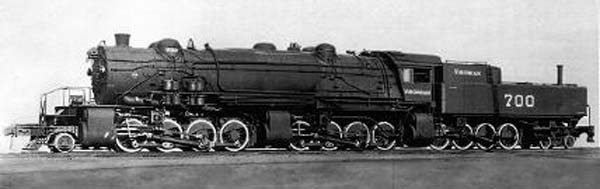
Then there were the “Triplexes”, a form of compound mallet whereby all cylinders were the same diameter.
1 Like
The Triplexes were more interesting than the ‘railfan history’ indicates. Henderson at Baldwin envisioned locomotives with four (!) and patented one with five (!!!) engines, the latter using a speaking tube as on a ship for communication between engineer and fireman.
All three sets of cylinders did not have to be ‘equal’ even though this probably saved some expense and cost in casting patterns and setup. The HP was in the normal place for a Mallet, on the ‘middle’ engine; one of the two cylinders exhausted to the forward engine, and thence up the stack; the other fed the rear engine, and then through a 'scape-pipe as on a steamboat direct to atmosphere (you would not want to know the horror of piping it to the smokebox for draft, and it was not practical to recuperate it in the tender for feedwater, or condense it). The “ideal” expansion ratio understood at the time was about 2:2 to 2.4x, so the LP cylinders ‘could have been made’ even bigger (!)
The first disaster was the expedient of using a motor tender as the third engine. Varying fuel and water levels changed adhesion much the same as on a Garratt. Southern Railway in particular had a history of experimentation with motor tenders – none, as far as I know, successful. (They are also the only railroad I know to try two auxiliary locomotives under one tender; a brave exploit, but even in hump service there were “too many legs of the wrong kind”.
Henderson had the same problem the contemporary ATSF did: he colossally misunderstood what the firebox did. I think it was common to assume that the water in the legs and over the crown was primarily shielding against melting or softening the inner wrapper, and that the steam came from the tubes and flies in the convection section. This culminated in the Jacobs-Shupert ‘explosion-proof’ firebox… which could not be made very large without tremendously overloading the back of the boiler, and which was assembled with a grand plurality of riveted joints with poor mechanical advantage and no easy access to many of the rivets once assembled, which led the thing to weep like a sieve after a comparatively small number of firing cycles.
Returning to the Triplex: the problem with the ‘using steam twice’ really wasn’t that only “half” the mass flow went into producing draft – given the size of the boiler, an efficient front end would produce decent mass flow. The problem was that in order to get any action out of a LP engine over the road, the cutoff on the HP engine needed to be set so that one cylinder sourced enough to produce thrust in two big cylinders… and after that, produce enough draft to make the whole trick work.
It might have been interesting to see if a proper SuperPower-style boiler (e.g. with deep firebox and better front end) or even the arrangement on the PRR HC1 would have addressed some of the woe. But the better answer (except perhaps when overdone) was the booster, in 1921, and then the auxiliary locomotive: smaller, comparatively light, and powered only when needed.
2 Likes
In regards to triplex, the center right piston fed the two front pistons, the center left fed the two rear pistons. Since all pistons were of near equal size, then It is assumed for compounding to occur, the lowered steam pressure after exiting the center cylinder, would need to encounter a cylinder of increased diameter to have enough driving force. In order to do this, the lowered steam pressure if applied to both front cylinders at the same time, would in effect encounter an “effective” doubling in size. If in effect, steam was applied to both front cylinders at the same time, this would have prevented the use of “quartering” the drive strokes typically employed in non compound engines. I must be overlooking something here.
No matter where the steam comes from, or at what pressure, it “waits” for the valve to let it in and direct it out. But since steam is applied to both sides of the piston in alternating strokes, there is almost always some place for it to go, even on the triplex.
The seperate engines of any articulated loco are not in any kind of timing relationship with each other. As soon as you have wheel slip, or even the slight progressive adjustment in curves, their timing relationship changes.
Sheldon
I get the idea of articulated trucks are not in time with each other as far as power strokes. I was referring to the quartering timing between left and right cylinders on the same truck(front or rear) with respect to the compound triplex. Additionally, the power derived from LP steam in a compound, is usually accommodated by a larger piston size or a shorter stroke to derive as much force as possible from the lower pressure. If you are saying that the front truck cylinders (left/right) were timed to fire at different times, then it would seem that this system would not derive maximum power from the LP steam, as compared to larger secondary cylinders.