I think this is the correct location for my post. Anyway, I have a Mantua 0-4-0 Goat Switcher that hasn’t run in 20+ years. I dissassembled it today and the reasons are obvious. I was able to pull the motor and turn it with a 9V battery which was uplifting. Specifically, I’m wondering the best method to clean this thing. Mainly removing the rust that has accumulated on the field magnets and the brushes. See the pictures below.
I was thinking WD-40 and a soft wire brush followed up with a detergent bath, denatured alcohol swabbing, and a lube job at the bearings.
I think I’d skip the WD40 and water/detergent and just go with the alcohol rinse (or maybe paint thinner). I’m also a little worried about getting that fiberboard piece soaked with just about any liquid–I’m a bit worried about swelling.
I’d suggest rubbing the commutator with a pink pencil eraser to clean it up.
I ditto the comment on WD-40. Don’t use it. WD-40 works for a bit and then causes more trouble than it solved. As it drys out, it is a magnet for dust and other crud.
Removing rust on the field magnets - navel jelly on a Q-tip, then wash with soap and water. Don’t get it on any of the other parts. But truthfully, I don’t think the rust will hurt anything unless it is rubbing.
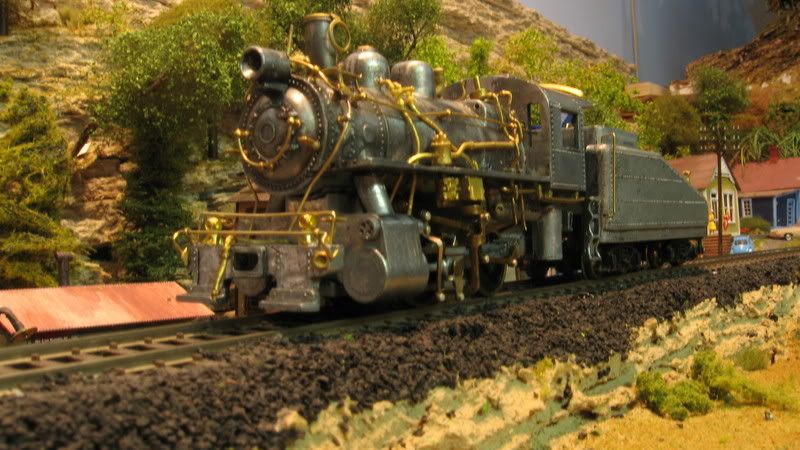
I can’t help with the motor problem, but I rebuilt an English Yardbird 0-4-0 and I found the Yardbirdtrains.com people very helpful. When I did the superdetailing they were able to locate some old and rare parts. They were wonderful and patient as we went through the search process. Good luck. I had a great time and it runs great. Here is one pic of the finished product. I haven’t decided if I should paint it or not
Thanks for all the wonderful info. I’ll try cleaning it with alcohol, then oil the bearings. Hopefully I’ll get it running. I’ll update my progress as I go.
So I was able to cut through most of the gunk with mineral spirits last night. Lubed the bearings and then connected it directly to my DC power pack. It ran pretty well for it’s condition.
I realized that the loco needs wheel bearings and a few other parts to function as a unit again. I’ll probably order those from yardbirds if they’re not to crazy expensive.
Success is sweet. Good for you. Be aware that ordering from Yardbirds is not always like odering from Walthers. BUT the can help you find stuff. As for crazy expensive, this whole hobby looks a little crazy at times, and some things can be expensive. I have way more in my Yardbird than a new plastic model would have cost, but this is from my youth and is worth it for me. Keep us posted.
What a great looking job you did! I know that you are on the horns of a dilemma as far as painting goes. I re-did a Bachman SY mike-I like to call it my “green-card” mike-to a totally “American” appearance, and just bit the bullet and painted it. I am glad I did. If I can get your e-mail address, I will send you some of the pictures I took of it.
I’m struggling to match your words to what I see in the photos.
The magnet is the big block at the rear of the motor. The magnet is not made of iron and should not have rust on it. There may be other corrosion you can clean off.
The 2 field pieces, which are also the rear motor frame, are connected with a rivet through the magnet. These are made of iron/steel to conduct the magnetic field, and have rust on them in the photos.
The armature has the wire winding around laminated segmented iron disks. The iron disks have rust on them.
The commutator is where the brushes bear, and is a segmented copper cylinder in the front of the motor. In the photo, there is carbon buildup on the commutator from the brushes. You do not show the brushes in the photos.
As for cleanup of the motor:
as mentioned WD40 is not a lubricant. WD40 (Water Displacement Formula 40) is designed to dry out and inhibit more corrosion in submerged metal objects - like outboard motors. The solvents in WD40 will lubricate temporarily. But as they dry out, they leave a sticky residue behind.
I would be very careful in doing anything with the armature. If the varnish insulation on the wire gets nicked or stripped, the windi
Thanks for all the useful info and clarification on my motor anatomy. When I ran the motor in my hand while connected to my DC power pack, I didn’t notice any “excessive” vibration or vibration that stung my hand. There were a couple of times when it bogged down slightly when I had the throttle between 50% and 75%. But these were only momentary and it soon returned to steady state. Again, I really appreciate your insight and help.