Over the years i’ve heard of about 5 materials used in making mountains and rocks. I’d like to know how to know which to use; what the differences are in them. Perhaps some are outdated ideas and no longer used. There’s (1) plaster of paris, (2)hydrocal, (3) sculptamould, (4) spackling compound, (5) drywall filler (nic-named drywall “mud”). Any wisdom will be much appreciated.
You can also carve them out of styrofoam, the pink or the blue variety works best, and by painting after carving, there’s no plaster involved.
I can’t get into Photobucket right now, or I’d show you some examples.
Google around, Model railroad mountains from foam, or carving mountains from foam, mix up the wording and you’ll find lots of examples. Look in images.
Mike.
1 cheep and soft
2 strong and hard my choice
3 never used but heard its some what like papermache
4 pricey use it for mortor lines
5 takes forever to dry if thick
I prefer Mud over foam. Easy to use,cheap, no mixing, no mess,can be tinted with craft paint to avoid white spots should you chip it. As long as you don’t use the garden hose to wet ballest,will with stand getting wet.
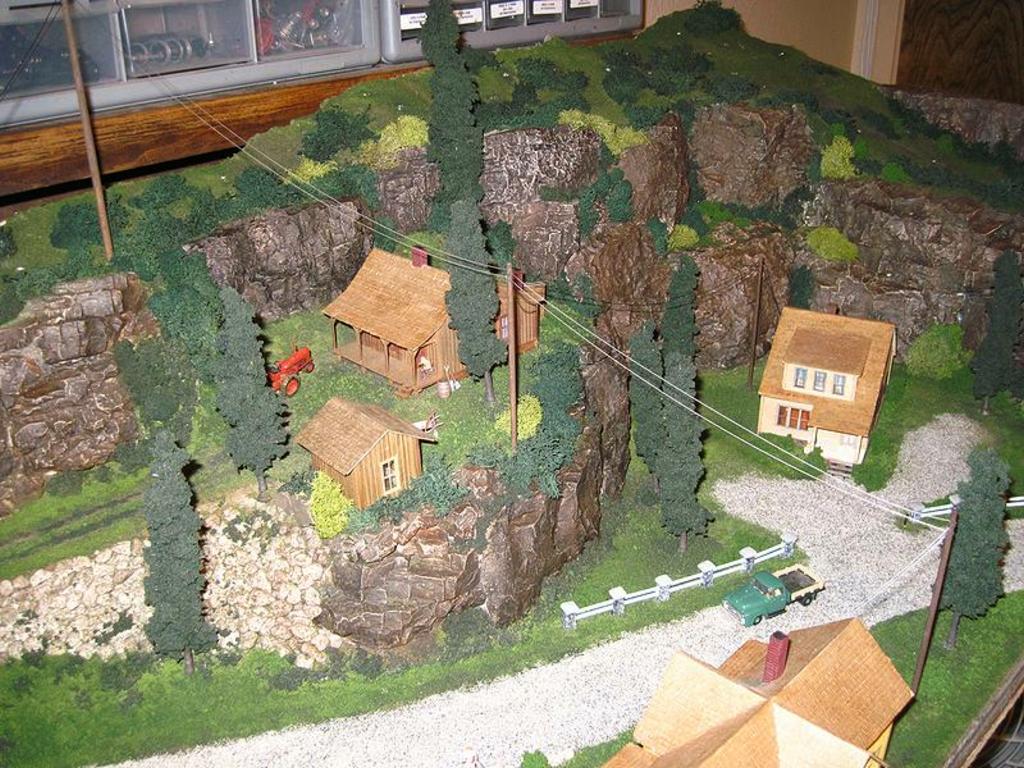
These walls are a first time experment carving foam, no mud


Sculptamold has some kind of fibers probably mixed with plaster. It is good for fliing areas and had a slower setting time than plaster and it dries hard. The fiber content does not lend itself for making rock faces.
There is a lot of discussion between Plaster of paris and Hydrocal for making rock faces. Hydrocal sets up fairly quickly and is rock hard. Good for precasting rocks for installing later. Plaster of Paris is softer, but still fairly hard.
I prefer Plaster of Paris because I like to use rock molds and cast the rock face in place. When I do more than one rock casting, I carve the areas between castings to blend them together. It is much more difficult to carve Hydrocal once it has set up.
Another product I like is Durhams Water Putty. It is a powder that mixes like plaster, and is a beige color. It sets up slower than Hydrocal, but is very hard. I like it for roads. I make a dam out of scrap wood and pour it inside, then use another stick to smooth it. Once set up, I wet sand it smooth as a paved road should be.
I followed this old video and was happy with the results. You can employ many methods to achieve what you want and even use several different methods on the same layout as I have done.

I swear by plaster-of-paris (POP). The stuff is readily available and cheap. You just mix it with some water and done. I spread it with my fingers or a plastic knife. I also use POP to make rocks made from plastic moulds. You can make the rocks appear different by putting it at different angles.
Pink or blue foam is what I use for making rock croppings. You can carve w/ a knife, hot gun, or my method: drywall saw.
I prefer to use plaster of Paris because it’s easy to find and works well. Sometime I use patching plaster which seems to be the same thing. I’ve never used Hydrocal plaster because I’ve never seen it at the store.
I tried using drywall joint compound aka mud but it shrinks and I didn’t like it. Spackling is about the same as mud.
Bragdon foam is a chemical used for castings. It is finer than Plaster of Paris or hydrocal, particularly when used with Bragdon molds. I like it for signature scenes at the front of a layout. It softens again with a hair dryer.
Mr. B are you saying it becomes flexible for molding around curves?
My layout 20 30+years ago was hydrocal. It can be messy. Best carved before it sets up, but you can go back and put new hydrocal between castings to smooth transitions. I had no trouble putting a mold on a curved surface.
Sculptamold, I’ve read it is part paper mache part plaster, but they don’t tell you that on the label. It was good enough for Model Railroader to use on their Canadian Canyons, so like myself, the fibers weren’t a deal breaker at normal distance viewing. I chose to use it this time, because I will be moving and it is much lighter than hydrocal.
My experience with drywall compound is cracks.
I used crumpled tinfoil as a mold for a large rock cut made from Sculptamold. Put it on the foam base around the curve, worked well. Have also made plaster of paris rock faces in homemade latex molds, they looked good too.
There is also broken ceiling tiles to make certain rock forms. I picked up some broken tiles, haven’t used them yet.
Good luck,
Richard
I have also used bits of cork sheet torn into strips to make a ragged edge, then stacked together. When painted/weathered, it has a good Appalachian horizontal rock formation look to it.
Thankyou very much. That is excellent information; that’s what i needed.
You can put me in the POP camp unless weight is an issue then I use Hydrocal for rock mountains. I used Paper Mache for years as a base but it shrinks badly as it dries. Paper Mache is very strong and will support it’s self when dry. A member of the Forum got me to try Sculptamold and one shot using it and I was hooked. A hundred times better than Paper Mache for a scenery base.
I really like the way POP and Hydrocal absorbs stain. I use WS stains to get the right color mix on my rocks. Early on I sealed the stain with a clear flat medium and learned the hard way that was a huge mistake. My layout is in our garage and I had installed 5 double bulb 8’ Fluorescent fixtures for lighting. Well over time the Fluorescent light took its toll on my layout fading the colors badly. With the rocks sealed they wouldn’t accept a new coat of stain. I had to redo all of my rock work. I cut over to LED lighting last summer so no more color fading on my layout.
The picture above shows a 2’ x 4’ module an
Don’t know about you guys, but LION just goes outside and finds some nice rocks. If too smooth, then break rocks open.
Simple, realistic, cheap.
ROAR
thankyou for your reply
thankyou for your input
Lion long time no hear you roar!
I aquired a pile of “boulders“ from when my family put in a swimming pool in the back I place them where I want on layout.
I attended a clinic where someone used stacked ceiling tiles to make rock faces. The tiles were made of compressed paper that he snapped off by chopping off (with his hand) the overhang over a table. It made the process quite easiy. Again, something else to consider.
1) Plaster of Paris: This is the only material I used for 30+ years on my own layouts. This product is easy to find in Florida. It works well, and I have always had good results. It is heavy, and there is limited working time. I have never had a problem with it.
.
2) US Gypsum Hydrocal 30: I have never used this. It is not easy to find in Florida. Well, the internet came to the rescue. I have 25 pounds of it here and I will finally try it over the next few weeks and see how it goes. As of this moment I do not know much about it.
.
3) Amaco Sculptamould: This is not suitable for making mountains. It is amazing for filling in rock castings and for the final little bit of work to sculpt the scenic profile. It has a very long working time. The time required to harden depends on the thickness of the material. More than 3/4" thick might take a month to fully harden. It is not as strong as plaster when hardened.
.
4) Spackle Compound: Not suitable for mountain building. I have found it very useful for river beds because it can be finished with a damp sponge for a very smooth surface.
.
5) Drywall Mud: The pre-mixed kind is just like spackle. The dry powder type that you need to mix is available in a quick-set formula that I have seen some people use for hardshell. I have never used it.
.
-Kevin
.