My layout will be in a 13.5’ x 20’ room. Among other engines and rolling stock, I have an Amtrak engine with some, I believe, 80’ cars and an N&W J Class engine with a few N&W passenger cars. At the current time, all engines and rolling stock were inherited from my father. I hope to do a double track mainline. What should be my minimum radius be?
Starman,
Your layout may be in a 13.5 x 20’ room, but what is the actual size of your proposed layout? That will basically determine,what your minimum radius of your curves will be. I would go with a min. of 24’'. Bigger,is better,when it comes, to curved radius. Also I’m assuming, it’s HO!?
Cheers, [D]
Frank
Hi,
Wow, what a nice room for a layout!
Minimum radius is a big deal on any layout and will contribute greatly to the operation and realism of running your trains. The bigger the minimum, the better. But, I suspect you know that.
I can only speak to HO… My minimum is in one corner and 26 inch radius. I had to do some minor trimming on a couple of Walthers passenger cars to make them run that easily. Your J loco should also run it easily.
Having your room, I would love to have 30 inch minimum on the mains at least, and 26 inch on the sub-mains, and for freight sidings (used by smaller length cars and switcher locos), I would go down to 24.
One other thought - from a guy who has been playing with trains for almost 60 years…
Take your time on the planning/design process. Do scale drawings. Don’t skimp on benchwork materials. Put in power feeders at least every 4-6 feet. etc., etc.
Take your time, and do it right…
Since nobody has responded yet… (edit: actually several responses as I was typing this!)
80’ passenger cars require a large radius. The NMRA standards are quite appropriate based on my limited experience, though performance of specific locos and cars may be a bit more or less forgiving. I chose 24" as the minimum for my 14’x13’ HO layout and it has been trouble-free so far, but most of my curves are wider than this and I do not run any cars that long.
Here you go:
http://www.nmra.org/standards/sandrp/rp-11.html
If you are new to the hobby then I suggest that you go through all the info in the NMRA site. It really is quite useful and should help get you started in the right direction.
Minimum radius, assuming HO scale:
24" is good
30" is better
36" is best
Rich
Thanks for all of your replies. I did neglect to state that my layout will be HO and I will be building wall to wall in the room. I am using Anyrail to do my initial layout. But before beginning my benchwork, I plan on taking the advice of several modelers in “Modeling a Rail Yard” thread who advised me to actually construct a layout using cardboard cutouts of switches and track, and brown paper, on the floor of my room. Sounds like fun! [:D]
And to add to that — 48" or larger is even better if you plan on running passenger or auto-rack trains, or anything else with long rolling stock. Sure, it can take a tighter radius, but it looks horrible doing so.
Yep, i shall amend my list:
Minimum radius, assuming HO scale:
24" is good
30" is better
36" is best
42" is better than best
48" is even bester than best.
Rich
My own experience is that 28" is about as low as you want to go with 80’ long cars. Yeah, they don’t look great, although they do run OK, but I’d say 48" min radius is just not going to leave much room to work in your room.
Also in line with choosing minimum radius is choosing a min turnout number, at least on the main. I suggest #8.
And power the frogs on those #8s.
Rich
With a three foot aisle space you would have room for a 90" wide table. If you leave 3: for a “border” that leaves 84 inches of width. So you could theoretically squeeze in a double track mainline with radii of 39 and 41" respectively (without any easements). Easements would take up a few inches off those radii and would be worth it re looks and operation.
80’ cars can go around 24" radii curves…maybe. I have a BLI 2-10-4 that is reputed to go around 24" curves and I have been able to make my Westside 4-4-6-4 (non-articulated) go around curves of somewhere between 30-32" radii…although it has to fight its way through to overcome the additional friction. I neither have, nor know anyone personally who has, a 4-12-2 so I can’t say what that long wheelbase engine would do re radii.
I have no insurmountable difficulties getting 9 80’ foot passenger car trains around 30" curves without derailing or decoupling. More critical than radii are vertical dips and horizontal “wiggles”…i.e. outside rail high going to inside rail high. Dips will cause uncoupling and wiggles will cause derailments. Good luck.
Model railroad planning expert John Armstrong noted correctly more than once that too large a radius (and turnout number) can be just as detrimental to a layout as one that is too small.
The reason is that the curves eat up space that would be better used for aisles, industries, yards, and other important elements. The determination of minimum radius is always a trade-off between appearance, performance, and fitting desired elements into the room.
It’s also important to keep things in balance. #8s on the mainline equate to about a 67" radius per the NMRA’s RP.12-3 for HO (see line 11 for the value of the tightest curve through the turnouts). For that reason, #8s on the mainline (although they look great) may be a waste of space when using HO minimum radius curves in the 30" range, for example (which might be best paired with a #6 turnout – minimum radius equivalent of 49") . Then one could save the #8s for crossovers.
The radius one chooses depends first on the equipment size and stiffness, of course, but also on the type of railroading one wishes to do, the towns, yards, and industries one wishes to include, the obstructions and entrance locations in the space, and so on. It’s impossible to answer the Original Poster’s question definitively without more information.
If the OP has not read John Armstrong’s Track Planning for Realistic Operation, that would be a first step before designing a large layout.
To determine the minimum functional radius for the length of equipment, the NMRA link suggeste
For 80’ cars, go as large as reasonably possible. If you can achieve R30" and > - go for it! Your rolling stock will operate much better and look better doing it. I would absolutely go no smaller than R24".
Tom
Amen to that, Brother Rich.[tup]
Byron,
True, #8s aren’t needed, but they do look great. And that’s why I favor them. Part of the reason also was because they forced a certain discipline on me to not pack in more trackwork. But that’s aside from minimum’s of course, and your point is well taken that #6s will work.
When I squeeze in more generous dimensions, it’s almost always beneficial visually. I found it’s usually easier and more necessary to constrain curvature, if a tradeoff is possible, versus trackwork. The track on a curve only looks tighter when a train is on it versus too sharp a turnout visually will always be visible unless a train is on it. So I guess that’s my approach to this, hoping it informs the OP about the process he should go through in evaluating what will work best for his situation.
On an around-the-room type layout, tight radius curves will look less objectionable than they would on a table-type layout in the centre of the room. On the former, you’ll be viewing the trains from the inside of the curve, whereas the latter will be viewed from the outside, where the exaggerated gap between cars is hard to ignore. [swg]
I set 30" as my minimum, but used it in only one place on the mainline. Everywhere else, I tried to use the widest radius possible within the available space. While a couple of curves are 32", most are 34", and I even managed to include one or two at 48".
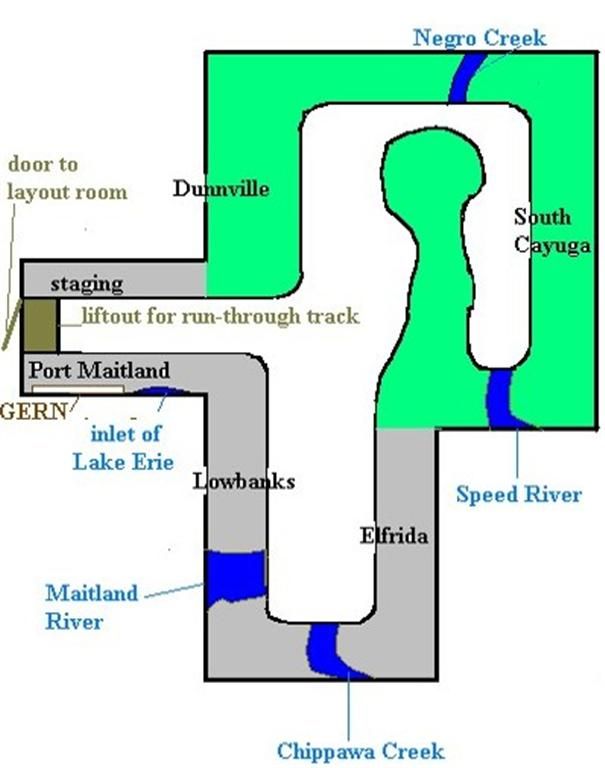
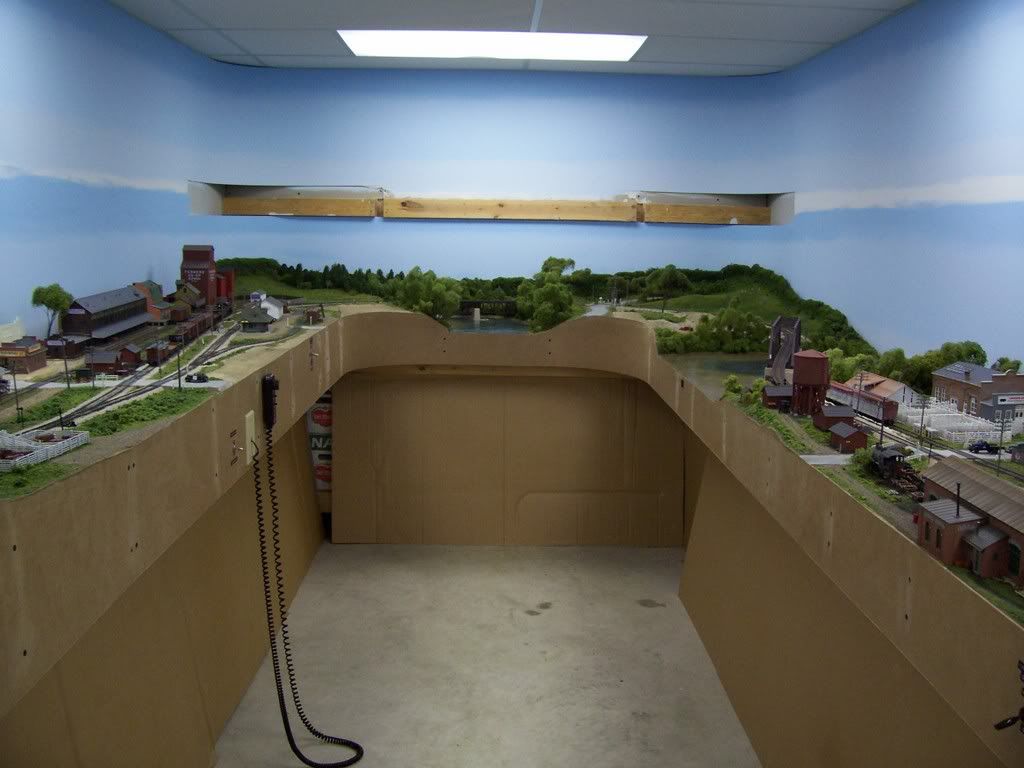
There’s no trackplan on the not-to-scale room diagram below, but the curves at the end of the aisle where Chippawa Creek is located are 34" radii, with a short straight section between them. The room here is only 9’ wide:
Here’s a look from the aisle:
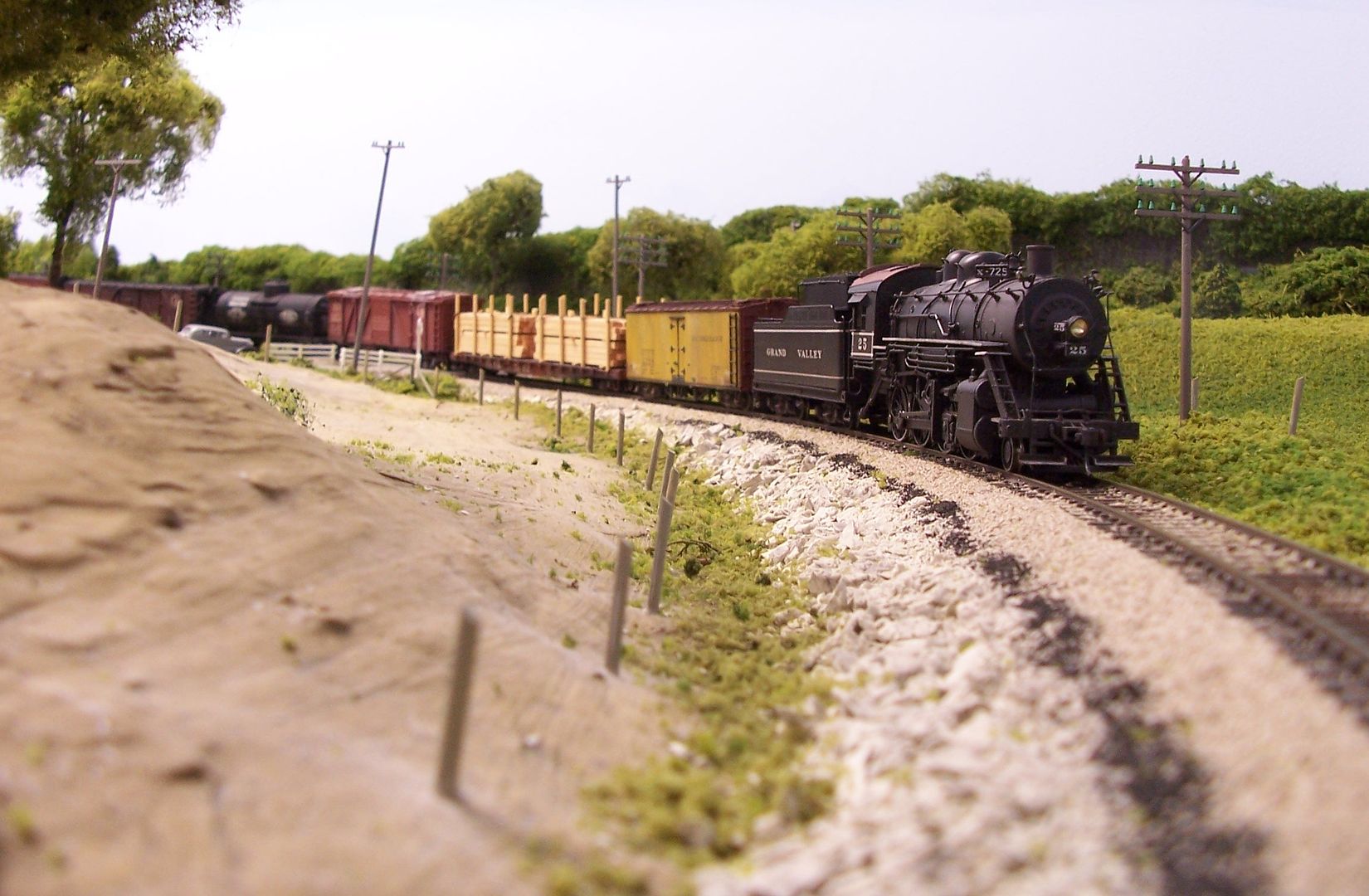
…and a train on the curve:
Wayne
LION runs SUBWAY TRAINS. Typically tighter radii are common. LION uses 50’ cars.
LION built table so that the inside curve of the TABLE was a 24" minimum, the theory being that tracks on the table would have larger radii. So much for theories. LION should have measured each track instead of eyeballing it. Some curves are far too tight for big equipments. But then LION runs no big equipment, so him is content with what him built.
If one had proper measuring tools and gauges that one could build a better mouse trap.
Oh well, gotta use what one has. A tail comes in handy for measuring radii, leastwise if you are not too fussy.
ROAR
Ditto that. I’ve built two layouts so far.
The first was a garage layout as a 16x19’ hollow L with minimum mainline curves of 30-inches and two 28-inch curves inside two reverse loops which were the absolute minimum. I had a few curves that were larger, 36 inches and a couple 42 inch curves. The 36-inch curve was where I could easily see my Walthers auto-racks and they looked sharp under them!
The second layout I build I designed in slightly larger 32-inch minimum radius curves because I was anticipating running some brass California Zephyr cars - it was a 14 x 24’ layout. Due to a move, I didn’t get that mainline completed.
If current home purchase plans are successful, I may have a 10x18’ basement room to design a layout. Due to its modest size, I may have to go with an around the wall design with a duck under. It should be possible to design in some moderately generous curves - I would shoot for minimum of about 30-inches again, larger where I can.
I set up a test track not long ago in my small living room using 28-inch radius KATO unit-rack and ran some SD45’s and SD40T-2’ with an 89’ TOFC flat car on it. Those 28-inch curves worked fine, but boy did they look sharp still!
So to echo what Mike said, 28-inch curves or even a bit larger should function ok with most long plastic HO engines and rolling stock, but they won’t look that good. Even 36-inch curves don’t look great under 89’ cars. It takes much larger curves to look cosmetically good, such as 48-
At the risk of seeming a jerk, your minimum radius should be whatever best suits your recreational needs. Some of those needs are obvious: the layout must exist within the space that is allotted to it – so, assuming you want a simple oval, you could use a radius smaller than 6.75 feet by the maximum overhang value.
If you’re modeling in HO, you should easily be able to fit a 79-inch outer radius with an inner radius around 77.125 inches, and straights around 77.5 inches apiece.
If prototypical operation is important, the inner curve should be good for an operational speed around 26.472 mph, and the outer curve should be good for an operational speed around 27.115 mph – in HO-scale; if you’re modeling in N-scale, those numbers are 48.684 mph and 49.868 mph, respectively.
Of course, if you’re modeling in N, you could increase the radii beyond what is the practical limit for HO, and bump the “allowed operating speed” slightly higher.
Although both Micro Engineering and Railway Engineering make custom turnouts and track sections, I doubt you’ll find any anything quite that gradual, so that puts you against the “minimum-vs-efffective minimum” conundrum.
There are myriad possibilities: you could use a manual “folding shelf” for track that crosses your walkway (especially at the doorway), or you could use a horizontal lift (“guillotine”) design – and either of those, with or without some degree of automation, all the way up to fully automated (preferably, I would think, with a manual interrupt, but I don’t want to get bogged-down discussing those details).
Or, you could choose a design that puts the layout on a table or island in the room, or you could put the layout along the wall, or some combination of those things. You don’t have to think outside the bo