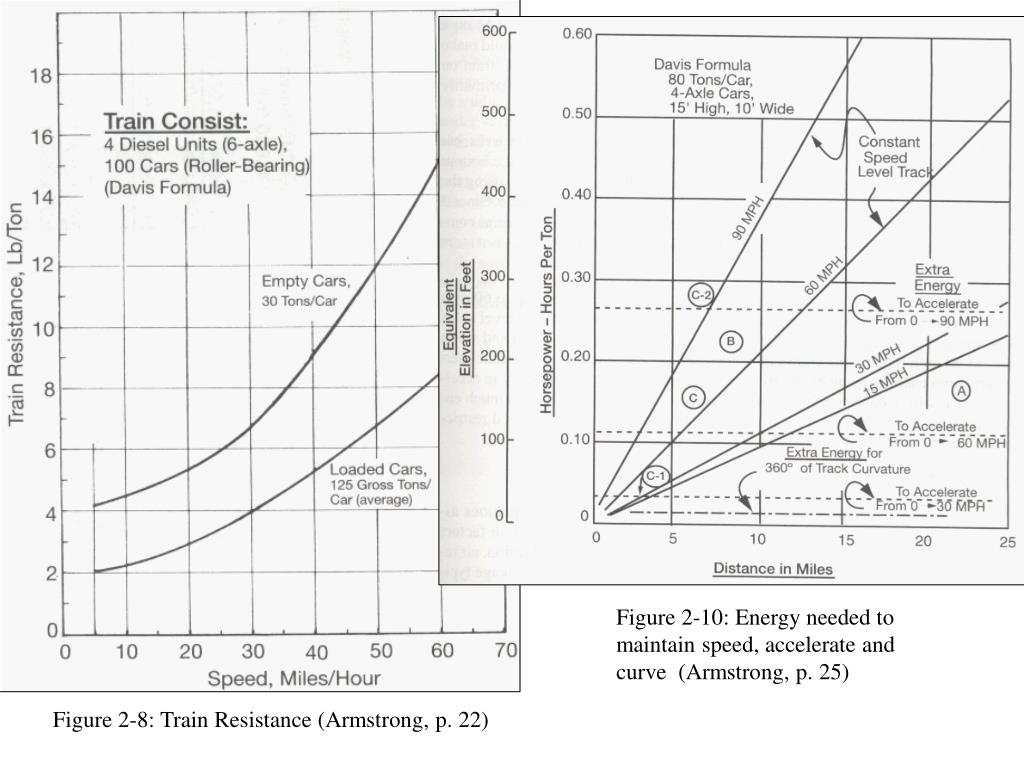
Charles, not really off topic, it applies to rolling resistance.
Our track, and prototype track is never perfectly level and we have vertical curves into grades, super elevations, etc.
Equalization keeps all the wheels on the rail ALL the time. Ever sit in a chair on an uneven floor?
Evenly distributed loads offer less resistance simply by being consistant. Loads that change create jerky movement, loading up, then unloading.
I pull long trains, there are lots of forces at work, equalized trucks minimize the chances that cars will string line in curves.
Additionally the trucks I use are metal, with metal wheelsets, this added weight is at the lowest possible point, making the car more stable, and allowing the gravity to center the wheelsets better.
Pulling ten cars, none of this will matter. Pulling a 50 car train, or 80 car train, of my 5.2 oz piggyback cars, it matters.
My tests show my trucks to be consistantly free rolling, as much so, or better than, any plastic truck/wheelset combo I have tested.
I wonder if the truck discussion merits its own topic? Although it certainly has a bearing on practical adhesion concerns.
Looking at this thing from first principles, once you reject the idea of clock-like cone-tip guidance, some interesting things follow, a couple of them involving ‘truck tuning’.
If we presume (“posit” is the famous pedant’s word; ‘stipulate’ mike’s) that the alternative explanation about bearings is correct – as I think it is – then we have two broad cases: one, that the axle is made of much harder material than the conical ‘journal’ area, or two, that it is plastic and perhaps low-surface-energy like acetal/Delrin. In both cases we also have the 50-degree axle cone and 60-degree ‘journal’ cone.
The first thing that jumps out is that “theoretically” you still have point contact at the tip if both materials are ‘inelastic’ as a couple of earlier posters assumed. The junction between two cones of different angles, whether or not centered, is only at the tip. Of course what this implies in practice is that depending somewhat on the weight there will be some point deformation, and this will result in the very slight flank bearing that Sheldon and others accurately describe. An interesting thing that follows is that, within what may be fairly broad limits, axle length becomes irrelevant to bearing effectiveness: the axle will tend to center between the two ‘journal’ cones and continue to have ‘optimized’ bearing characteristic (assuming only that its tips don’t permanently deform the sideframe material if they wander a bit with lateral loading) provided the 60-degree cone in the sideframe is consistent and smooth its whole depth. Perhaps this explains why truck tuning as a practice
That’s exactly why prototype locomotive suspension provides for equalization. There’s an equalization problem in line with the wheelbase and another across the track. The solution is both very simple and ingenious at the same time: sprung levers.
Bearings and especially the lubrication of bearings.
Lubrication of a spinning bearing is a very interesting phenomenon.
As the relative speed of the race and the track (not an engineer so I frequently forget the correct terms) increase the internal friction does not in proportion to that internal speed. Load effects also are not even close to linear which is the main reason for lubrication in the first place.
A spinning bearing with oil in it develops hydraulic effects from viscosity. The oil forms a ramp or wedge which drives the metal surfaces apart. This is easiest to imagine for a simple journal bearing with no moving parts.
The same principle allows a boat or hydrofoil to lift out of displacement mode, or indeed a stone skip across the water on a pond.
Aerodynamic effects that are related include reduction of drag due to boundary layer effects. Air to air friction results. Boundary layer also applies to hydrodynamic skin drag.
The friction within an oil lubricated bearing is primarily the viscosity friction. For hydrodynamic lift you expend power to lift the hull which then drastically reduces wave drag while increasing skin drag but by a lot less. Once the hydroplane achieves a stable plane power required reduces markedly or speed increases markedly at the same throttle setting.
I suspect the main rolling resistance effects for steel wheels on steel rails result from the rigidity and elasticity of steel. Pneumatic tires on some sort of concrete are compl
Another method of estimating coefficient of friction for locomotive tires on nickel silver rail occurred to me while watching my Rapido Royal Hudson chuff along at almost zero speed under DCC.
Just slide the unpowered locomotive using your spring scale. You get “stiction” friction as well as sliding or kinetic friction. Modern DCC locomotives might exploit stiction.
Using the inclined plane method you measure the angle at which the locomotive begins to slide and then the lesser angle at which it stops sliding. I don’t recall exactiy but I think you solve for tangent and that should get you your coefficients.
Even easier would be to use the difference in angles directly to compare relative pulling power of two or more locomotives. Not really necessary to actually solve for the coefficient or the drawbar pull force (tractive effort for the prototype).
This may be valuable in the kind of practice that many people reading this thread want to see, and it’s certainly a couple of techniques that are easily used. The catch is that any ‘macro’ sliding involves a very different mechanism than either actual adhesion from rolling contact or the sort of ‘stiction’ seen in creep control. For the latter to work at model scale you’d have to pulse the drivetrain reliably in and out of slipping torque at the same rate that produces the angular rotation of the wheels observable at prototype levels… remember the modulation produces pulse noise at audio frequency which will give you an idea how much the wheels actually rotate per ‘cycle’… and I suspect even full epicycloidal gearing with instrument-grade backlash compensation wouldn’t give that in a model.
You will note that I carefully beg the question whether the difference between ‘sliding’ and ‘static’ friction is that significant compared to the value easily observed for sliding wheels or locomotives. Large numbers of serious model railroaders won’t care and I’m not going to tell them they are wrong.
some of us have measured the pull of locomotives with wheels spinning as well as at just the onset of spinning. knowing the pull (oz) and weight (oz) of the loco gives use that number ~25%.
~25% can be used to estimate the drawbar pull of another loco simply based on loco weight and along with an estimate for rolling stock wheel resistance (~2%) explain why some locos don’t pull as many cars as the owner expects. sometimes the loco is light or could be balanced better and sometimes the trucks are the problem.
Working on my pretty little Genesis Mikado again it struck me that traction tire placement demonstrates why weight distribution on a connected set of drivers does not work the way one might think.
Why only one driver with a traction tire is required? The Genesis Mikado has none. I’m sure adding one would immediately solve the low drawbar force “problem”.
Some model articulated locomotives have a traction tire on each engine. This should make no difference to a single motor connected geartrain model. Is it as simple as manufacturing convenience? Two identical driver sets are easier to make than differing front and rear sets for each locomotive.
Then there’s the issue of compound articulated locomotives with separate high and low pressure engines…
Weight distribution doesn’t influence drawbar force unless (until?) the coefficient of friction is different for some connected drivers than others.
slip occurs when the force on the driver exceeds the friction force. while all drivers have the same force, the friction is lowest on the driver with the least weight.
Keep in mind there is static weight distribution, and there is “weight transfer” (when the drawbar pull is not in line; think of it as rotation degrees of freedom in addition to translation).
If a model locomotive were effectively equalized like the prototype, most of the pernicious efforts of individual-axle loading would be solved just as on that prototype: the equalizers would move until all axles were balanced-loaded, within the limits of suspension travel. That would have to be very carefully laid out and made, minimizing any friction or interference causing the equalizing to hang up, but it would require little lubrication other than perhaps at the pedestals to function efficiently if the contact surfaces in the equalizers were sufficiently hard and radius-formed and polished.
Instead, we get drivers that are sprung nominally to increase electrical contact, and while (as with locomotives in England built consciously without equalized drive) the spring pressure can be carefully adjusted to give ‘equal’ weight apportionment for adhesion to all the driver pairs, this will become wrong if the sprung driver pair is then floated up or down. Much more likely, I think, is the use of lighter springs pressing these down without much effect on actually helping suspend the locomotive itself in reaction – I suspect that in some engines the actual vertical suspension is carried (hopefully very unprototypically but you never know) on the lead and/or trailing truck(s). Now in my opinion if all the drivers were sprung (with the corresponding results on drive design) you would still have to be very careful balancing the locomotive fore-and-aft and then accounting for weight transfer, as all the springs will compress until in force balance with gravity, but this is not dictated by axial tilt but by weight distribution, and stopping the balancing short of equilibrium (e.g. by suppor
Two comments: it isn’t useful to consider the behaviour of rubber contact patches in a pneumatic tire when assessing how steel on steel develops drawbar force. Anyone who has driven an indoor only forklift intuitively understands why.
My point was about why only one driver is typically equipped with a traction tire.
Locomotive suspension was never about tractive effort as far as I can see. Locomotive springing would be disadvantageous were track to be perfectly level. The springing had to do with point loading at the rails.
Weight transfer effects may be useful to consider for sprung road vehicles but I doubt springing a locomotive has anything to do with that. Weight transfer is of course a misnomer, it refers to leverage effects on sprung suspension caused by driving or braking forces exerted at the contact patches. Weight is not changed much less transferred anywhere.
Total drawbar force is not affected by suspension of locomotive driving wheels and weight transfer has to be minimal given the very low internial moments as compared to sprung road vehicles. Increasing the load at any drawbar height above the rails will force the locomotive drive wheels downwards and deliver enhanced traction as a result. It should not matter whether that increased leverage is equally distributed across all drivers and springing certainly could not achieve that in any event.
The effectiveness of the single traction tire should prove this.
Why would this be intuitive for a forklift operator, since “indoor only” forklifts are (conventionally, by an overwhelming majority of standard practice) neither equipped with pneumatic tires nor steel tires?
Please do explain.
-Kevin (formerly an OSHA qualified forklift operator instructor)
Because any reasonably experienced forklift operator would likely have driven a forklift equipped with solid tires and maybe even one with pneumatic tires. You obviously have. But do you understand why solid rubber tires behave quite differently to pneumatic tires? That’d be interesting.
In the case of model locomotive traction tires you’re dealing with solid rubber and the friction effect of “creep” for solid rubber behaves quite differently to that of solid rubber tread on a pneumatic tire. Model traction tires also no doubt creep around the groove in the metal tire which complicates things somewhat. The object of my remark was to encourage some clear thinking about how a set of connected drivers actually develops drawbar force. I am saying that weight distribution cannot be one of the relevant factors, at least at 1/87 scale.
Part of this thread refers to “creep” as a part of transition from static to kinetic friction for steel on steel (or perhaps nickel silver on nickel silver) but rubber, now that’s interesting stuff. Given the very low contact area pressures of a model l
You know, I never thought about that – and it would be very easy to test and then measure: just matchmark a point on the driver rim with the corresponding edge of the tire, then operate for a while and periodically measure the ‘displacement’. I’m tempted to put out a ‘call’ for large numbers of operators to start doing this…
I think it is, but perhaps for reasons not in the representational models we’ve been making. Certainly several threads have noted that at least some models ‘pull better’ when properly balanced on the driver wheelbase.
I think we should set up some sort of experimental protocol to conduct reproduceable testing. Remember that although the pressures are low, so is the effective ‘contact patch’ between an unworn plated wheel and the square railhead profile at the gauge corner in a great deal of track.
I agree with you that the ‘null hypothesis’ is that little if any observable creep (in the sense that effect is relevant to prototype traction control) takes place, and I will raise the hypothesis by saying that its ‘scale’ equivalent would involve hopelessly minuscule modulation of driver rotation even with very fast, somehow effective pulse control of motor rotation.
The first objection that comes to mind is that boats don’t periodically have most of their effective mass wobbling near the
I was of course perversely referring to operating a fork lift as a vehicle. Of course the safety training relates to its primary function.
As for lever arms operating on boats, my default boat is a sailing ship. Now leverage on sailing vessels is extremely interesting and makes operating a forklift look like child’s play by comparison.
Also, I concede I was still mildly annoyed by a persistent and completely unnecessary difference in perspective which I intended to defuse, albeit somewhat aggressively. Hopefully it worked as intended, we shall see.
I’d like to add that the contour and burnish method has allowed any locomotive I have tested to pull considerably longer trains
I don’t know if the adhesion is improved but at the other end the overall drag is significantly reduced and that puts The forces in the locomotives’ favor.
that being said there is reduced Shudder on wheel slipping and overall consisten operation
I’ve had locomotives that were definitely “slippery” when new. I’m thinking of the Broadway Limited PRR P5as as my most recent example.
The six drive wheels and three axles are pretty rigid in the frame. I’ve been running three of them on a sixty-car freight over the past month or so. In the beginning it required all 3 motors to move those sixty cars up a 2% grade.
Recently I removed one of the motors and the two remaining P5as are walking right along with the same sixty cars.
There may be a coating (darkening agent) or manufacturing oils on the wheel treads but I believe as the engines are run-in that the bearings and wheel treads even out and pulling power improves. Ideally, each drive wheel would bear exactly 1/6 of the weight but without equalization this is not easily attainable.
I believe most engines require at least five hours and maybe more of actual run time before they find their “sweet-spot” and get down to business.
I would have much prefered BLI would have designed these three-axle locos with sprung journals but maybe they will be OK afterall.