I’ve heard that many short line and some regional railroads - perhaps Montana Rail Link - still run cabooses, but that info may be out of date. Can anyone confirm that some larger-sized lines that still do so?
If so, is there a specific ongoing reason they aren’t using FREDs?
Assuming no rolling stock manufacturer still makes cabooses, is there a specific style of steel caboose that is still in service?
Thanks…and hoping I can add a cool caboose to my line…
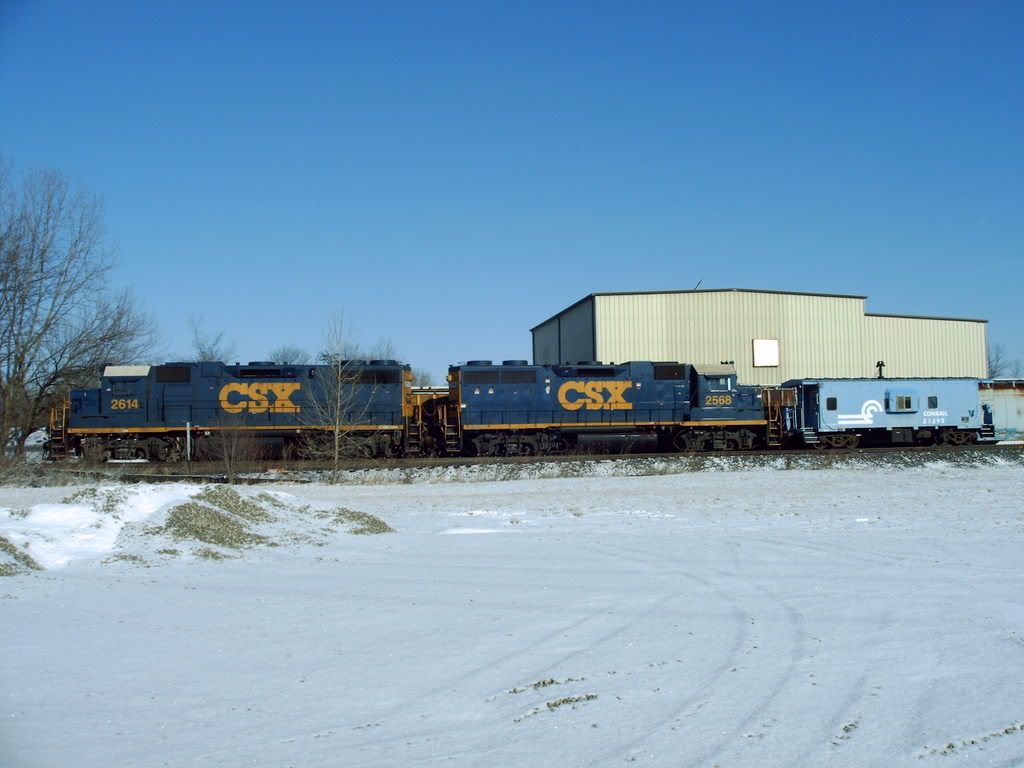
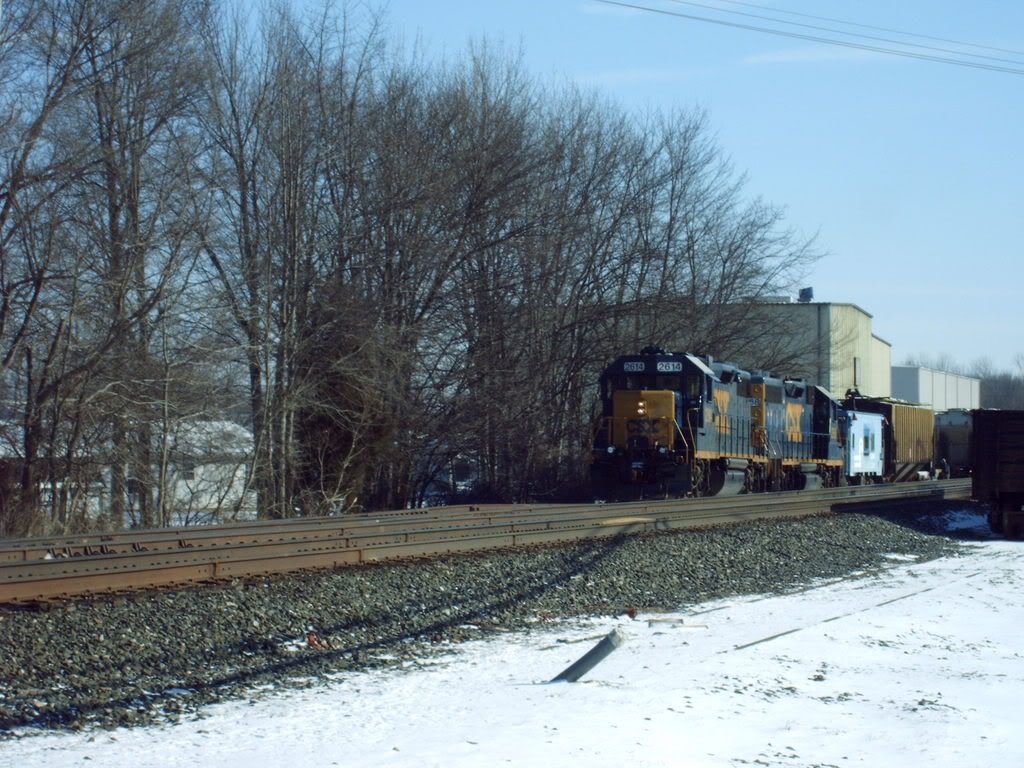
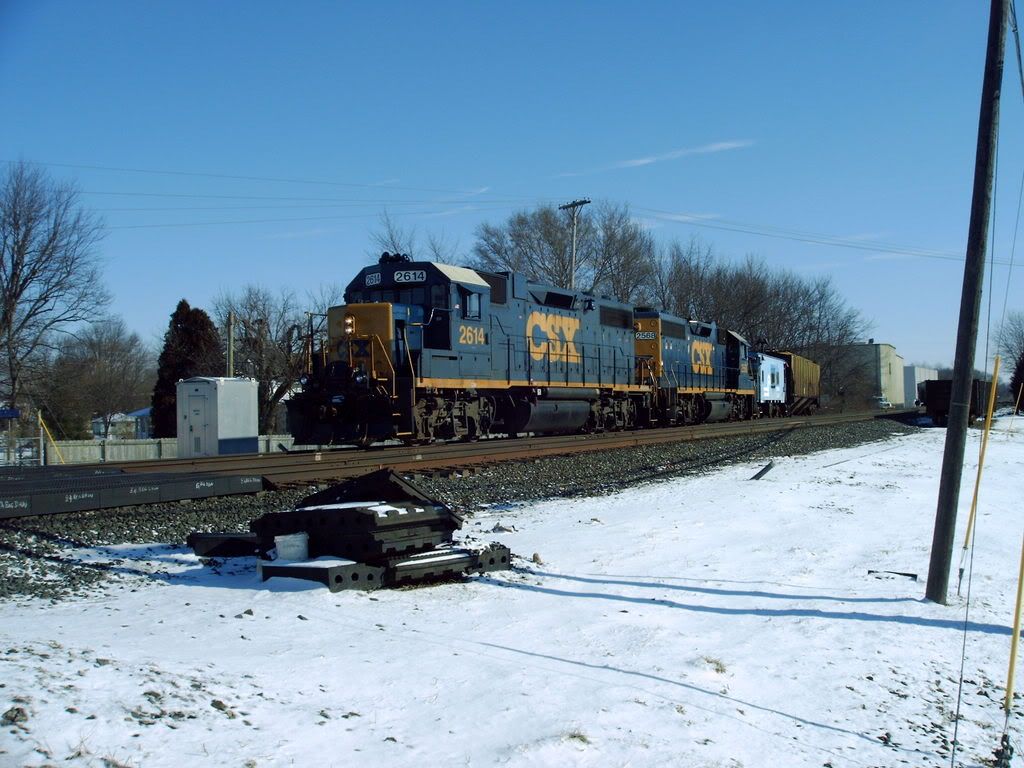
CSX says they don’t run a caboose any more, but I shot the Fortville, Indiana local doing some switching just two weeks ago, and guess what…
This is the way they showed up for their pickup.
And here they are working the local industry siding.
They picked out several more cars as well, but I won’t use up all the bandwidth to post them here.
When it was all said and done, they threw the caboose on the end of the train and headed down the tracks.
I know that sometimes they use a caboose as a spacer car or in MOW, but they used it here as a spacer for picking the cars, then as a regular old fashioned caboose when they left.
Some regional and even major lines use cabooses for certain work,; maintenance, lots of switching, and lots of back up moves. They use whatever’s still around. probably the newest ones that were left.mike h.
I don’t know if this helps because it’s not really modern(more like 1990s) But, Wisconsin Central took 5 cabooses and re-did them. They Put horns and lights on them and the engineers controled the locomotives from the caboose via radio control. I think they did this to cut down crew numbers.
I saw one on a train coming in off a branch at Goshen, IN, a few months ago - it was an old Conrail bay window job. Looked like they were carrying guys to do switching work out at the end of the branch, and they needed more than two people for that.
Technically, they’re not cabooses, but rather shove cars. The cars, either stripped cabooses, or modified flatcars, provide the crew a place to ride on extended shoving movements.
If they are called cabooses, they still have to be equipped like cabooses - seats, toilets, stoves, ect. By calling them shove cars, the railroads can eliminate all that.
Some cabooses still exist as research cars, and ride along cars for shipment protection.
The BNSF seem to have a caboose at every major yard, I assume for transfer jobs and as a switching platform but who knows. At some of the old ATSF yards that I have visited they have the (ACF?) wide vision cabooses for this use. One I saw in Belen, NM, 1 in Shopton (Ft Madison, IA) 2 in Albuquerque and one in Chicago. The wide visions were the last ones purchased by the ATSF so it would stand to reason that they only kept the newest ones. I have not seen an older style caboose on the ATSF since the late 80’s. You will also notice that on most of the cabooses they have covered all the lower windows. Apparently the big red cabooses attract graffiti artists because there seems to be a trend there. I’ll post pics of the ones that I saw in Albuquerque May 2006.
ok. I found the book where it mentioned the radio controlled caboose. Here is what it said:“In an unusual twist, the Wisconsin Central Railroad used cabooses to reduce the number of crew members needed to operate certain trains.” It also said this:“Thus, an enigeer can aslo serve as his brake man, throwing switches and uncoupling cars while controlling his locomotive from track side.”
Don’t know if they’re being used as “shove cars” or full fledged cabeese, but CP Rail uses a couple of old Soo Line cabooses (one white, one brown, both horribly rusty) on runs south from Pig’s Eye yard in St. Paul down the Mississippi a few miles to the oil refinery just off of 70th and Hwy 10/61 in St. Paul Park MN. I see one or the other once or twice a week being used with a string of tank cars and usually a couple of Soo diesels. The diesels pull the train going south, coming back north the diesels stay in the rear and push, so the caboose/shove car is up front. Kinda like a push-pull commuter operation I guess!!
My freelanced railroad, the Springfield Central RR uses cabooses, so yours wouldn’t be the only modern railroad to use them. How large is your railroad? Mine would probobly be a Class 2, so I’m not sure it would classify as a “larger-sized line”.
There is a daily BNSF local (possibly called the 4th La Mirada, as I hear this on my scanner all the time) that includes an ex-ATSF caboose in the Southern California area. It is essentially the same modern era ATSF caboose that El-Capitan posted, complete with its own graffiti. It goes through Fullerton then heads down the Surfline to make some pickups and drop offs at some of the trackside industries in Anaheim. It continues down the Surfline until Orange where it “wyes” and heads north east to reconnect with the mainline at Atwood. It’s not really a wye but a very large triangle with Fullerton, Atwood, and Orange as the points…but I’ve always referred to it as the big wye.
When I was attending the Chapman University Law School, I used to park my car in the lot that is adjacent to the tracks in Orange Ca. After morning classes and before my afternoon internship job at a local law firm, I would have lunch and wait to see the local pass by running backwards caboose first, stop, then head forward off toward San Bernardino. What a sight to see while having lunch.
Because of the many back up moves this local makes, the caboose is needed. The employees really seem to enjoy riding in the cupola…a rare occasion in this modern era. If anyone has the chance, definitely try to see this oddity.
My Allegheny Highland/Virginia Western freelance spans western VA and into WVa, having acquired trackage from CSX and NS…it would be considered a regional, I think, rather than a simply a shortline…so the caboose issue I want to stay on the right side of prototypical reality fo such a line. I heard though that Montana Rail Link uses cabooses (cabeese?)…anyone know about that?
I found an image of a Montana Rail link caboose: http://www.trainnet.org/Libraries/Lib005/MRLC1004.GIF . It said it was taken in 1996 so it’s not really modern. I read that Montana Rail Link still uses Radio controlled cabooses. Here’s the site:http://www.railroadforums.com/photos/showphoto.php/photo/43181 I guss the radio controlled cabosses are pretty common. On my layout it has a 3 percent grade. I have a caboose that’s not proto-typical at all. I call it a “helper caboose” and it has an air tank under it for better brakeing power, a power box, and a horn on top. It also has a radio atenna, running boards, and bracing cables. It’s like the radio controlled caboose, because it controls the helper locomotives. But it still has it’s windows open, and every thing else.
Looks like a cool kitbash, making a radio controlled caboose. Two examples here, WC and Montana Rail. I didn’t know about this, learn something every day on the forum.
I’ll use a caboose on my MOW train, too, and maybe for some remote mountain-local switching.