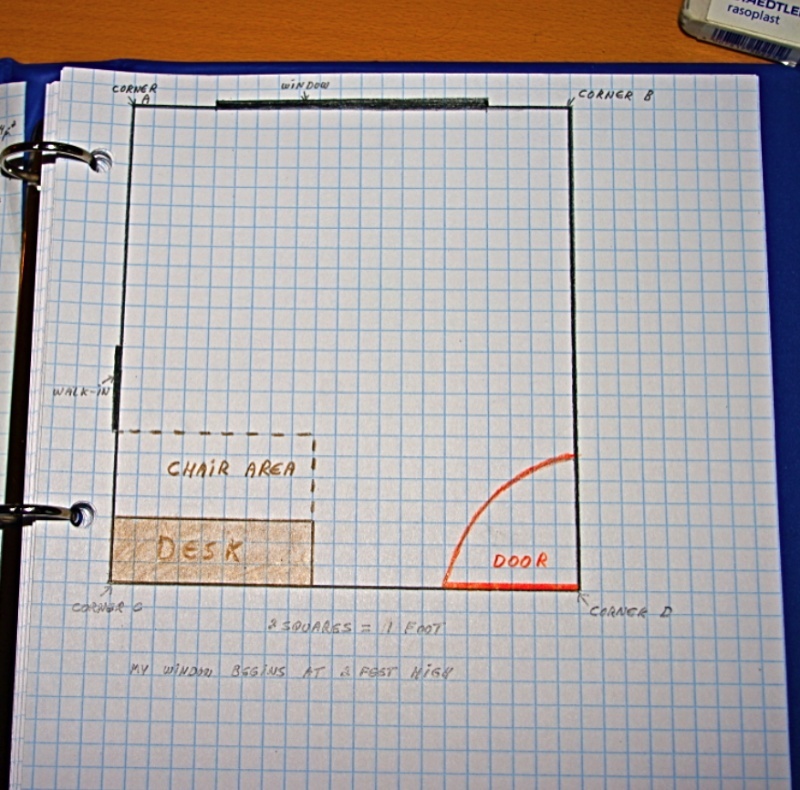
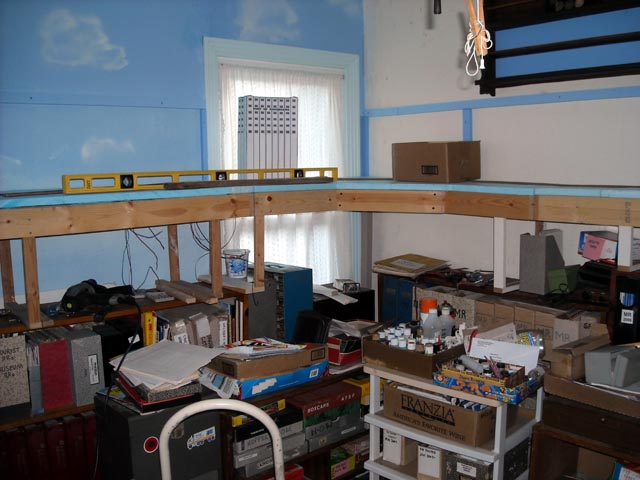
Hello guys, I just made a plan of my little room to see what kind of N scale layout I can have. My room is 11’ 6" by 10’ 6". I have a walk-in door, a big window that starts at two feet high and a modeling desk that I plan to buy. I decided to put my desk at this place but it’s possible to put it at another place.
I would like to have the longest layout possible. On my layout, I would like to have a lot of industries, a little village and a freight yard in which I can do a lot of switching. I would also like to be able to have a train doing a circle around my layout when I use another one for switching and classifying cars …
First, to help the folks here, what scale? EDIT: Oops, I see in your tags you said N scale, doesn’t change anything below.
You can have your layout high enough so that your desk can go under it, thus not interfere. Just don’t plan to put it under a section where you may need to reach in to correct oops’ like a switch yard.
Foam (blue or pink) comes in 2’x8’ sheets (some places 4’x8’) and that makes a good depth for a layout. If you want you can go a little wider, but check how far in you can reach, considering scenery and the height of your layout before you make it much wider than the 24".
You can angle a narrow section across the corner where your door is to give you continuous running. If your layout is high enough and you are flexible enough you can duck under. Otherwise a swing or lift gate would be needed.
A 2’ high scenic backdrop in front of the window would leave light coming in the upper part, yet block the window in the primary viewing area of the layout.
How mucof a layout errrr… what shape do you want? an L shaped layout may serve your needs or an island layout. If you want wide turns of atleast 15" R you could do 3 to 3.5 feet wide for an L shaped layout. that should be enough to reach across. if you do an Island layout you could do 6 by 8 feet if that’ll fit properly in your room with enough space to work around the edges.
What railroad prototype/protolance/freelance are you doing? I remember you referencing yourself as a canadian modeler, but there’s lots of Canadian railroads to choose.
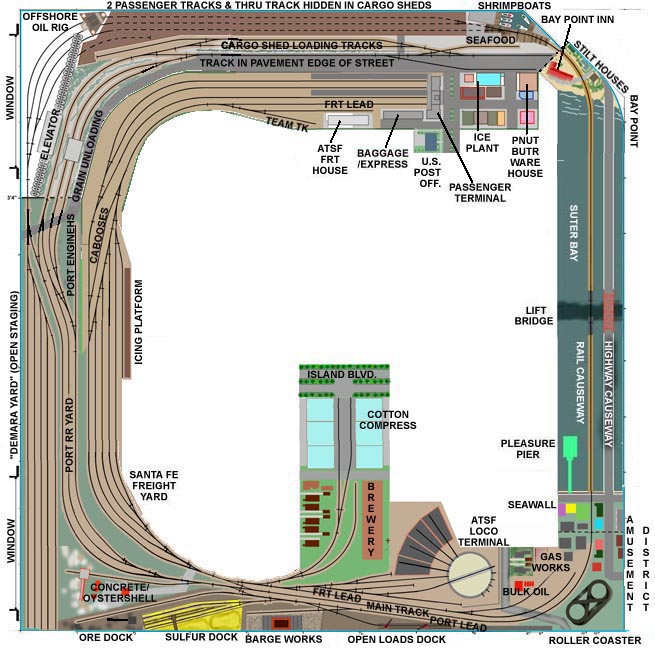
This N scale layout is perhaps too involved for a first building effort as-is, but the overall shape and arrangement might give you some ideas. It is a little smaller than your area, I think, and could be simplified. A more-detailed plan is available from the linked page.
Note that a workbench is placed under one section, as others have discussed for your desk.
Hi guys, I would like to model a Canadian National locomotive and maybe also a Canadian Pacific. I would like to have, if it’s possible, two trains running at the same time.
I hesitate between those periods:
1955-1965
1975-1980
I would like to model a region called the Laurentian mountains (Laurentides in french).
Cuyama, your layout looks great but it would be impossible to use one like this because I have a huge window, a door and a walk-in that I can’t hide.
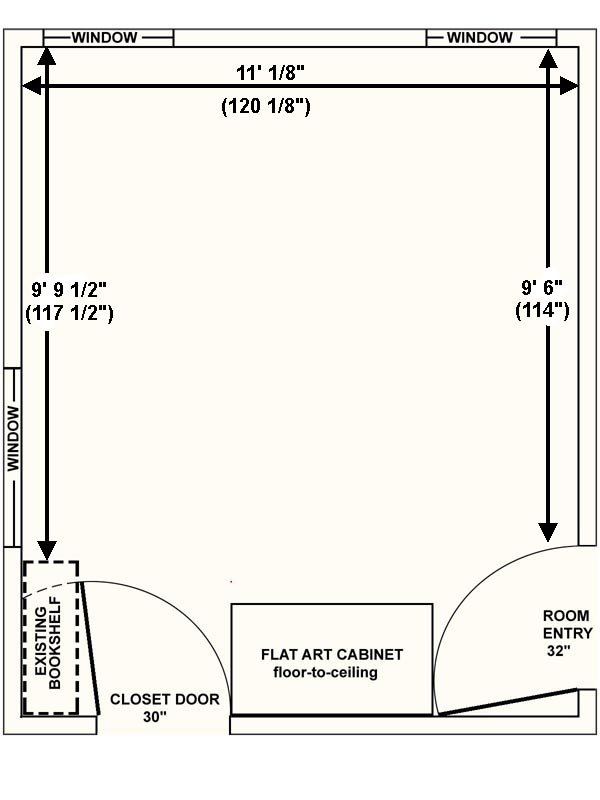
I have a room with a usable area very similar to yours.
I am going around the room with a layout 14 to 27 inches deep, 18 inch radius mainline curves, no grades.
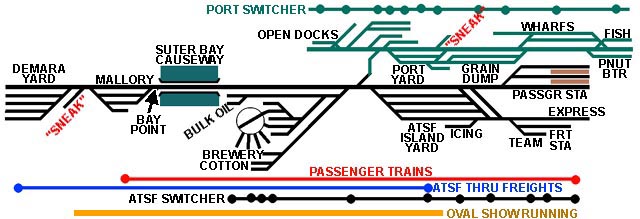
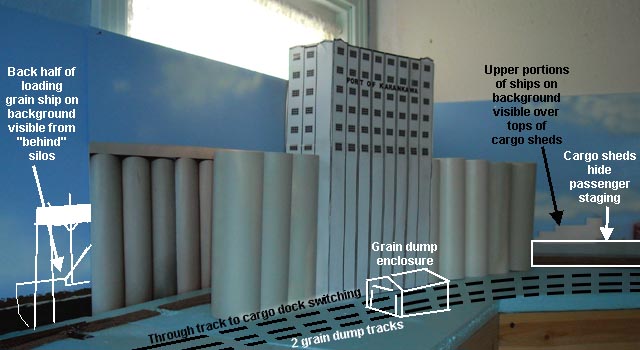
There is only one continuous loop route, and it is not intended to be used for normal operations, only for test running. The main route is one and a half times around the room from open and hidden staging to end of the line terminal yard and passenger station, and interchange to port switching railroad.
Access to middle of layout via duckunder- which can be rolled away when not running or better access to room needed.
Duckunder made to resemble “mile long causeway.”
Open staging disguised to look like one of several adjacent railyards in congrested port area.
May not be anything like that you are trying to achieve, but an idea of what can be done in similar size space.
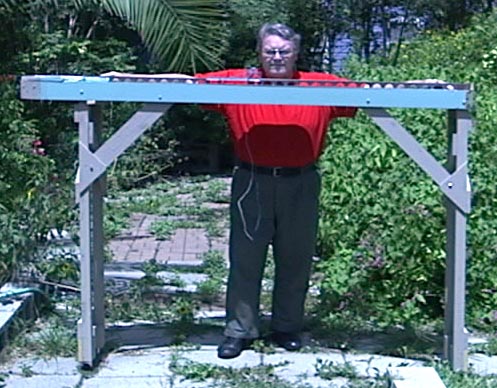
You don’t need to make your tracks go up and over your desk, you have the whole shelf your layout is on high enough so that you can work at your desk under it. Your desk top probably isn’t more than 30" to 32" above the floor, many folks have their layout at 42" or higher. You can either have your desk pull out a little (put casters on it) or just have a slightly narrowed shelf above the desk. Might help you to read a little about shelf layouts to understand their construction. Actually they are quite simple.
A duck under would suffice if you want to have continuous operation. If you are young and can duck, leave it as it is and duck until you have a different space or gain confidence in your building skills. If you have issues ducking underneath a shelf at the height you decide to set your layout at, get a roll around chair at a yard sale or used furniture store. My friend has done this and it works even though his layout is lower than it should be for a person of his height.
There is a book on shelf layouts available from our host or maybe someone else can refer you to a post that discusses them. Do a “Search Our Community” in the right hand column and you should find some information on them.
That is a great track plan,design…If you or someone you know is construction handy,consider a pocket door for your closet and maybe for your entrance door… I have four in my house,installed by me and they are a tremendous space savor…Just my thought!!
In fact, if I put my shelf at a height of 5’ I will block most of the sunlight coming from my window. And if I put my track down below my window, so at a height of max of two feet, I think it will feel weird, don’t you think?
Zstripe, what do you mean exactly by pocket door? Do you have any pictures so I can have an idea?
I forgot to mention that I’m open to different shape of layout if it’s convenient for my modeler’s desk and if there are enought room left to move around my layout.
A ‘‘Pocket Door’’ looks like a regular door from appearance,but it does not swing,it slides on rollers into the wall,thereby having more usable space… If you have lumber,or big box stores by you,ask them if they have any,pocket doors,they come in different widths…
I don’t have a pocket door but my walk-in has another kind of door. One that when you open it, the door separates in two-parts and the door is cut in two.
I don’t know if you understand my explanation lol
For the pocket door, I’m not very good with my hands so I’m not sure I would start a project like this soon.
Those doors that you describe are known as “folding doors”.
Pocket doors are a good idea, and a great space saver, in new construction. But, in an existing finished room, the wall has to be opened by removing the drywall and trim and then tearing out studs to build a header in place. Not a task for the timid. You need a carpenter or else you better be experienced with construction techniques.
I understand very well what you mean,it’s called,a ‘‘Bi-Fold’’ door…Yeah the pocket door can be a little challenging for someone with minimum experience,but great to have…Year’s ago my first,I made a funny and put a door knob on it,I still laugh thinking about the people that could not get it to open.LOL…
Your layout only has to block as much light as you want it to, other than the actual thickness of your layout base and framework. You could have a short backdrop or none at all if you want more light. A removable section could be put in when you are running trains and removed when you want more light in the room.
I wouldn’t suggest putting your layout below the window, at that height it would be very hard to work on. Unless you are quite tall, I think 5’1" is high, though some folks do have it that high. If you are worried about hitting your head when working at the desk, your base doesn’t have to be as wide as the rest of the layout. You can get a lot of activity in a foot width for N scale. Sit at your desk with something mocked up to simulate the layout shelf, raise it, lower it, try different widths to see what will work well for you,
You said that you wanted to model the Laurentian mountains area. I couldn’t find data for the CP in this area, but I found a CN system map with pretty good detail.
It looks like no railroads run through the Laurentides Park, but several lines skirt the area. There is a single track CN branch from Quebec to Clermont. This branch runs along the St. Lawrence river for almost its entire length, and is still used today.
In 1965, there was a line from Quebec to Riviere A Pierre through St. Reymond. It appears to have been another single-track branch line. It’s now a bike trail. Google Maps lists it as “Velopiste Jacques-Cartier/Portneuf.”
Another single track line went from Chambord to Riviere A Pierre. From what is on the “map” section of Google Maps, it seems that the line is currently abandoned between Lac Minerve and Van Bruyssel. Google Maps has an old satellite picture and shows the line in use. An even older photo seems to show a yard and wye in Lac-Edouard. It also seems to show something in Linton, but the resolution is very low. There is a small yard in Riviere A Pierre, and it used to meet the Quebec to Riviere A Pierre line. Part of the wye is still there. The line continues south. This line seems to mostly be single track along rivers and past lakes. Great scenery, but little operating interest.
The fourth line near the Laurentian mountains goes from the wye at Chamford to Chicoutimi. It runs along Lac Saint-Jean for a ways before going inland. There is a wye in the farmland near Staint-Bruno, and a branch running to a loop around a large plant between Alma and Delisle, near Dam-en-Terre. Google Maps has no information as to what the plant is. After a bit of searching, it seems to be a Rio Tinto Alcan (just Alcan before 2007) aluminum smelter. It seems to be heavily rail served, with a two small