It is so nice when a breakthrough comes. I have been struggling with the idea of the California Western. With one level I can get the whole line plus the Interchange yard at Willits. But I wanted more and varied operation. So I sat down this morning and drew out the schematic.
The problem, like with all two level layouts was getting from the bottom to the top. A helix was pretty much out of the question, and using a Nolix meant an errant main-line running at grade though every scene. I could get it almost, but always there was a situation I just couldn’t stomach.
Today I figured it out. I looked at the space between the water heater and the furnace and figured a helix would fit, but look like heck and be very inconvenient. Then I figured I could run behind the furnace and loop back the same way. I would not lose any space by the heaters (I was planning on having the freezer there) and the loop would be suspended from the ceiling and would not mess with my entertainment area as everything there would be low.
So, the top deck is a go. The “(or mining)” becomes logging And the mining operation is moved where it should be out on the NWP (No Where in Particular) . The NWP was owned by the SP and ATSF which is the bulk of my fleet.
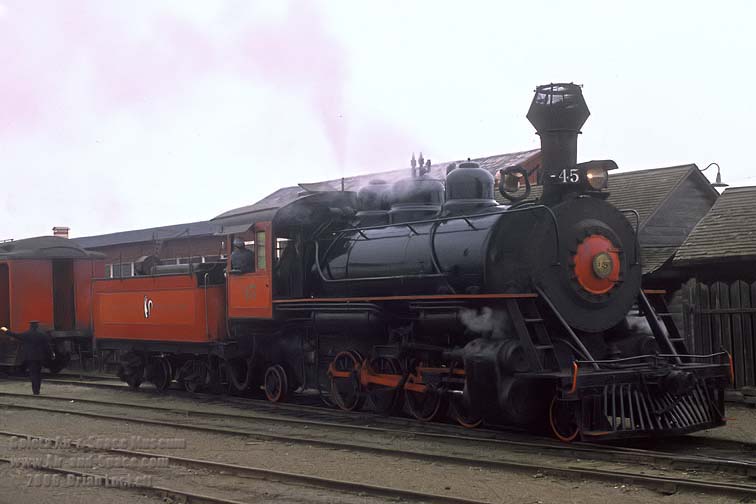
And this morning I found a color photo of the official color scheme. Now when I look back at the black and whites I’ve collected, I can see which engines where painted that way.
Now if I can figure out the colors of the California Western.
The engine, I fear, is the tourist version, as I fear the skunk on the tender wasn’t there before the 30’s. I might adapt it if I don’t find anything else. I’m actually considering calling the Fort Bragg library and and asking a librarian for book suggestions.
Congradulations. My plans are falling apart. I seem to be unable to get the stagging yards in the proper sequence to provide for a decent run. I’m toying with the idea of using a loop to gain altitude to a second level on which to locate the needed second stagging yard.
I suspect being a logging road, any color other then black would have been rare. #45 has worn two different brightly hued schemes during the excursion era, done to appeal to the tourist and not that of a work-a-day operation.
Good concept on adapting the Skunk logo for your time period, It was first used on company tourist brochures and timetables around 1927 or so. The road aquired the Skunk moniker upon delivery of the rail diesel cars, it was said you could smell them before you saw them, hence the nickname.
Way to go, Chip! It looks great to me, especially with your new eureka. It will be interesting to watch you go through what Jarrell has gone through, from the bench to track, to… [^]
Hmmm, I can’t tell if that is gloss black on the boiler just reflecting the light as opposed to the flat black of the smoke box, or if it is actually a lighter color. Blue? Battleship Grey?
Another breakthrough. I found a 1914 film–298 minutes long, of the Northwestern Pacific railroad Golden Spike celebration and some of it was filmed in Willits.
And I found a roster for the Cailifornia Western. The bad news is that their main roster was 2-6-2 Prairies in 1917, the year I settles on and only Bachman Plus (with real smoke) makes them that I have found so far.
Yes the smokebox area often was painted a different color - a graphite-based paint (which is a silver color) or a color sometimes called “russian” or “russia” iron. Just exactly what that color is has been the subject of many debates, as you can determine general shade from a B&W photo, but not exact color, and they simply did not have color photography back then, so it all relies on written description. And even among people who have no problems with color blindness, details of a shade are often quite subjective.