Hello all. Its been quite sometime since I posted here, life and other pursuits took priority. Now I have some time and space for a real layout. It will be a multiple layer layout around the walls in my spare room for a HO layout. Lower level will be 12" from floor and consist of nothing but staging and yards. The next level will be at 36" from floor and consist of the main part of layout with a possible penninusla. The upper level will be at 60" from floor and be just simply more track to make the run longer. very little buildings but lots of scenery. The lower will be U shaped, the middle will have a lift up for entry and the upper will be high enough for a slight duck under. The room is 12’ on long wall, 10’ across, and 8’ on short wall. My questions are as follows.
Is 18" radius too shallow for a helix spanning 4’ with outlets to middle and top level if I am running longer cars such as 86’ box cars or longer locos such as Dash9?
Is 24" too narrow of shelf for good HO running?
Is there a good resource out there for step by step helix construction?
Is there a better way to transition from level to level?
Helix radii less than 24" in HO are going to be major headaches unless you are dealing with small engines and small cars with good weighting and balance…and couplers. Eighteen inches is well under that.
24" for shelving is very generous, even for a main level. Your upper level could be as little as 6-8" if you do it right, even with a passing siding.
Can’t help with the helix resource, but at least one member, Mark Brunton, has a monster built. Others will provide guidance there.
There is a system informally called a ‘no-lix’ where you use grades between levels, but it involves loops or switch backs and a ton of linear trackage placed solely for that purpose. Again, I’ll let those who have undertaken this approach to offer comments.
Thanks for the info Crandell. I have updated my design with a helix with 24" radii. Trying to figure out how to work in a 12 stall roundhouse into the lower level. I am using Atlas’s RTS 8.0 freeware to design the layout.
What type of track do you prefer, flrx track or the piece by piece method? I realize this is going to be a major undertaking but really looking forword to it, even if I can only run the trains with no scenery for a while. Are there any good websites out there to shop HO products. I browse ebay every night
In any case, you should go for flex track - it makes your design more “flexible” and more prototypical. flex track is a little more difficult to lay, but the result is rewarding.
Btw, you can save your RTS-files also in am .bmp or .jpg format, so you can post them here!
Yipe! Even with your later post saying you’ve updated to a 24" helix, I would say is going to be tight. I have 80’ passenger cars that can have trouble on 28".
Well, you can´t beat the laws pf physics! When you built a helix with a tight radius, you will find your trains derailing constantly, unless you use truck-mounted couplers. But even with truck-mounted couplers, the minimum radius should not be below 24" and the maximum gradient above 3%.
A friend of mine had to tear down his entire layout and start anew, as the two helices he had built were a constant source of trouble. Building a reliable helix requires quite a lot of precision. MR ran a number of features on how to build a helix in the past 10 years, unfortunately, I don´t recall in which issues.
Well thats why I came here to ask you guys. i have only built simple 4’x8’ layouts and really want to do something more fun. I mispoke earlier. I redesigned my helix using 24" radii track and it comes out to roughly 4’ across. Would this be easy to run longer cars and locos on? Guess I shouls have mentioned I want it to be a double track helix, one track up and one down. Space wises I have the perfect spot for it in the corner if it doesnt get to big. What about building a lift up setcion for a pass through, anyone ever done that?
First, a 24" helix is too tight for the long equipment you wish to run. Second, the full width of the helix, including clearances and suports at the edge, will be signficantly wider than 4 feet. And if by “one helix up, one helix down”, you mean helixes turning in oppostie directions, you’ll need even more width.
It’s been suggested multiple times in this thread that a tight radius helix is not a viable idea – particularly if you’ve never built complex layout sections before.
I tested several HO steam locos and passenger cars on a 24" radius loop to determine the capabilities and running characteristics in that environment.
BLI M1 4-8-2
Proto 2-10-2
BLI Q2 4-4-6-4
All performed flawlessly
BLI T1 4-4-4-4
Was acceptable but not as smooth with lots of overhang.
BLI J1 2-10-4
Was tight with some “creaking” but did not derail after several tries and about 20 min of continuous running in both directions.
Bachmann 80’ coaches with swing mount couplers, and examples of all 50’ and 60’ freight cars (and head end passenger cars) in my collection with body mounted couplers were also fine.
Centrailia PRR P85 coaches operated reliably.
Walthers heavyweight passenger cars did NOT operate on this loop. They will need modifications to the underframe.
I then tested at 26" and 27.5" and there was no noticeable improvement in the J1, T1, or walthers cars, other than a few less creaks from the J1.
Be sure to factor overhang into your overall space requirments, as well as the fact that 24" radius is the track center line, not the outer edge. this quickly becomes 52-54" or more, depending on the overhang of YOUR equipment.
Hummmm maybe I need to look into using the long linear grades to transition between levels. Could someone tell me more about this method? Right now my plan is to have three levels. The first at twelve inches off the floor the second at 24" from the first one and the third at 24" from the second. If I used the linear transition I am seeing a possible change in spacing, maybe just 12" between levels. A helix any larger than 4’ across would take up too much room. Any help that you guys can give is greatly appreciated. Like I said this is going to be my first real layout and I want it to function as smooth as possible
Your project of building a multi-deck layout is certainly an ambitious one, if you have never done it before. It is not an easy task, and honestly, even with my experience in building layouts of more than 4 decades, I would not tackle this one. Also, a layout height of only 12" above the floor seems fairly low - is it not possible to have the first deck at 36", the 2nd at 48" and the 3rd one at 60"? That would be much mor comfortable to build and operate.
Kalmbach has just released an interesting booklet, where you find answers to your questions:
I second the motion on the deck height. 12" is waaaaay too low. I have operated on layouts that did that and it wasn’t fun.
I also would suggest you revisit the whole concept of how the plan is organized:
Putting your yards 12" off the floor wil be horrible to operate. Real railroads have running between stations. Unless you are putting in a bunch of helixes to get between the 2nd and third level having all your switching on one level and all the running on another level will not be a satisfying plan.
With the distances between decks you will have most of your running in the helices. For example at an extrememly tight 24" radius with 4" between turns, each lap is approximately 13 ft (2.6%). 12" to 36" is a 24" climb. That means 6 laps in the helix or 78 ft of track. Going from 36" to 60" is again a 24’ climb so another 78 ft of track. Then getting from the top layer back down to staging is a 48" drop, another 150 ft or so of run. In your plan you have about 320 ft of track, 5 scale miles, in helices.
I will definately have to buy that publication. My biggest reason for a multi level layout is the space constraint. I see that there will be a section on a train elevator in the book, a concept I had considered. Also looking into the No-Lix concept now. Any helix larger than 4’ across will just take up too much space. Anyone have experience with this? Also I have adjusted my heights. Lower level will now be at 36" then 48" then 60". Are there any other, non expensive model railroad design programs out there? I would like to be able to draw my own bench work.
Besides all the othewr replies as to the height and helix radius, a decent operating helix for the length equipment you want to run should be 28-30". Just because a level turn will work, doesn’t mean that the forces exerted on the train on a grade within a helix will.
A helix of this size will eat up considerable rea lestate from that smallish room for the layout.
A better idea would be a 2 level layout connected by an around the room “Nolix”. You could have a lower level staging. This is quite an untertaking as mentioned, I hope you’re ready for it. The layout design will be critical for decent operations.
To design a Nolix running against the walls will require some inovative construction for the track to pass through the benchwork for the elevation/ grade. Basically, the benchwork will need to be almost free standing at the track penetration and grade clearance. In 10 ft you will only gain/ loose 2 3/4" @ approx 2 1/2 % of grade. You could go to 3% but that would be the max. Running this grade at the isle is not an option as you will block the level.
Save image as a jpg file on your computer. Make it some smart size - e.g. 640 x 480 pixels or some such thing - will make your image hosting account hold more pics and make it easy to view your pictures.
Upload jpg to some web server hosting pictures (e.g. sign up for a free account at http://www.photobucket.com) .
Copy URL in “direct link” box under your uploaded picture on photobucket.
Click on “insert picture icon” while writing a post here (looks like a picture of a small tree).
Paste link into popup, click “OK”.
Btw - as a side observation: this is such a frequently asked question that it really should be in the welcome mail people get (or should get) when they sign up for this web site.
Each ‘PDF’ includes helix rationale (probably better in volume 1) and helix construction (probably better in volume 2), and; you will understand ‘why staging’ after you read these PDF-books.
Each ‘PDF’ has an article actually incorporating serial (not parallel) staging (occurring on the helix):
Volume 1 article, The Silver Gate Northern, is along 2 walls with a dogbone-appearance on each end, that in a sense reminds you of a walk-in layout, where the helix is at the left end of the layout.
Volume 2 article, Union Terminal Railway in HO Scale, is constructed as a 4’x8’ layout with the helix underneath part of the 4’x8’ from upper to lower level.
An example of one subtle question (with diagrams) answered in volume 1: Should your ‘Track Approach Grade’ to the helix be level, or already on a grade – when it reaches and leaves the helix?
When I download a PDF-book, it is printed on a black & white laser printer, that nicely greyscales any color photo/graphic – then is 3-hole punched to a notebook for easy reading.
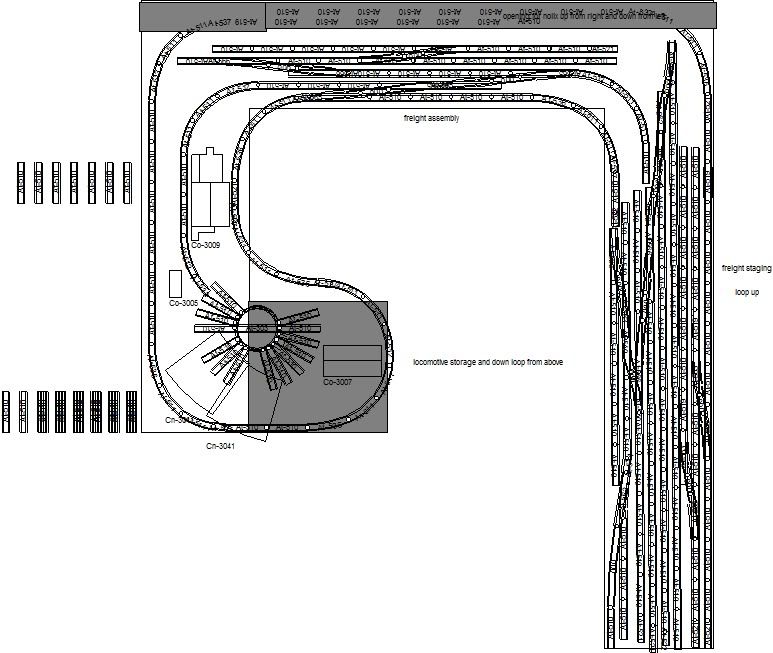
Well here it is my prelim design for my lower level. To the right is a freight yard/staging yard. Up top is open to whatever I choose. The grey rectangle is denoting the no-lix up and down. On the left is locomotive storage and yard. What do you guys think?
Atlas will love your design, so much track, so many turnouts…[:D]
Seriously, you have "plastered just about every inch there is with track, some of which appears to go into the nirvana of model railroading. Also, a lot of tracks can be reached only through switchbacks, not always a prototypical approach.