

2 Likes
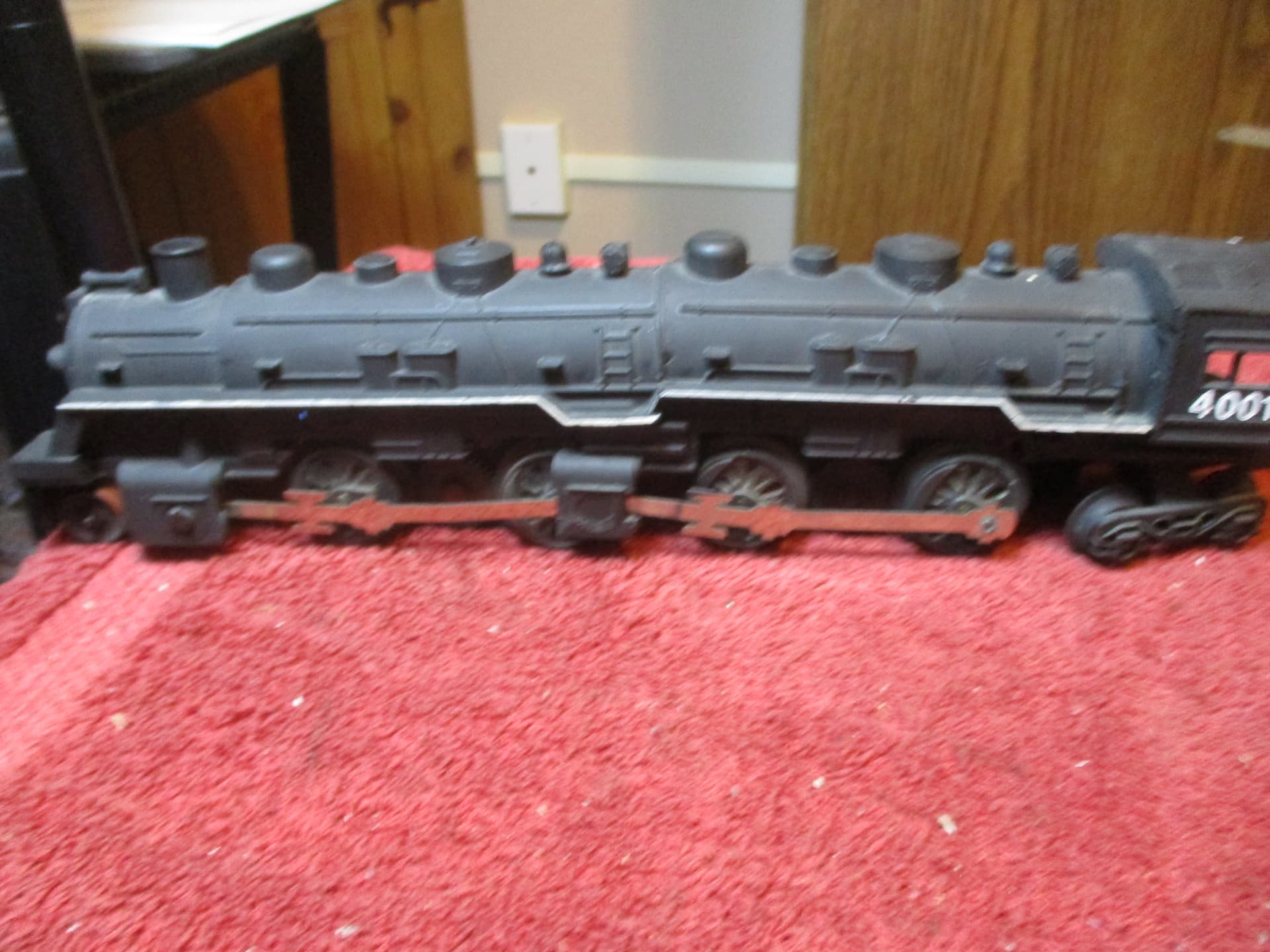
Man. A tinplate articulated.
Looking closely at it, I would wager that this is a homemade thing made by splicing two locomotives together. The domes in particular are repetitious, duplicating each other.
However, thinking about it more, I don’t believe that it’s a true articulated because those two locomotives are certainly joined rigidly together and can’t possibly make it around any kind of tinplate track curve at all.
It is a terribly imaginative creation, though. I like it.
1 Like
I’d guess so. It’s not actually tinplate, though–likely plastic. The base locomotives appear to have both been Marx 490s. I don’t know the origin of the front truck; the rear one appears to be Lionel MPC, though it may be early K-Line. The two motors are probably from both the 490s.
Always thought “tinplate” referred to the track. I am corrected
Actually, this is an area of confusion and debate. Tinplate refers Extremely Generally to any model train which is not a perfectly exact model (three rail included, no matter how close to scale it is), Very Generally to semiscale model trains, Generally to model trains which are made out of stamped steel, and Specifically to model trains which are made out of stamped steel which has then been plated with tin. I do not much like the first two definitions, as they lose the origin of the word–stamped steel plated with tin. Technically, you are not wrong in your usage, it’s just that my brain immediately rebels against that application of the terminology.  And tubular track can be tinplate–in that it is stamped metal. Most, however, is zinc-plated.
The definition I thought was correct was the first one. Not being involved in toy train collecting I did not know about the fine variations. All good to know. Thanks.
No matter what the definition, I find this particular item to be extremely interesting and fascinating. One can always wonder what drew some individual to create it.
You’re welcome! And I do find this to be an interesting contraption. To be honest, if I could jigger a hinge in the center sort of like some of those really oddball Santa Fe locomotives, I would not mind doing a similar project. Articulated steamers are noticeably lacking in the cheap O Gauge market.
You could do it with that one, making a ‘bellows’ exactly the way Henderson proposed. The problem is that for the bellows to be strong enough not to pull apart in handling, it might be too stiff to allow good curving.
The trick might be to arrange a gimbaled drawbar between the two ‘engines’, with the bellows only as a gap filler.
The other alternative might be like the ‘scale’ T1 I designed for Thomas/Skaneateles style wood track: use elastic foam with a printed ‘skin’ between the constructed segments. (I confess I got the idea from the execrable scenes in the Polar Express movie where the boiler bends around sharp curves…)
Bashing engines into other types of engines was very common in the 1920s-30s. Lionel’s O gauge 2-4-2 got turned into a large variety of engines by some enterprising builders, including a 2-10-0 IIRC.
BTW in the engine in the OP’s pictures, I wonder if what at first appears to be a faulty joint between the two boilers (note how it sags a bit) is actually some sort of flexible material, designed to allow the engine to snake around curves?
Y’know, I think that a drawbar would be perfect. Then some nice, fine material–maybe 3D printed–and it’d be ready to roll! Hmm–I oughta get myself some junked-out 2-4-2s.
Ummm… somebody REALLY wanted an articulated locomotive! That’s two Marx 450’s merged into one! Without really wide radius curves I don’t think all of those flanged drive wheels will operate unless the boiler has some kind of diaphragm.
PS, I recall a photo appearing in CTT years ago where someone took a 400E boiler and installed two 6 drivered O gauge locomotive drive cassis’ under it and created a 2-6-6-2. MTH liked the idea so much that they tried to steal it and cataloged one. They were never made likely because either the modeler who came up with the idea blocked them or because nobody wanted to order a locomotive that gave no credit to the guy who came up with the idea.
I saw someone on Facebook created a 2-12-2 using 2 2026 boilers.
This reminds me of a potential ‘reverse engineering’ scenario. In the postwar period, ATSF apparently gave serious consideration to adapting a N&W Y-class boiler to use on a 4-8-4 chassis (probably 3776 class when the alloy-steel cracking problem became so pervasive. You could easily go the other way for a 2-8-8-2 sized locomotive with the usual both-drive-units-pivoted approach under a suitably large or long boiler shell…
Love to see a pic of the whole underside.
I wonder if somebody had a supply of 072 curves . . . .
Kitbashing tinplate to make something more prototypical has a long history - this from the September 1937 Model Railroader

1 Like
Huh…
I know Gary Anderson has made some big Marx articulated steam locomotives, but mhudman’s example doesn’t look like Gary’s work.
Here is a Youtube video of some of Gary’s big engines: https://www.youtube.com/watch?v=8G9Q9RqnXOU
James
1 Like
I’ve made a couple of Marx windup articulated steam locomotives using the “flexible boiler” method.
This older video shows a test run of my Marx 1203 Triplex - kitbashed from two Marx 401 windup locomotives and a plastic tender - pulling a 29 car train on an early version of my windup layout: https://www.youtube.com/watch?v=U96L1YcuI4o
My homely Cab-Forward - kitbashed from two 833 shells - can be seen at 2:15 on this video:
https://www.youtube.com/watch?v=MZKASWidrIw
I would like to see a video of mhudman’s loco running!
JP
2 Likes
Looks like he ended up listing it on eBay. According to the description neither motor runs…
Vintage Marx Customized 2-4-4-4 Steam Locomotive Handmade 2-Motors Please read | eBay
1 Like