Internet Explorer 9, eh?
You need to find and click the “Compatibility Mode” button. For some reason, IE9 defaults to “incompatibility mode.” Then you will be able to actually see the stuff you’ve typed in.
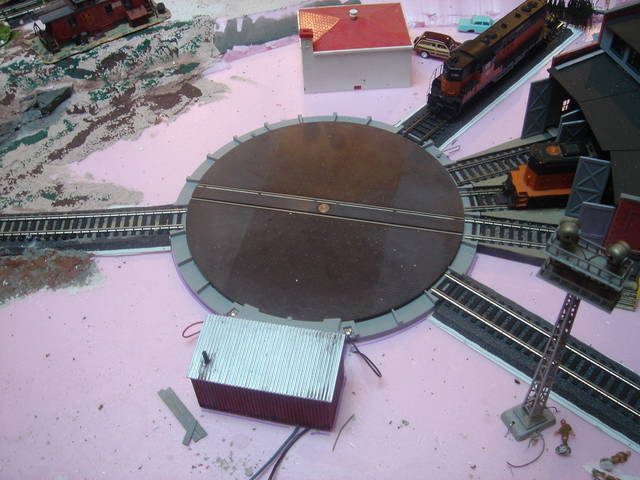
The smallest commercially-made HO scale turntable is probably the Atlas. It is a deck turntable, not a pit. The overall width is about 10 inches, with the rotating part 9 inches across. This is only large enough for smaller engines - 4-axle diesels and short switchers. I have a Proto 0-6-0 steamer that just barely fits.
This is what it looks like:
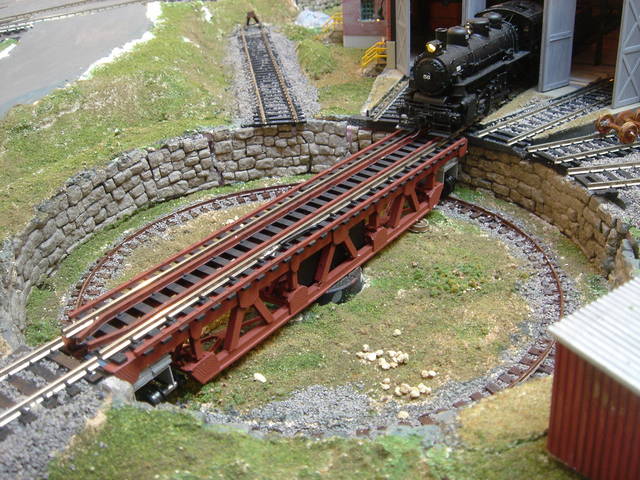
I turned mine into a pit turntable by building a bridge, mounting the bridge to the deck, and lowering the entire mechanism 2 inches into the base:
For most of the early 20th Century steamers, you would want a 90’ turntable. For the longer drag engines of the articulated type, and for the more modern high-output passenger and freight locomotives with the coast-to-coast or ‘centipede’ tenders, you will want between 120’ an 130’.
Converting to the HO scale by dividing those units by the scale, which is “1 over 87”, you find that 90’ divided by 87 comes to just over a foot in diameter in HO scale, and the largest currently available, 130’, comes to a hair under 18" in diameter.
Crandell
The absolute minimum size turntable on my 1:80 scale layout is about the size of a US or Canadian penny - 20mm diameter.
It’s installed in the shop area of my larger colliery, and makes it possible to turn a mine cart off the through track into the steel shop, track at right angles. It has tramway rails welded to a steel disk (actually a brass disk and soldered, not welded.) The tramway is 600mm gauge and the rails form a 90 degree crossing on the disk. Prototype motive power is a pair of 0-5-0s, attached to a hard-hat miner. The model is unpowered.
On a more practical note, a turntable bridge needs to be long enough to turn the longest loco or car that will ever use it. That could be anything from a B&O 0-4-0T to a UP 4-8-8-4. The minimum size for a removable turntable structure will be about 50mm (2 inches) greater in diameter than the length of the bridge. This is case where the size will be driven by the modeler’s roster. One size most emphatically does not fit all.
Chuck (Modeling Central Japan in September, 1964)
That rather depends on the length of the locomotive(s) that you wish to turn.
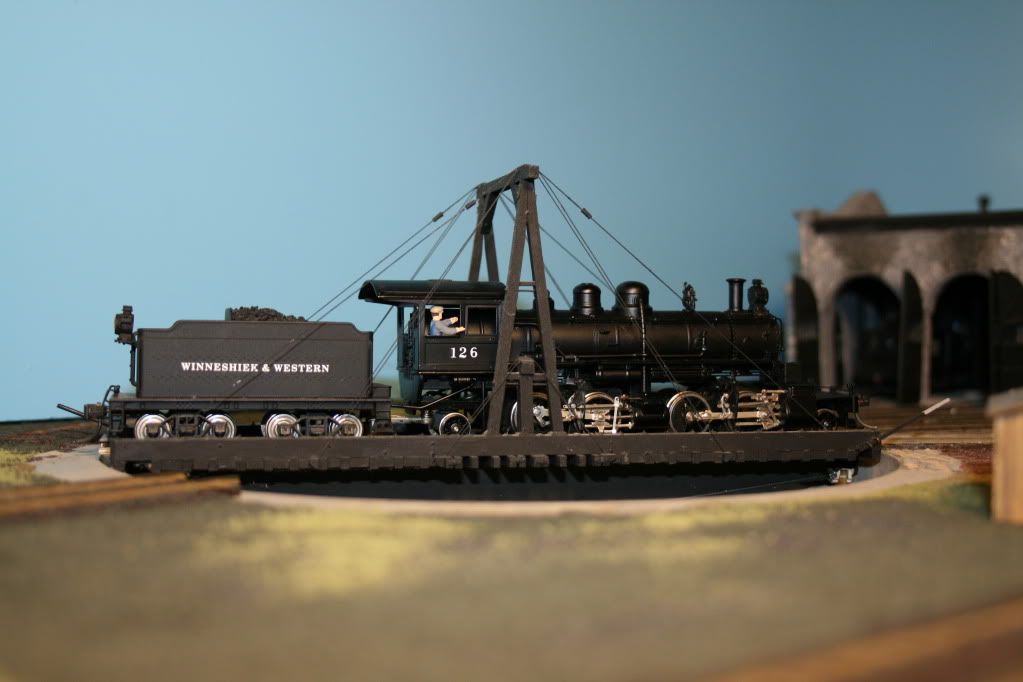
In HO standard gauge, I have a 65’ turntable, which is rather small. Still, I can fit 2-8-0, 4-6-0, and all of my logging locomotives on it, including a 2-truck shay that is semi-perminately attached to a “camp car” that adds electrical conductivity. Here’s a photo of a 2-4-4-2 (“leased from the Little River”) just fitting onto that turntable.
Bill
Related to the original posting… Without being too facetious, is there anything wrong with tayloring the table’s size to your road or modeling adventure?
If modeling D&RGW you could get by with a small table as they never ran large engines, but if you see a Big Boy or DD-40 in your future then your turntable needs to fit the engine. Pretty simple really.
If you are only interested in turning an engine, then a simple turntable takes up very little layout space. However, add a round house onto it and a simple wye is the best turnaround solution, space wise. A simple loop takes up space, but can be worked into the operational aspect of the layout in any number of ways.
I have yet to see a creditable, manufactured, complete turntable kit. Most are in the toy “acceptable” class, especially the fully automatic ones. Oh, there are plenty of really nice gallows style turntables that are laser cut kits, etc., but you still have to make the pit from scratch and all the other components.
I guess it depends on where you are in your modeling effort. If into diesels and want a quick and dirty setup that is “plug and pray” right out of the box, then you have a couple of ready options. If you are going for that special look regardless of diesel or steam operation, then be prepared to scratch build or, at least, kit bash a bit.
Just make sure you don’t buy the first table you see and then buy an engine down the road that won’t fit.
Richard