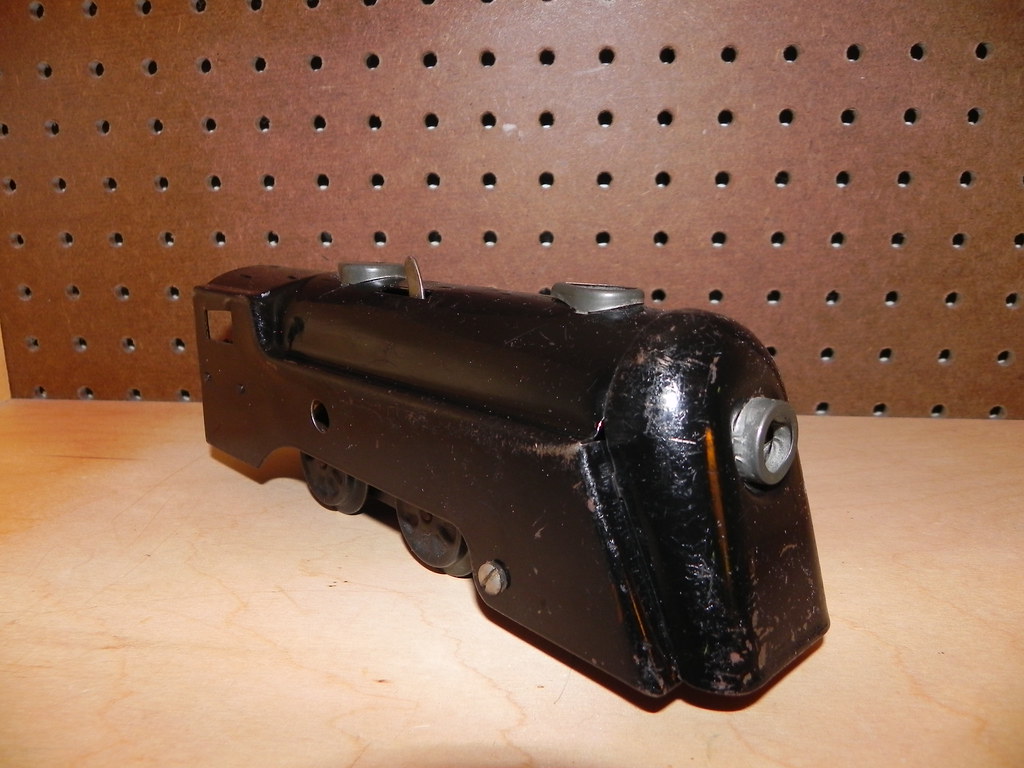
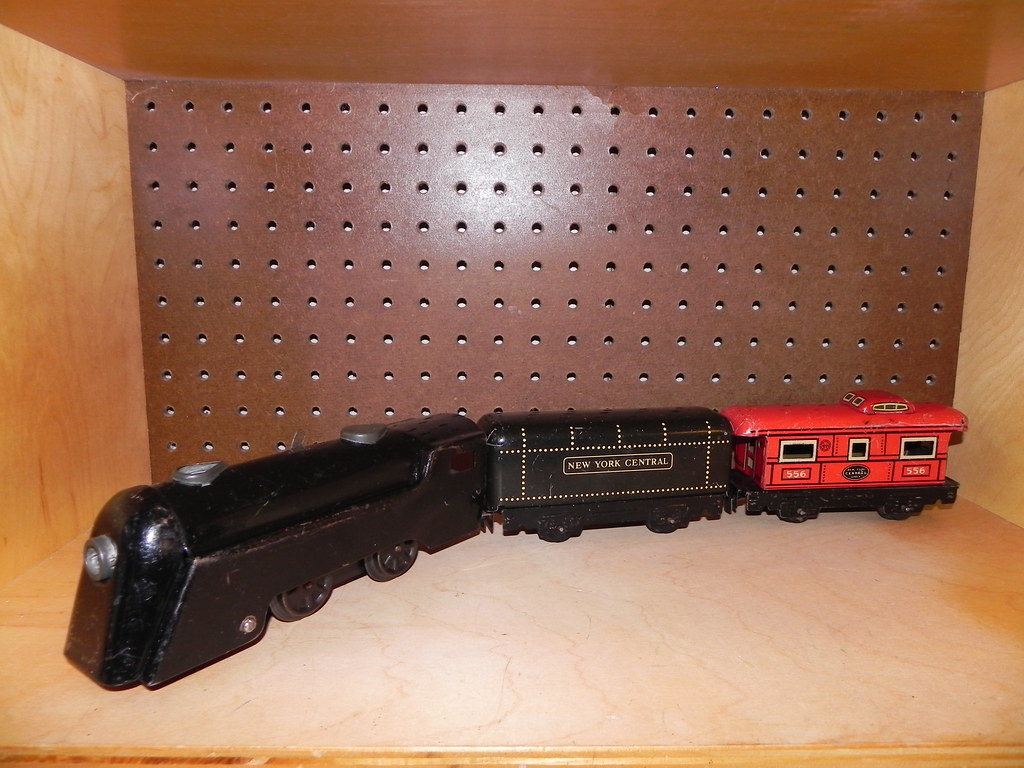
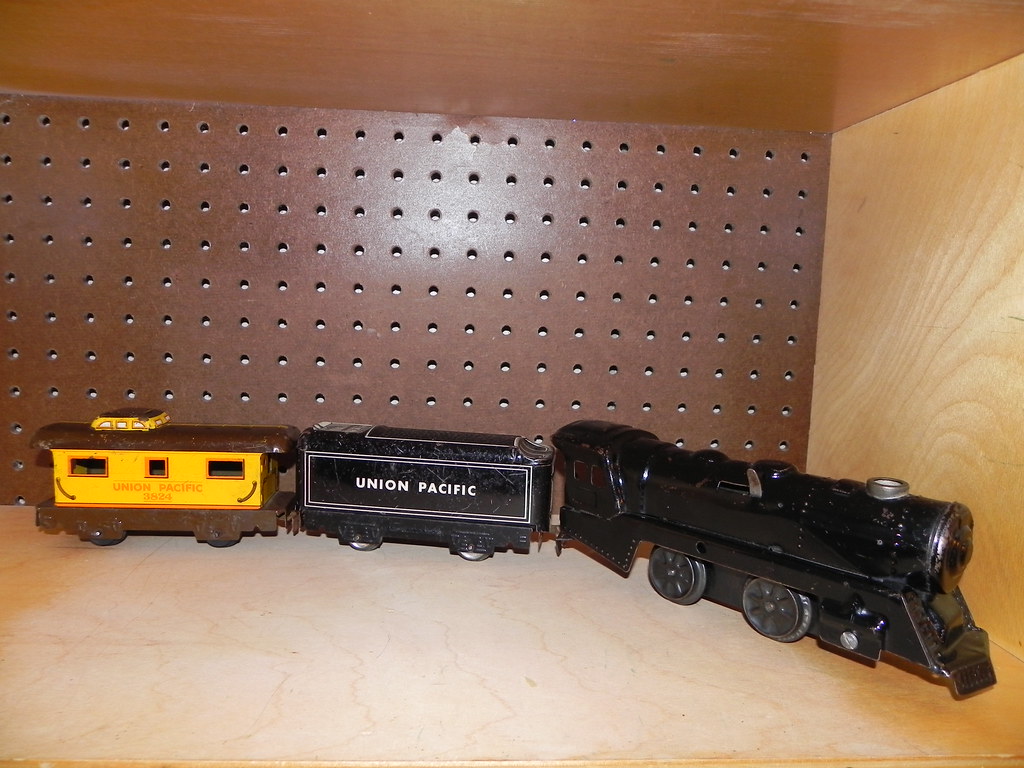
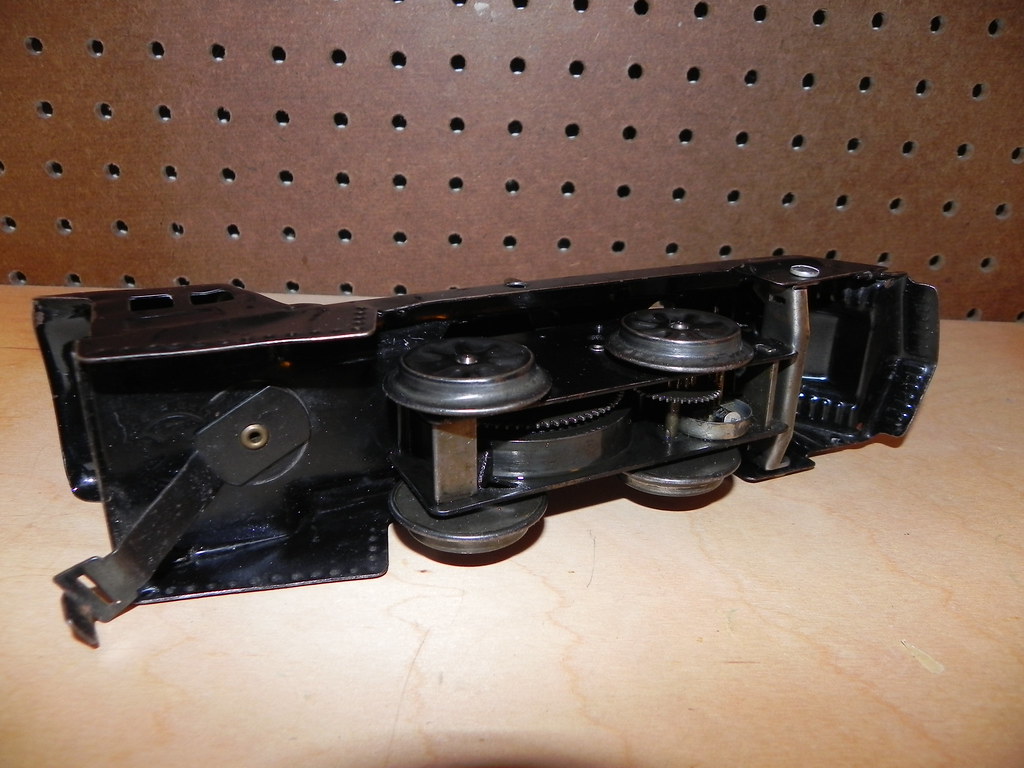
Well, not too pretty, just a bunch of plain janes, with no added trim or side rods, but I love them. neither engine has had the paint over the holes for the handrails poked open, so I guess they never had them.
If anyone can date or I.D. these Engines let me know ,as soon as I have an accurate description of what I have I’l post them in the Marx thread.
Jason, thanks for posting the pictures, those are some good looking Marx trains! I sent you an email concerning the mainspring, be sure to check the spam folder in case it got misdirected. If you didn’t get it, please send me another PM.
It isn’t unusual for the Marx windups to not have handrails or siderods - Marx made inexpensive toys, and often left off such details in order to meet a price point for a retailer. The windups were the lowest priced trainsets, so it wasn’t unusual for cost cutting measures to be implemented on them. I don’t believe any of the single dome CV’s were ever shipped with handrails, but some have siderods and some don’t. Of course, never say never with Marx!
Both the 833 and CV are post war items. Let’s start with the CV first (they are my favorite, after all) - I believe they were made until 1948. Marx didn’t produce trains in 1943 - 1945 due to WWII, so that would put your locomotive from 1946-'48. However, it has black wheels, which I believe didn’t show up until 1947, so that would put it in the 1947-'48 time frame. The black stamped steel drive wheels are the definitive clue to it being a post war CV. As a side note, I spent quite a bit of time researching Marx windup CV’s using period literature, orginal examples and observations from experienced collectors. The result is a 5 page document that I call the “Marx Commodore Vanderbilt Mechanical Locomotive Timeline”. I’ll be happy to send you the file if you would like to read it.
The 833 was produced between 1947 to 1953 from what I can determine from period catalogs. Again, yours has black stamped steel drivers - a hallmark of postwar Marx. Some 833’s were shipped with the later 17 spoke diecast drivers, although I haven’t pinned down a definite year they were introduced - I believe it to be in the 1951 - '53 timeframe. That being said, I would th
Well this is kind of cool, I have concentrated on collecting early postwar trains from 1945-1950 to go with the 2 sets my father gave me…I had no idea these 2 Marx fit in to that time frame when I bought them. I got them cause they were “cheap” I just figured they were newer than late 1940s early 1950s.
Thanks again for the info James, I’d love to read the article you wrote about the CV, you have my email address in the PM. Thanks again for the help with the spring.
Could you post any photos or catalog images of the type of sets the CV would have pulled? I’d like to track down the proper freight cars to go with it. As of now I’m happy running the only 6" gondola I have with it.
I guess I should get some better photos and post these over in the Marx Collectors thread. If the info is better preserved in that thread I guess its better to post them over there. In case anyone has not seen it or is interested in more Marx here is the link to that thread. http://cs.trains.com/ctt/f/95/t/207544.aspx
Wish me luck on the spring swap, I hope to try to post photos of the repair, I never tried to write a post on a repair before, or even take the time to shoot photos while I am fixing something. I hope it works out good.[:(][:'(][:$][:D][Y]
I’ve been slowly converting a pile of rusty & dented marx 3 rail track into cleaned straightened & painted 2 rail track, I found a 32"x48" sheet of plywood, hope to make a small windup layout out of it soon. I got a lot of inspiration here with David Smiths small layout http://cs.trains.com/ctt/f/95/t/216469.aspx
Is part of the spring still there? If so, you should be able to measure the width and thickness… and if the entire spring is still there, the length. I’ve had good luck getting some springs from www.clockworks.com - you will want a hole end mainspring, and be aware that you may have to modify one or both ends to make it work. Also, you probably won’t find an exact match, but it is likely that you will find one that is close enough to make it run. Take a look and let us know what you find, always happy to help get another clockwork train back on the rails.
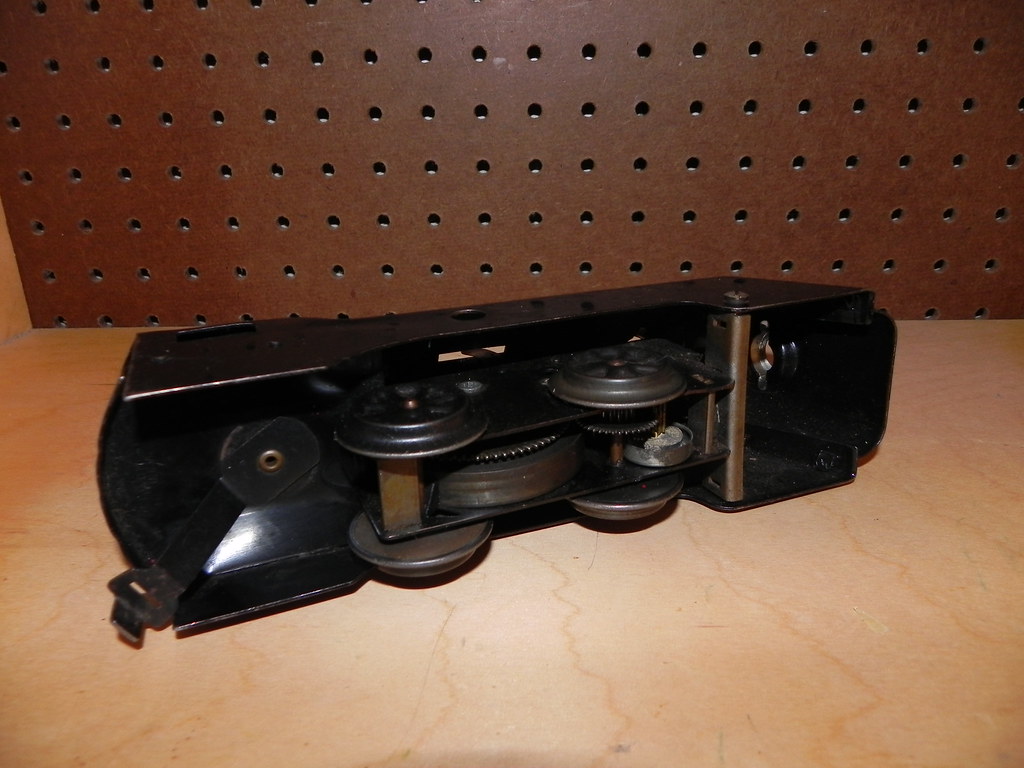
Thanks James. There’s no remnant of the spring, although the rest of the mechanism looks ok, ratchet works, etc. It’s quite small, only 5/16" width available for spring, and less than 1 3/4" space for the diameter. I don’t see a pin for the outer end, and similar AF Hiawatha’s on the web may have it looped in a slot at the bottom of the frame(??). I bought a bedraggled AF clockwork on eBay, but it’s spring is larger (3/8" x 2 1/8" diameter), and it does have a pin end. It’s probably from one of their little cast steamers?
I’ll keep an eye out for another smaller AF Hiawatha clockwork, and I think I’ll get a 5/16" x 0.20" x 40-50"(??) with a loop end from your clock source. Any advice on this order, or on installation?
Bill, the loop end spring will work, but you will probably have to cut the end off and reterminate it… not a big deal. It might be a bit easier with a hole end spring, but on clockworks the strongest 5/16" hole end spring that I see is 0.016" thick and 54" long (CMH 121). It is quite possible that the outer end of the spring looped around a frame member or through a slot in bottom of the motor. AF seems to have a lot of variations of motors - just like the many variations of their cast iron body steamers! If your motor has an enclosed bottom and there are two slots in it, that is where the outer end of the mainspring will terminate. You will just need to take a propane torch, heat the end of the spring cherry red, and bend the end into a hook shape. Let it air cool naturally; don’t quench it in water or oil, or blow air on it. If you get the loop end spring, there are a couple of ways to cut the loop off. You can take a sharp chisel and give a good whack across the end of the spring where you want to cut it… since the spring is hardened, it will only leave a score mark. You can then flex it at the score to snap it off. Wear leather gloves and safety glasses! Or, you can remove the temper by heating the end cherry red, let it cool naturally, then cut it with a large pair of diagonal cutter or chisel.
Installing a mainspring can be a challenge. Each motor is a little different, but basically you will need to figure out which direction the spring winds, get the inside end hooked on the hub, then wind it into place with the key. For motors that have the slots, I leave the outer end straight until everything is in place and the tail of the spring is sticking out the slot, then bend the hook shape into the end as described above. After it cools you can finish winding it into place and run the motor.
If you have any questions, let me know. Also, if it isn’t something you want to tackle,
Hello James - I’ve been away, and now have a couple of grandkids here with all that takes. I ordered a new spring, and I’ll carefully install per your instructions. Results (video) soon. Thanks! Bill
I finally got to the Hiawatha, and managed to install the new clockspring per your instructions.
As you can see, it now works, but it takes a lot of twist to get 10-12 half turns, it doesn’t have much range (perhaps 30-40’), and it has no pull up my gentle hills. Is that likely the small spring in a small space, or are there other factors worth exploring?
Thanks, Bill
(sorry, the site doesn’t seem to accept my brief iPhone video)
Bill, there are a lot of factors at work that determine how well a windup motor will perform. Things such as the width, thickness and length of the mainspring, the amount of room available for the spring to expand as it unwinds, the gear ratio and driver diameter, as well as the type of governor. To be honest, most motors with a small spring like this won’t have a lot of power or run time.
However, there are things you can do to optimize it. Drag is the enemy of the clockwork train. Everything needs to be oiled and spin freely. This of course goes for the motor, but often times the undriven wheels and siderods of the locomotive are forgotten. Also, pay close attention to the wheels and axles of the tender and any cars the locomotive is pulling. Just a small amount of drag can make a big difference in performance. Finally, windup trains - due to their limited power - work best on a level track with generous curves. The manufacturers of windups here in the states usually intended them to operate on a just a small, level oval of track… they were mostly thought of as a child’s toy, and so performance wasn’t a primary concern. The English, however, marketed high-end clockwork locomotives to adult enthusiasts, and offered robust mechanisms with powerful mainsprings. Some manufacturers even offered a choice of gear ratio - a taller ratio for less pulling power but more distance, and a shorter ratio for better pulling power for grades and longer trains, albeit with a sacrifice to the distance travelled.
Regardless, inspect every moving part to make sure it isn’t binding, including all the wheels and axles. Make sure there isn’t any carpet fibers or pet hair wound around the axles & shafts. Lubricate everything. See if that helps…
For comparison, a typical Marx motor, running on my level O42 mainline, will usually run somewhere between 100 to 120 feet on a winding. However, they
Find yourself one of these UK clockwork engines, has forward and reverse drive, and a brake that can be tripped by trackside trips. Made by Bassett Lowke in the early 1930’s and given away for coupons from smoking BDV cigs. 30,000 were made according to my book on Bassett Lowke. Powerfull 4-4-0 engine. Most all engines made by BL were available in Clockwork and several also came in electric and Live Steam. I am planning a mainly Clockwork and Live Steam tinplate layout but will be 3 rail track for my postwar Lionel to run on as well. Just put my name on a collection of really clean postwar that came in at the LHS. But its the Clockwork trains that really put a smile on my face. I am hoping to find a red/silver Hafner clockwork with bell ringer. I had a boxed set with that engine in my teens, sold it to buy more Lionel. Wish I had kept it now! Mike
1931 Clockwork Duke of York in gauge 0
late 1920’s/early 1930’s live steam Stainer Mogul in gauge 0