New to Scenery - How to lay the grass??

I am really new to this, this will be my first build really. As far as the grass goes (like shown on the images in this thread http://www.modelrailroadforums.com/forum/showthread.php?p=45543&posted=1#post45543 ) what all is needed?

A local hobby shop here has the Woodland Scenics (Shown on the image below) products. They have the “Jug” type container with them. But I have a question, what all else is required? I Really have no clue on where to start with laying this down, after I get my buildings planted and the terrain the way I want it.

Any special equipment? Special type of glue, brand, type, etc? Just what all do I need to lay this down to make it look as nice as yours?

Thanks Alot! (image below of what they have, its the container, but I think they have the bagged as well too)
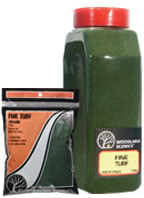
I want/like to have the same grass as shown in these pics below (the normal, short colored that there is more of than not) Which grass is this called? The hobby store has several different ones. Thanks!

There are various ways to glue down the ground foam. Perhaps the easiest, if you want a bit of “earth” tone here and there, is to slather a very light, and I do mean light, shade of tan paint in the area to be greened up, and then to sprinkle the darkest of at least two shades of green ground foam using their shaker. This is not a slap-dash, but requires some concurrent thinking, some pauses to consider what you have created, and then more of perhaps another shade. In other words, enjoy the sprinkling…don’t have it all over in 10 minutes.

The wet latex paint that you use will do a faily good job of bonding the ground foam as long as your paint is on a non-permeable surface, such as on extruded foam sheet insulation. If on plywood, it will likely get absorbed somewhat, unless you do a good job of priming it first. If it just gets sucked into the wood, your foam will need something else.

Once again, at least two, and a light sprinkle of a third tone of green, maybe some of the burnt grass as a top layer. Go easy with all layers and build them up to get the effect that pleases your eye. Once it is in place, you can gently mist or spray a mixture of matte medium and water, or white or carpenter’s yellow glue, water, and a couple of drops of dish detergent. I like my glue mixtures lean, so about 8-1 in favour of the water.

For added realism, you will need the odd bush or hedge row, and individual small bushes here and there. Trees, too, of course. You are not wanting a manicured lawn, so what you see roadside is what you want to achieve. Build up layers, but don’t forget to show the bare earth at times.

In this scene, if you can overlook its spartan look (it is an early work on my village, so it is incomplete), you will notice a bare patch in front of the pickup and barn. That is just plain old white and tan and some gray mixed to a light tone you see, and then ground foam sprinkled aro

I like to first put down “ground goop” before laying the grass. Ground goop is really easy to apply and makes the scenery look more realistic.

Ground goop formula: 1 part vermiculite (in the garden center of a hardware store)

1 part celluclay (hobby lobby)

1 part of earth toned flat acrylic paint

3/4 part elmers glue

1 capful of lysol concentrated disinfectant cleaner (so it won’t sour if you plan on storing it in an air tight container if you don’t use it all in a session.)

Mix it all together in a plastic bowl that you can put a lid on later to store what you don’t use and with a putty knife smear it all over the area you plan to scenic. It will spread as easy as icing on a cake. Once it dries, mix up some elmer’s glue about 60% water to 40% glue, a couple of drops of liquid dish detergent, and paint it over the ground goop with a 1" paint brush and then sprinkle in the woodland scenics grass over the wet dilute glue. Also purchase some woodland scenics foliage and some woodland scenics coarse turf and glue them amid the grass to make small bushes in random patterns over the grass. I also like to sift red sand or sandy loam thru a strainer and sprinkle it in the grassy area to make bare spots. The more there are different ear

Well, you’ll probably scream when I tell you to buy a book (or several). For scenery, I recommend:
Dave Frary, How to Build Realistic Model Railroad Scenery.
Lou Sassi, Basic Scenery for Model Railroaders.

Now for a quick run down on how I do it.

  • I use extruded foam insulation for my landforms. After carving the shapes, I cover the foam with pre-mixed drywall mud.
  • After the mud drys, I paint it with tan latex house paint. Before the paint dries, I cover it with WS Fine Blended Turf - earth for railroad and industrial areas, green for other areas.
  • Then I apply the courser textures. I use many colors of WS Course Turf, and mix in some various color/grades of ballast in places.
  • When I get it the way I like it, I spray it down with Wet Water - water mixed with isoprol alcohol. Next, I dribble on a 50:50 mix of water and white glue with a little alcohol added. I don’t like using a sprayer for the glue, I prefer the control of my mustard bottle.
  • Lastly, I add trees, larger bushes - I use WS Clump foliage, and poly fiber balls coated with ground foam - and tall grass - WS Field Grass.

Hope this helps,
Nick

How do you actually put the grass down? Just sprinkle it with your fingers and rub it around ?

I use the shaker cover in the bottles that you show above, but it is not so great for the larger or coarser grasses. Otherwise, I use a slightly folded piece of cereal box cardboard. I cut out the side of a cereal box, put a crease down the middle of the piece so that it makes a wide “V”, and then use that to shake the ground foam onto the surface from a height of about 6-10".

Do not rub the foam around…ever…EVER! Let it be where it falls, or wipe it all up and start over.

I use the shakers for fine ground foam. For coarse foam, I put in the palm of my hand, then shake it out. Occationally, I’ll pinch it between my fingers, where I need more control. For ballast and other rock type stuff, I use a plastic spoon.

Nick