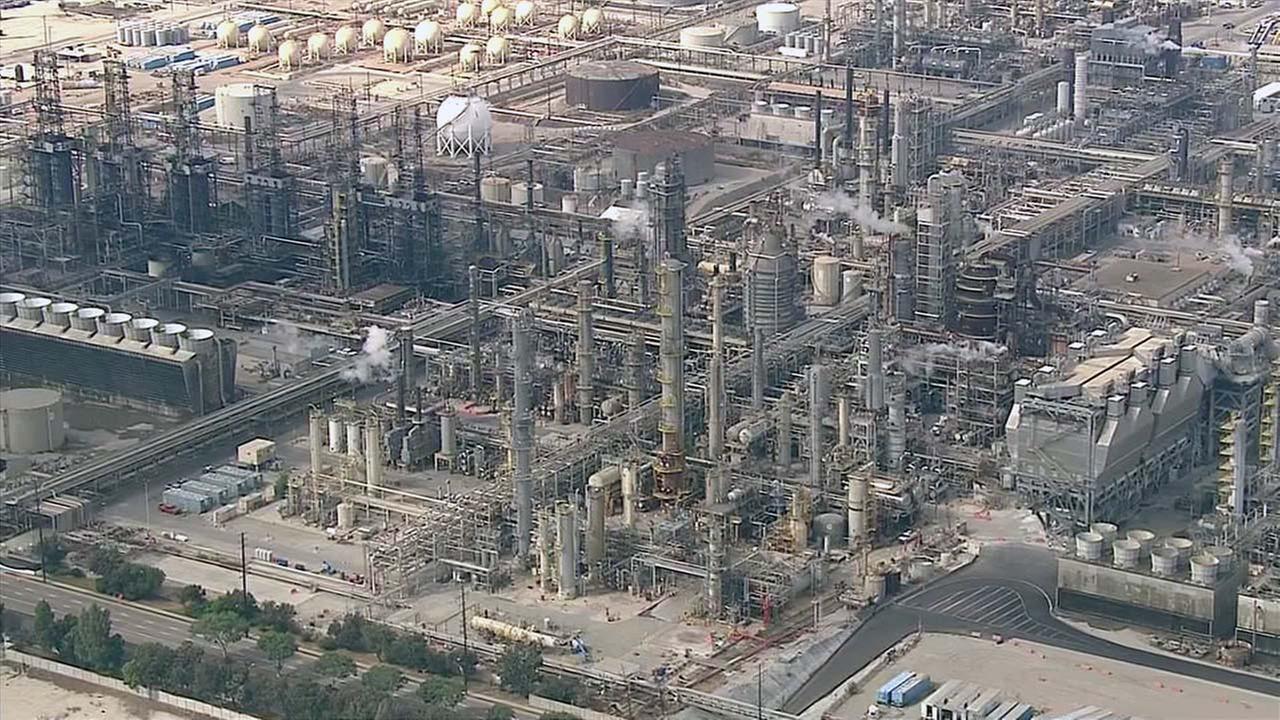
I am planning building an oil refinery, since I have ordered 10 of the Atlas 31000 gallon tank cars for my layout. I have been looking at Google Images and googled how refineries work. But I have to admit looking at how refineries are a maze of pipes and tanks, it seems a bit intimidating to attempt such a thing from scratch. I have been saving the sprues from many model kits and plastic caps from various household products. Are there any ideas or plans out there that could be roughly followed? I have track space for the 10 tankcars and about one foot by two foot space for the refinery. Any help, guidance, links, would be appreciated. Thank you.
Well Ted, I can suggest what I would do, is to take the info I see on Google images, which I just looked at myself, HO scale oil refinery kits, search and learn just how a refinery works, from raw to finished product, and plan my own arrangement, to fit the space I had to work with. Walthers offers a lot of parts, and pieces, and I think Kibri also had a kit.
I also used sprues to model piping. But different kits are availiable with valves, and such, molded in.
Refineries are huge operations. Set yours up next to the edge so that the tank car loading area and a few other buildings are on the layout and the rest is just off layout. Many large industries are done this way. I hope to have a coal fired power plant (shame, shame), with the plant and coal dump on the edge, coal pile and transformer farm off the layout.
When I build, I use a pretty wide prototype brush, but it has to be believable.Unless you need to be 100% real you don’t need to know how a refinery works, just what it looks like;lots of piipes,tanks smoke stacks,some kind of rack for loading rail and truck, will give you that apperance.
There are piping kits out there,or sprues,I have used 12ga. coated wire,but that won’t give you the neat unions or valves. Tanks can come from whatever looks like a tank pvc pipe comes to mind.
The product gas/oil needs to move from point A to Point B-C. Start with a loading rack at the track,lay some pipe ,add a tank. a building smokestack.ect.
Sounds like a fun project that could be built for less then some kits.
Most industrial processes large enough to be rail served are so complex in nature that we “amateurs” need help is grasping the basics. Jeff Wilson’s Industries Along the Tracks series of books for Kalmbach are a good first resource for this, and the first volume of the series (which I think is out of print but seen at swap meets and on Amazon) covers petroleum refining in terms we can grasp. Actually Wilson himself says that refineries are so large that they are impractical to truly model even if your layout is very large, but can be done if you focus on the loading racks with just a few of the tanks or towers (either modeled or on the backdrop) to convey the central message.
Plastruct makes a complex (daunting?) looking kit that while large itself is obviously is just a tiny portion of a real refinery or chemical plant, but it effectively conveys the message
Thank you all for your responses and great information. I plan on a reasonable facsimile of a refinery with pipes and tanks. For the room I have it will be basically the unloading area but with enough of the detail to make it look like it is a part of the real thing.
You’re going to have to really compress it. Refineries are huge. There are only a handful in the country, mostly in California or Texas.
The railroad car loading area is on the edge of the complex far away from the actual refinery, past several large tanks which block the view except for some of the taller structures.
Actually, smaller regional refineries were quite common. Sinclair, Wyoming, Commerce City, Colorado, Ashland, Kentucky etc., etc. Almost every oil patch had a refinery.
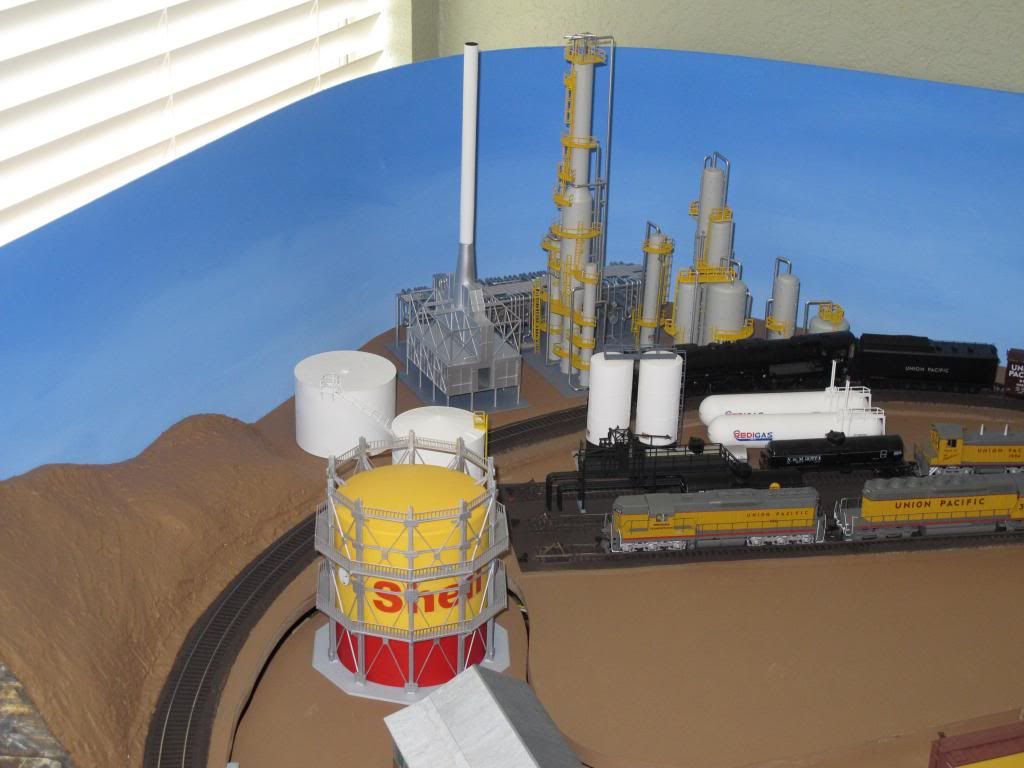
The photo below shows the Walters refinery (furnace, columns & heat exchangers on left) combined with the Vollmer columns on the right. The tanks shown are other kits. The Vollmer kit is a little hard to find in the U.S. at a reasonable price for the simple kit. The tank car rack is a Walthers kit. I also have some Walthers piping kits, one for crossing over the tracks, the other general piping but I have not added those yet.
The stuff in the tank. Keeps air out of the tank. Fire = heat + air + fuel. If you have air space above the tank then the vapors will mix with the air giving you an explosive mix (air + fuel). By keeping the air to a minimum you keep the risk of explosion to a minimum.
Some oil refineries receive and ship products via rolling stock other than tank cars. Catalyst for the cracking units received via covered hoppers. Packaged products like oil and grease shipped out via boxcar. Solid hazardous waste out via special containers on flat cars. Occasional delivery of large size vessels, piping, machinery and cranes via special heavy load flat cars.
Happy modeling and good luck with your “Boilin’ oil” industry. Regards, Peter
Yikes, a thread about a refinery and I am only now responding!!!
I’ve worked at a number of refineries, most notably the Mobil (now ExxonMobil) refinery in Joliet Illinois and Beaumont Texas. The Joliet refinery was the first grass roots one built in many decades, starting up in June, 1973. Unlike most others, it was built with expansion in mind…and thus became a model for what refineries could be.
OK, a typical refinery brings in Crude oil via pipeline, barge, and the smaller refineries will also bring it in via tank car or tank truck. We are talking a lot of oil, for a decent sized refinery can process 300,000 barrels a day - a barrel being 42 gallons.
The biggest tanks are for crude storage and have fixed roofs. The gasolines (multi grades plus aviation gas) are normally stored in floating roof tanks. Diesel fuel and heating fuel are stored in solid roof tanks. By products of butanes and ethane are a gaseous state and stored in ball tanks. Petroleum coke (nasty stuff) is stored in open pits.
The crude oil is run thru various “units” to break it down into the components. The towers that you see catch the heated/evaporated crude components at the different levels. Simply put, the crude oil “fumes” will condense the heavier oils lower in the distilling units, the gasolines higher up, and the ethane/butanes at the top. From there the components are pumped to other units where the gasolines get octane boosted, finer cuts made of the different grades, etc.
Even a medium sized refinery is a huge complex. One might put some tankage and units on the edge of their layout and have a backdrop showing the “rest” of the refinery. Otherwise, a good representation of a refinery would take up an awful lot of room. Of course my take on this is likely skewed, having spent a lot of years in and around them.
Yikes, a thread about a refinery and I am only now responding!!!
I’ve worked at a number of refineries, most notably the Mobil (now ExxonMobil) refinery in Joliet Illinois and Beaumont Texas. The Joliet refinery was the first grass roots one built in many decades, starting up in June, 1973. Unlike most others, it was built with expansion in mind…and thus became a model for what refineries could be.
OK, a typical refinery brings in Crude oil via pipeline, barge, and the smaller refineries will also bring it in via tank car or tank truck. We are talking a lot of oil, for a decent sized refinery can process 300,000 barrels a day - a barrel being 42 gallons.
The biggest tanks are for crude storage and have fixed roofs. The gasolines (multi grades plus aviation gas) are normally stored in floating roof tanks. Diesel fuel and heating fuel are stored in solid roof tanks. By products of butanes and ethane are a gaseous state and stored in ball tanks. Petroleum coke (nasty stuff) is stored in open pits.
The crude oil is run thru various “units” to break it down into the components. The towers that you see catch the heated/evaporated crude components at the different levels. Simply put, the crude oil “fumes” will condense the heavier oils lower in the distilling units, the gasolines higher up, and the ethane/butanes at the top. From there the components are pumped to other units where the gasolines get octane boosted, finer cuts made of the different grades, etc.
Even a medium sized refinery is a huge complex. One might put some tankage and units on the edge of their layout and have a backdrop showing the “rest” of the refinery. Otherwise, a good representation of a refinery would take up an awful lot of room. Of course my take on this is likely skewed, having spent a lot of years in and around them.