Hi, I’m about ready to begin operating my layout and I was wondering how other people with the Walthers cement factory handle the switching jobs there. For example: A plant that size would need constant switching to move covered hoppers under the loading shed by the silos. And how are other modelers bringing in the limestone? I plan to bring it in by train, but I don’t know how or where to unload it and it seems that would require constant switching. How are others bringing in the other ingredients for cement? It just seems the constant movement of cars under the loading shed and dumping limestone could be tedious for an operator and I’m looking for ideas to represent the flow of cars within the plant without it being a drag for the operator. Dropping off the empty covered hoppers and loaded hoppers with limestone and picking up the loaded covered hoppers and empty hoppers is easy and obvious, it’s the within-plant switching that has me concerned. Is anyone out currently operating with the Walthers cement factory? How do you do it? Appreciate all help and discussion, jcopilot
Many if not most plants were built near the source of limestone, so it was hauled right out of the quarry into the plant. One plant near me had an extensive aerial conveyor system going over both railroad tracks and roads to reach their plant. There would be a crusher, which I don;t think is in the Valley Cememnt kit. Other inbounds would be coal/coke. Outbounds, don’t forget box cars for bagged cement. Even with covered hoppers, there was plenty of cement shipped in bags, which were loaded in box cars.
–Randy
I have Walthers cement plant. I have one track going into the shed, and 3 on the outside of the plant for hoppers/boxcars. I use mine like a small cement plant. Nothing to big. I only have about 6 hoppers for the plant. With a mix of boxcars.
Here’s a few shots.


During the winter 2007/08, I built the Walthers Valley Cement plant for our club layout at the Boothbay Railroad Village. I feel that Walthers made a number of mistakes in the kit for an operational standpoint. One of the major goofs was no way for incomming materials to be delivered to the plant.
If you check the instructions and descriptions on the box, the manufacturing process starts at at the aggregete building, but there are no places to deliver raw materials to that building except for a number to truck doors. Realistically, trucks could not deliver the volume of raw materials to support a large cement plant. At Dragon Products, a cement plant located in Thomaston, ME, limestone is delivered to their version of the aggregate building from the nearby mine by conveyor. Other materials come by train. To correct this, I took the loading shed off the silos and kitbashed it on to the aggregate building. I modified the silos for the track to run through. It was a lot of work and the result is a rather tight access that does not allow passage of Plate C covered hoppers under the silos. In retrospect, I should have scratchbuilt a delivery shed on the aggreate building using the kit delivery shed as a guide.
Another major problem with the kit is no provision for fuel for the kiln. Maybe they assumed a gas fired kiln with the gas coming by pipeline. That eliminates another RR traffic source for the plant. On our model, we had the choice of coal or #6 fuel oil. I did not want to build a coal handling facility and we did not have room for it on the layout. We bought a Walthers fuel tank and added some tracks for tank car unloading.
We added a Walthers Golden Valley Canning to represent a cement bagging plant (suggested in the instructions). This will allow shipments out of bagged cement by both rail and truck. The changes I made include replacing the wood loading docks with scratchbuilt cement ones, and adding a conveyor from the
That’s right, but all the examples I know of were at the end of branches, such as at Kentucky House, Davenport, and Cowell (Concord), CA. Exceptions are/were at such places as Merced, CA and Seattle (near the stadium), WA.
Mark
This facility doesn’t produce cement. It is merely a storage/distribution facility (railroad to truck). You might want to add some trucks for carrying the stuff away and perhaps a facility for bagging the cement.
Mark
Wow, George, so much of what you said is right in line with what I’ve been thinking for a long time. No place to deliver incoming limestone, by rail, truck or conveyor. No way to identify how the fire in the kiln is fueled, coal or fuel oil, and no way to unload either. I, too, have a Golden Valley Canning kit for shipments of bagged cement. And I really like your idea of building a shed by the aggregates building to receive limestone. I, too, intend to spot tank cars on the ‘outside’ of the kiln building for fuel oil delivery, unfortunately, no room for storage tanks – Darn! Great idea. How many tracks are they for your cement factory? How are they aligned? Please, everyone, don’t misunderstand, while I appreciate what you have written here so far, no one has described how they operate at the cement factory. My concern is the tedium of periodically and repeatedly moving covered hoppers under the shed at the silos, boxcars at the bagging building and hoppers at the aggregate building. Does anyone have any experience with switching this cement factory on a layout, your own or someone else’s? How did they replicate the repetitive (boring) switching? And how successful were they in avoiding the boredom while still giving the illusion of all the loading and unloading that must take place? Anyone? jcopilot
How about the rather humongous plant at Monolith, CA, right next to the joint UP-BNSF line from Mojave to Bakersfield and right down the road from Tehachapi (somewhat farther away from the loop?) The aerial view I just studied shows 13 loaded hoppers on the coal spur and a LOT of covered hoppers around and under the loading silos. Limestone comes in by conveyor line from a transload at the quarry - the plant isn’t geared to handle those house-size haul trucks.
When comparing the Monolith plant to the Walthers kit, I’m reminded of that line from Crocodile Dundee: “That’s not a knife. THIS is a knife.”
Chuck (Modeling Central Japan in September, 1964)
The Monolith plant is on a short branchline (some miles), or if you will, a very, very, long spur, with a multi-track, double-ended yard directly/solely serving the plant. Typical of most prototypical track layouts I’ve seen for cement plants, the tail-end of the branch is the switching lead for the yard. Also typical, the limestone source is adjacent to the plant. EDIT Ooops, I confused Monolith for another location. Chuck is correct.
as for spotting cars for unloading, many industries have a powered car puller or capstan than enables an employee to pull the cars through the unloading area and the empties just roll right on out the other end. others use a front end loader with a coupler attached to the bucket. many small granaries use a big old farm tractor with a heavy chain and hook or a fork lift truck if the track is in pavement. i worked a few summers at the IC shops in Memphis while going to school. there were about a dozen tracks under the shed including 2 or 3 rip tracks. a yard engine switched the shop before 7 am and after 3 pm. also during the noon lunch break if needed. otherwise, we moved cars down the line with a big old Massey Harris tractor using the above mentioned chain and hook. in modern times, many car shops and industries use a “rabbit” this runs between the rails and engages an axle on a car to move it into or out of the building.
i am currently building a large flour mill and grain elevator on my model railroad. there are two unloading tracks about eight feet long that pass through the shed with the pits for the grain to fall into. the industry job sets the loads into these tracks with the farthest car over the pit. as the grain is unloaded the cars move through the shed and out the other end, remaining coupled all the while. when the last car is unloaded, it is sitting over the pit with the end just outside the shed. the yard engine can then pull all the empties back out and reset the tracks with more loads. the engine never goes inside the building.
grizlump
You might want to check out http://www.eurorailhobbies.com for cement industries (try Faller, Piko industry pages in their pull-down menu)
One plant I worked at had an ingenious system for spotting cars without the constant use of a switcher. We used a fixed capstan (or vertical winch) and had a very long heavy hawser over 2" diameter, with a heavy steel hook in a eye splice at the end. We hung the hook on the bolser over the truck and could control the pull by the number of turns of rope on the winch. Chocks and sometimes a light setting of the hand brake controlled the car from rolling too far. John Colley, Port Townsend, WA
For fuel oil deliveries, “model” a buried tank; all you need is an unloading area, a small pump house, and some piping running from the pump house to the kiln building.
The plant has 6 tracks, from left to right facing the quarry end of the plant:
-
Cement loading at the silo
-
Bagging plant
-
Storage track
-
Aggregate building
-
2 fuel oil tracks
These are a couple of older photos that I took about a
I was thinking of the California Portland Cement Company’s huge cement plant at the end of 9.2 mile branchline built in 1955 going west from the tail of the wye track at Mojave, CA to Creal. This is about 6 minutes south, 4 minutes east of Monolith, only a few miles away on the mainline towards Tehachapi.

April 26, 1964Southern Pacific, San Joaquin Division, special instructions say, in part: “Extra trains originating at Mojave and operating between Mojave and Creal will display indicators as an Extra train on the entire trip as indicated by the engine number of the lead unit leaving Mojave and are authorized to operate as Extra trains between Mojave and Creal without obtaining a clearance. Rule 99 will not apply betwee Mojave and Creal.”
Ver-ry interesting track plan at Creel! The whole shootin’ match is a switchback move from the branch, and the coal delivery route is a second switchback off the opposite end of the cement loading yard. Real life switching problem, anyone…
As for the plant itself, FIVE (count ‘em) kilns, and a truly humongous loadout. Makes Monolth look kinda’ small.
Chuck (Modeling Central Japan in September, 1964)
Here’s a current view of Lehigh Portland’s plant at Union Bridge, Maryland, the largest plant of its kind in the western hemisphere…
The only rail access used to be from a section of street running up Farquhar Street, but a recent new spur to the east (you can see the big Wye track there by Shepherd’s Mill Road is now the route in.
The map also has bird’s eye views of the facility so you can see how really freakin’ big it is.
You may have no choice but to switch to N scale!
FYI, I believe all the limestone is trucked in from local quarries. I know they switched to trucking in the coal that fired the plant when they installed the new kiln a few years ago, because it’s a new high efficiency deal, and also burns what is euphemistically referred to as “Bio Solids” (those would be turds from Baltimore’s wastewater treatment plant)
It’s quite an operation, and Lehigh remains a 49% owner of the Maryland Midland, which took over the Western Maryland tracks there in 1983.
Lee
Due to the kindness of a stranger this morning, I received the Creal schematic shown below. I imagine the two coal-car tails are on an incline, allowing cars to roll over the coal dump as needed using gravity. This layout uses industrial switchbacks in an efficient and effective manner and do not create the artificial track puzzles modelers employ. The end-of-branch (as at Creal and Davenport) or longish spur (as at Permanente), switchback lead to a double-ended yard was common for cement plants, at least in my part of the country.
Mark

I was somewhat [ ] [] [] [] to post those old Dragon Cement photos in my prior reply, but they were all I had available and it is a 50+ mile round trip to the layout. Yesterday was our work session at the Boothbay Railway Village model layout and I took some current photos. [:D]
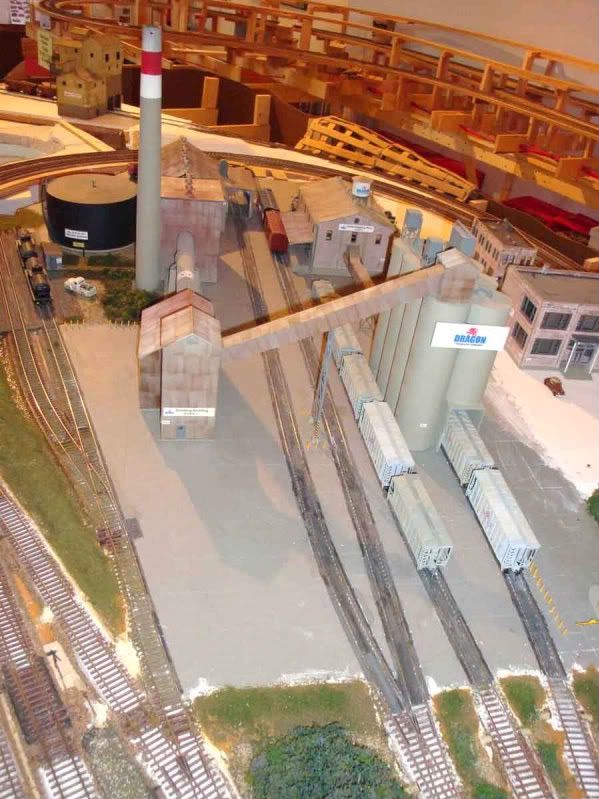
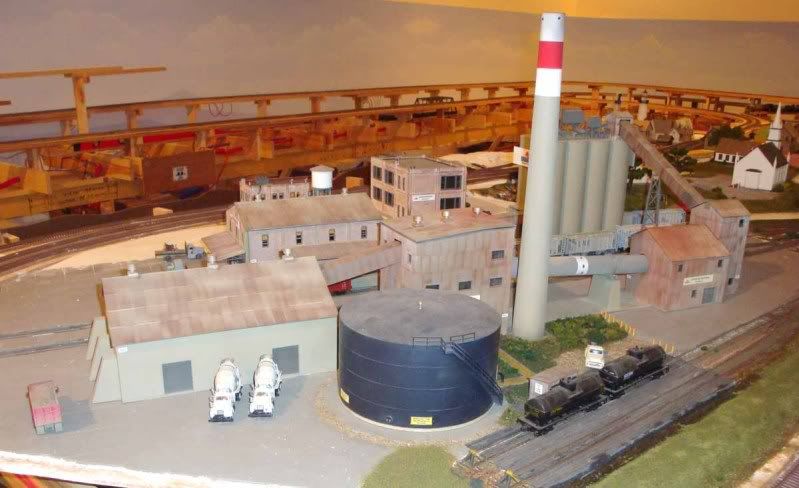
This is an overall view showing the track plan and major buildings
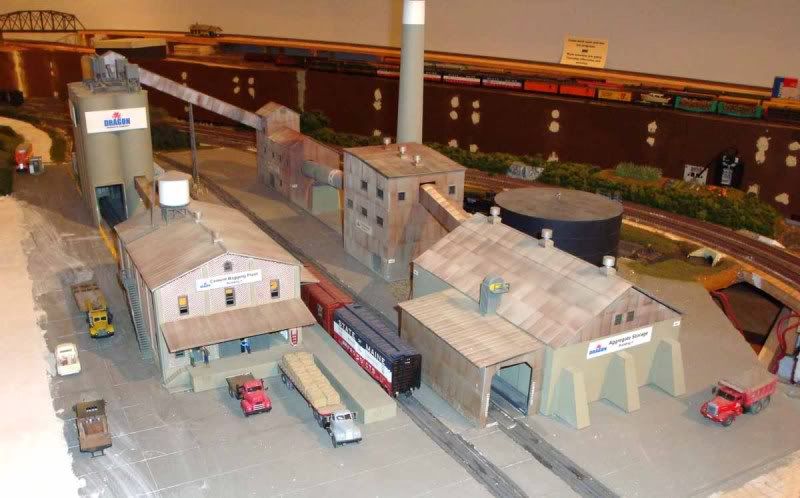
The Aggregate Storage Building with the unloading shed and the Cement Bagging Building with rail and truck loading
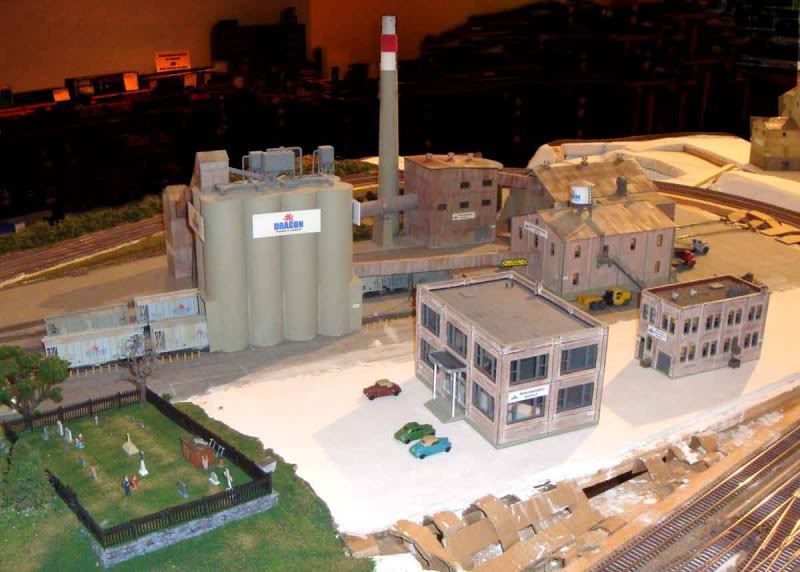
Administration and Maintenance Buildings with Cement Silo in background
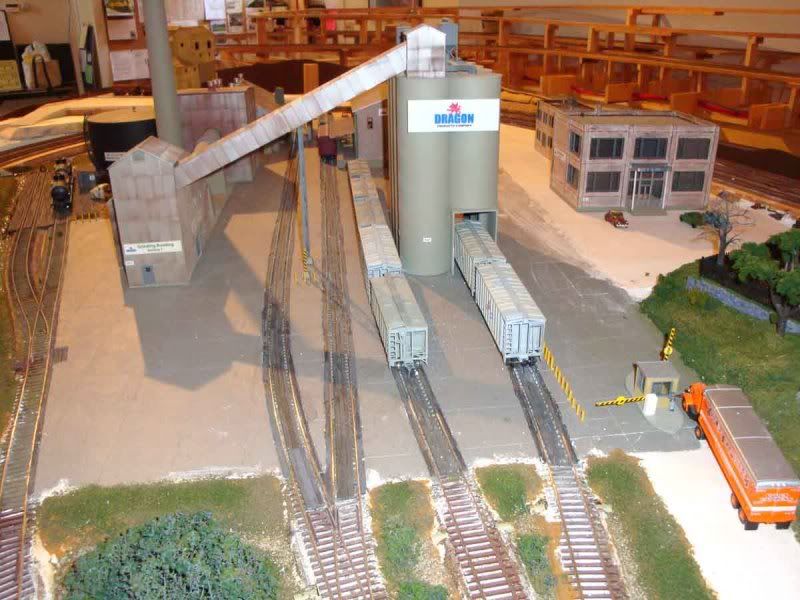
Cement loading and Main Gate [Edit - photo corrected.]
Fuel tank and tank car unloading
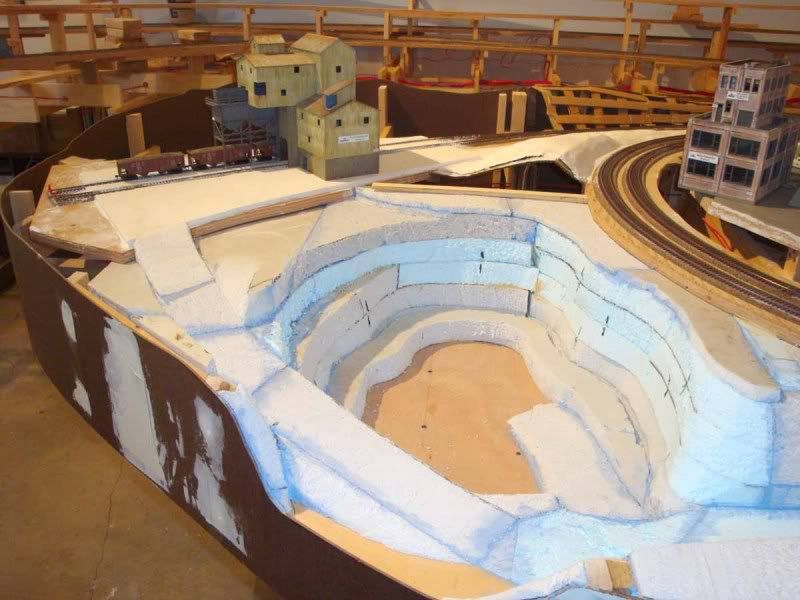
Quarry and rock crusher. This was a project for this winter and is still mostly blue styrofoam. We make a bit of progress every week!
There is still a lot of work to do on the plant including laying out the concrete drive areas near the Admin Building; materials in storage at the Maintenance Building, road markings, more scenery, and a fence around the whole plant. This is just one part of
George, Thanks a bunch for the new photos. The factory complex looks really good. It’s amazing how similar your factory layout is to mine. I am right now in the process of relocating switches and track because of what I’ve learned from this and other posts and my new track arrangement is very, very close to yours - a track for unloading at the aggregate building, a track for tank cars with fuel on the ‘outside’ of the buildings, a track for the bagging house, a track for loading the cement and a track for storing extra cars. I’m also using the Golden Valley Canning Company kit as a bagging house. Did you scratchbuild the covered conveyor from the silos to the bagging house? Many thanks for the photos, I really like how its turned out, jcopilot