I keep seeing pictures of people with locomotives that have painted wheels for weathering etc. So how can I paint locomotive wheels without messing up power pickup from the rails?
You may get a variety of replies, but all I do is weather the wheel faces only using a #1 paint brush with acrylic paint washes ( Pollyscale and/or Modelflex) of medium gray and then, rust… I wipe off any paint that lands on the wheel treads, axles and axle tips, which MUST be kept clean. I did this to one of my Athearn U-Boats. The washes dry in less than 2 minutes. No problems with electrical conductivity.
Take a look at something like this.
http://www.rgspemkt.com/WheelMask.html
Makes the job a whole lot easier.
Chris
on my engines i take off the truk sides and use a piant brush with boxcar red and grimy piant colors. after it looks good to me i clean the part of the wheel that tuoches the trak with thiner on a q tip.
The Wheel mask is a good product for rolling stock but the OP was asking about loco’s
I have a home made wheel mask.


what size drilling bit was used here? i want to do this.
It’s much easier doing as DJO suggests:
You can also leave the sideframes in place, hook power leads to the motor, and then use the brush to paint the wheel faces as they rotate slowly.
For freight and passenger cars, a brush will do the job more quickly than you can do by using the masking jig (removing the wheels, placing them in the masking fixture, painting them and then re-installing them on the car). [:-^] For cars being built, I brush paint with the wheels still installed in the sideframes, and for so-called r-t-r cars, while the trucks still in place on the cars. A four-axle freight car can be done in a couple of minutes, including the wheel faces, backs, and axles, and a touch of paint on the springs.

For steam locomotives, I prefer to brush paint first, especially the drivers. While doing so, it’s easy to also do the loco’s frame and the backs of the wheels. This is applicable whether the loco is in parts or more-or-less fully assembled. With the loco assembled, but the drive train disengaged (so the loco can freewheel when pushed) I like to follow-up with an over-all airbrushing of the wheels and running gear. This is a good time to do preliminary weathering on these areas, too. After this is completed, the wheel treads are cleaned using a brush dipped in lacquer thinner.
Regardless of which method you use, painting the wheels (front and back) will look much more realistic than leaving them unp
Everybody seems to have ignored the “locomotive” in the header. Assuming you’re not talking about diesels, which can be handled like regular rolling stock, steam is a bit more complicated. (note the picture in the head of this forum’s column - I assume one of Tony Koester’s NKP Berks).
I would suggest removing the wheel sets from the locomotive, and using the airbrush, spray them with the weathering color of your choice (again, study the picture at the head of the column). Try to get them even, since the wheels rotate, and would tend to weather evenly over the diameter of the wheel. Once colored, remove your masking (axles and wheel backs).
To avoid getting a lot of paint on the wheel treads, carefully wipe the treads with a heavy grease BEFORE painting. Then, when the paint is dry, carefully wipe it off the treads.
The same suggestion holds with wheel masks and axle tips - put some grease on the axle tips before painting, then wipe it off after.
I dunno: out of seven responses, four of us have addressed the issue of locomotives. [:)]
Wayne
yeah, but those were on diesels. Don’t count as locomotives [:D]
Well, in that case then, only you and I resonded to the original question. [swg][(-D]
With your “gmcrail” user name, it reminded me of GMD, which is EMD’s Canadian plant (technically GMDD - General Motors Diesel Division) [;)] I didn’t picture you as a modeller of steam, though, despite your reply.
For painting steam loco running gear, I’ve had good results removing all grease and oil before painting, then running the loco immediately after the paint is dry (but not yet hardened). This removes any paint that’s accumulated on the bearing surfaces between moving parts. The wheel treads are cleaned with lacquer thinner, then the loco is set aside. After the paint has fully cured, the bearing points are lubricated appropriately.
Wayne
Oh, Wow! If that’s a common perception, I’m gonna have to change my username![:D]
“gmcrail” was the name of my custom decal business (now gone). The GMC are my initials (see my sig.). And I do have a few diesels, notably a couple of Hobbytown units (E-7 and an RS-3) along with several Athearn BB F7s, a BB SW-7, and a Bachmann 44-tonner, and I think one wide-body GP in SP Black Widow paint… However, against around 30 steamers, the diesels are definitely in the minority (where they belong). [swg]
I got rid of most of my diesels when I backdated the layout to the '30s, but there are some pretty nice ones being offered nowadays. If I needed more power, I’d be sorely tempted, although some of them would definitely not fit into a '30s-themed layout. [swg]
I did hold on to these two older Athearns for sentimental reasons, though. They’re detailed to match their prototypes on my home-town railway (my favourite prototype road) and also appeared in MR’s Paint Shop many years ago.
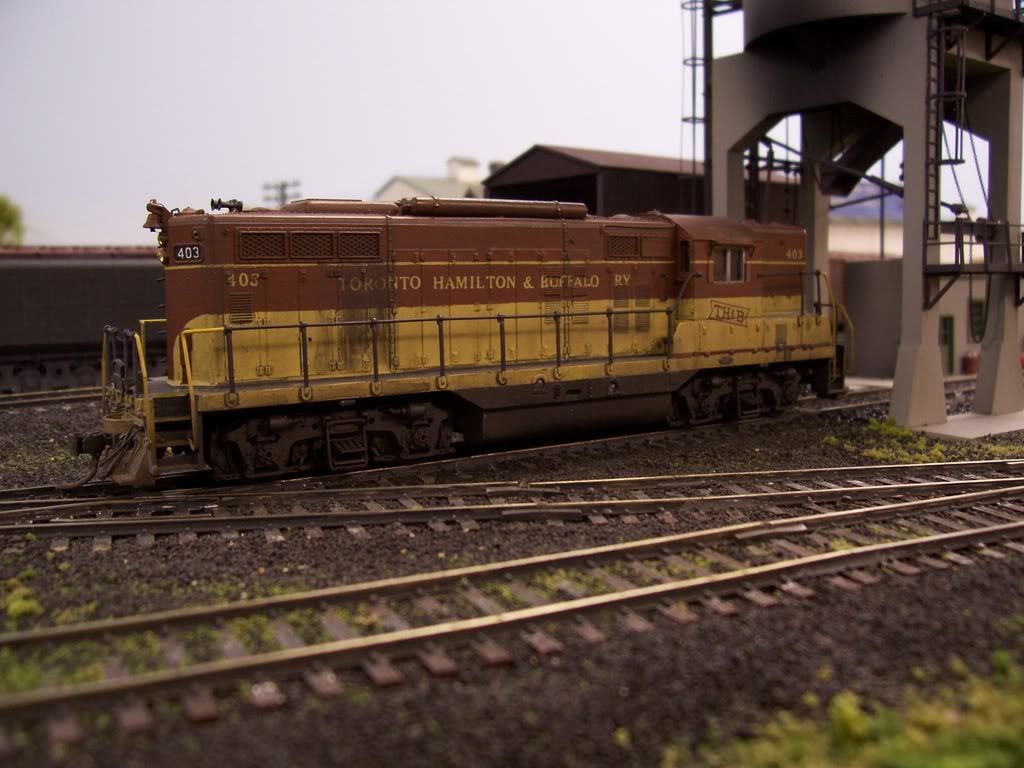
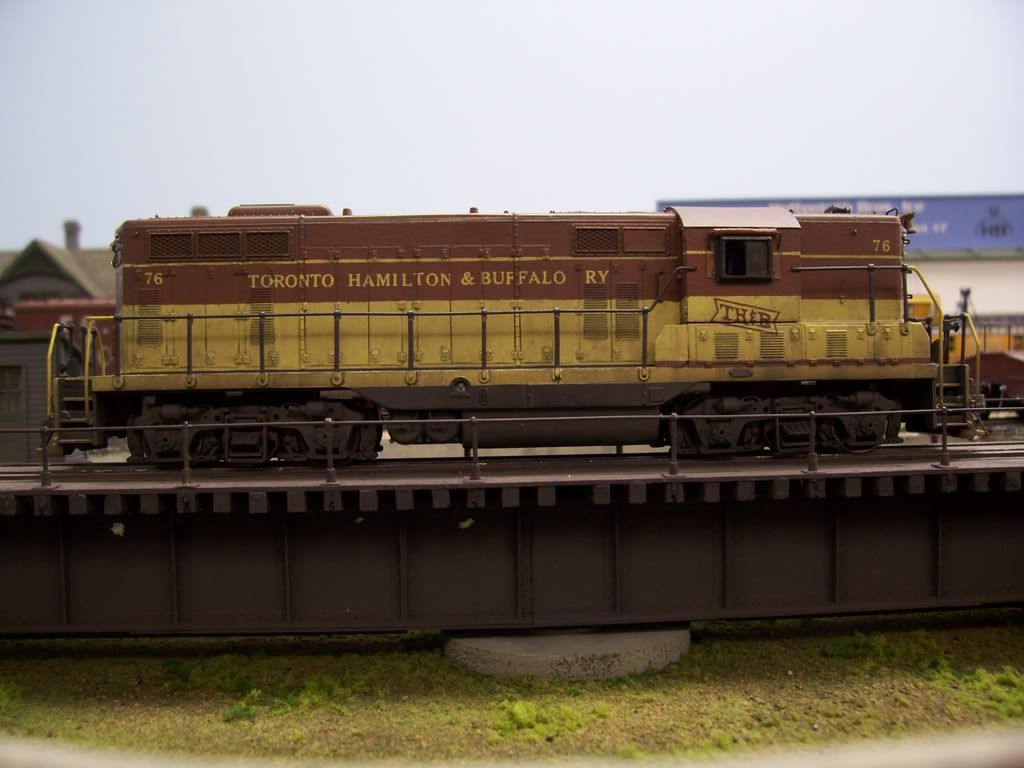
Incidentally, in 1950, this road purchased the first geep ever produced at GMDD. Slated for preservation, it was destroyed in a grade crossing accident in 1980.
Wayne