Hey people…have a painting issue hear. I am useing Model Flex paint from Badger (had good luck with it in the past) but this time when I am painting my latest projects the paint just beads up on the plastic, includeing the primer. I washed the engine shells in plain dish-soap to maybe remove some grease/oil that may have been deposited. I don’t understand what is going on?
Did you rinse the model thoroughly? You could try giving it a quick scrub with Isopropl alcohol and let it air dry. You could also add a couple of drops of that alcohol to your paint to help cut the surface tension. Don’t spray it on too heavy, remember, several light coats are better than a heavy one.
Ahh…the joy of acrylic paints! [V]
Give me laquers or enamels anyday!
Rotor
Had the same problem with MF. Now I only use it for weathering.
I have the same problem with leather dye/alcohol mix.
Why the sarcastic rant, Rotor??? Our fellow forum member is asking for help and support.
AlcoRS11Nut
Couple of things**…(I’m assuming that you’re applying this paint with an airbrush)**
-
Make absolutely certain that the surface is free from oils, silicones, and other contaminants. Sweaty hands can affect a paint job.
-
Make sure that ModelFlex is THOROUGHLY shaken and stirred. After agitating the paint, stick a clean toothpick or similar object inside of the jar and check to make sure that there are no clumps of pigment on the bottom. If so, break it up and agitate again. As with solvent paints, the chemical binder and pigment starts to seperate after the paint sits on a shelf for an extended time period.
-
Air Pressure: Are you using an air regulator? How many pounds (psi) do you set it for the airbrush? With a Badger or Paasche airbrush, I usually apply ModelFlex between 20psi and 27psi, depending upon the color as some pigments are slightly more viscuous than others. If the air pressure is set too low, the paint tends to spray out in larger water droplets instead of a fine, atomized spray.
-
Don’t thin ModelFlex unless you’re going to apply it on the model as a wash.
Post back with some more details as to exactly what you were doing. I had a rough start with acrylics at fist but a good friend convinced me to give it another go. I’m glad I listened!
BT
He’s just a mean vindictive person. I’m surprised Crandell hasn’t banned him from this forum yet [:-^]
I wonder how many complaint letters PBS got because Bob Ross said “The joy of painting”? [B)] I didn’t think rotor sounded so harsh as to have to start a sidetrack about it. Geeeeeeeeeeezzzzzzzzz! Rotor, when we say using paint we are talking about actually painting with the paint. Maybe rotor hasn’t been using a respirator, or it hasn’t been working properly. I know water-based paint doesn’t have the same side effects as lacquer or enamels but that’s just some of the reasons some of us use the water based stuff.
[oX)] Kumbaya, people! Koooooommm Bye Aaahhhhhhhhhhhhhh.[oX)]
Anyhow, what kind of air supply are you using? Do you use filters (in-line air filter and paint filter or strainer) ? If you get moisture in your air line it can cause things like what your describing to go wrong.
Alco:
You didn’t say how you were painting / applying paint…
With a brush, I don’t like the way ANY of the acrylic paints cover! It seems to require a number of coats and still doesn’t come out looking well. On the other hand I do like to use acrylics with my air brush! And have had good success. But…A number of things are extremely important.
Firstly: DO mix the paint VERY well. I have a mixer (battery power, small, hand held) that I got from Micro-Mark that is a “God Send”. It does a great job of mixing with out introducing air into the paint, keeps the rim of the jar and lid clean, cleans up easily and doesn’t make a mess!
Secondly: DO NOT thin Model-Flex paint unless absolutely necessary. Take it to the cup or right out of the bottle as is.
Thirdly: Be very certain that the surface you are painting is clean. I do a wash with dish soap, warm water and a soft brush followed with a rinse of water and white vinegar. An alcohol wash / rinse works too, and I have had success with both. I guess it’s your choice.
Fourthly: Handle the surface to be painted only while gloved. Do not get body oils and acids on the painting surface!
Fifthly: Apply the paint in a number of thin coats…This can be very simple, or harder, depending on the airbrush you are using, but can be manipulated with practice.
Sixthly: Be sure your air is clean. Use a filter to be sure NO oil or water is mixing with your paint at the source of the air.
And…Lastly, for what ever it may be worth; I use an air pressure of about 20psi, which is BTW recommended by Badger, for Model-Flex paint…Because I have found it to dry on the needle (internally) with a higher pressure when painting for an extended period of time.
DITTO
David B
WP3020,
I understand that Rotor might have been simply wisecracking [:o)], but think about it.
If you’re encountering a frustrating problem in your modeling activities and turn to the forum for help.…the last type of response that you’d want to read is something that increases your level of frustration.[banghead] Right? [;)]
BTW: I sure do miss Bob Ross. Such a cool, down-to-earth person.
Is it the model or is it the particular bottle of paint you are using?
Sounds like if it is beading on primer as well as styrene (especially on multiple models) then the problem is the particular bottle of paint.
Chuck it out.
You’re absolutely right. This forum has been all about “feelings” lately, and obviously your’s were hurt in a devasting and irreparable fashion. Thats why I’ve started a campaign to ban Rotor from this forum for his mean spirited personal attacks on you. Even though he didn’t mention your name, we all know it was meant for you.
Back to the subject at hand here…I’ve used both badger and floquil paints. I like using the badger paints for engine shells as they dry very quickly. I’ve found that you must use several coats, maybe 6 or 7 to completely cover the shell adequately when using badger paints. I’ve had some difficulty with different batches of the paints too. Some seem to work a little better than others. I’m not sure if the paints are dated or not, but that may explain some irregularities.
For weathering I use floquil hands down. Only because I have better control of the paint. I can adjust if for a much finer mix, and not worry about it “clogging” my paasche air brush. I’ve been painting for 20 years now.
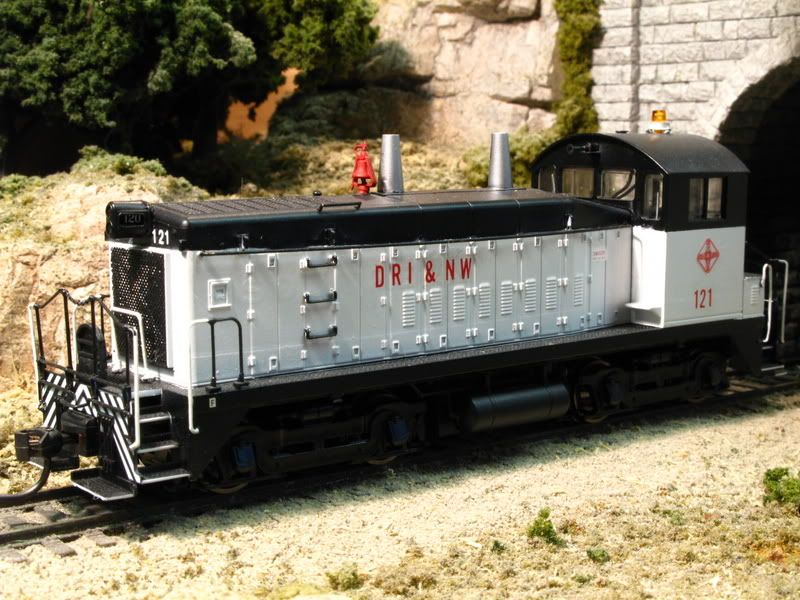
This engine was painted with badger model flex paints exclusively with an airbrush.
[%-)]
Search Youtube for him. There’s even some Bob Ross out takes on there.
If I have to explain it forget it…
Geeze…maybe I should just go back to my padded cell. [#oops]
Rotor
If there’s a layout in it, GO FOR IT![:D]
Uh, yeah Driline, [:o)][:-^]
I got it long before your above post. I’ve thought highly of your past posts and was wondering why you chose to spit vinegar at me?
But it is of no consequence and relevance to this thread’s poster needing help with a paint issue. BTW: Good tip on your part as well.
Peace out