Can anyone offer tips on painting those little figures.[Z] Someone just gave me a bag of about four billion of them. What kind of brushes are good? What does one use to apply tiny amounts of paint to eyes and ears? I was thinking the end of a needle dipped in paint might work. All helpful hints greatly appreciated. Thanks.
Unless it’s O gauge folks or larger, I don’t think anyone attempts to paint the eyes (that is if you mean painting the white and blue, green or brown parts).
The local hobby shop or art supply store should have a good supply of very small-tipped brushes. If they’re Preiser figures (white plastic) I paint the “flesh” color first, face, hands and legs (for ladies in skirts). If it’s a man you can leave the shirt white and paint the pants blue, grey or brown. If the figure is wearing a suit, you can paint the jacket the same color as the pants. Then I paint the hair brown or black or pale yellow (for blond) and the shoes black or brown.
I like to do them as much as possible while still on the sprue, and do them in “assembly line” fashion. Paint the flesh color on say 10 figures then set aside to dry. Then add blue pants to some figures and set aside to dry. Then paint some figure’s pants brown and let dry. Come back with some pink for the ladies dresses.
Like anything else, you just have to take your time and practice. At first just try to do simple paint jobs and do them “good enough” to use say inside a passenger car or in the backgrounds. Over time you’ll get better and better at it.
I try to find the smallest brush i can and buy a few of them, and cut about half the bristles off near the top and use the brush then. Be careful and experiment by cutting a few at a time, also the local hobby shop should carry the tiny micro brushes in a 10 pack I think.
This past year there was an article in MR (by Cody???) about painting the small HO figures, that described a sequence for doing so to obtain good results. Check the index to see when that was published… Cedarwoodron
I do a fair amount of looking at other hobbies like military modeling and fantasy figure painting. Most guys that paint figures usually use very good quality natural hair brushes such as Sable and Kalinsky types. The natural fibers usually have better spring in the brush and tend to keep their shape better than hobby brushes you would buy in your LHS. Also different manufacturers have different styles and sizes of brushes. For instance, in an art supply store you may see 10 different brushes each labeled number 0 but clearly different sizes. Some have longer bristles and hold more paint others are very short. Each has their own purpose.
I think of painting teeny btiny little people like I am a casting director for a movie. I look at a batch of unpainted… or commercially-painted figures as like a mob of hopefuls at the studio casting office who want a job in the movies- maybe if just as an extra. I know the script of the movie, the scene and time and mood we are trying to create. Then I look at the would-be actors and see which could fill those roles. Sometimes I will find someone a little different from my preconception, but I also see sometimes a way to make them into a character somewhat different that what they walk in as.
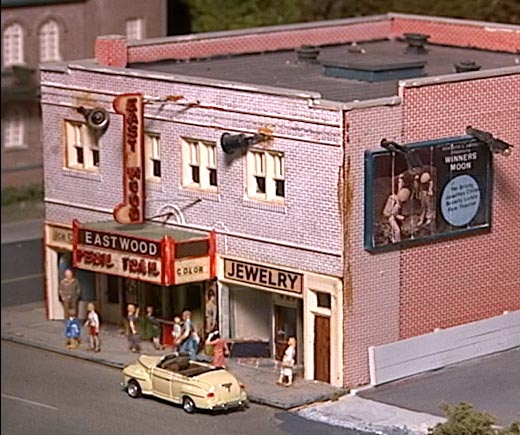
Casting the people in front of the small town moviehouse. My transition era layout makwes me think of 1950s movies. And I had a figure that looked as if she could be made into- if not Marilyn Monroe, a small town woman who THINKS she looks a lot like Marilyn Monroe. At the right side in front of the jewelry store. Maybe nobody will catch that, but having a characterization like that in mind will help me paint people that don’t look all alike.
The child figures standing at the curb are brother and sister. The girl, 14, is in charge of her little brother, earnest about it. But they were told to stand in front of the theater when the movie let out, and they can’t think of looking anywhere except directly in front of the theater. They don’t realize that their mother has to park a couple spaces down from the theater fire zone and they haven’t noticed her honking or waving. So Mom, in beige-orange dress, had to get out to get them. The slightly creepy man at left with bhis bhands in his pockets is trying not to let anyone notice he is staring at the 14-yea
Cheapskate that I am, I paint figures with acrylic craft paints using toothpicks. For HO scale figures you don’t need to paint in the eyes or ears. I can paint on a mustache, though. I do file the toothpick to a finer point with an emory board.
I understand a one or two bristle brush is needed.
I’m to lazy to be bothered painting HO figures.
Plus, my eyes are not that good. I AM nearsighted, and can read fine print without glasses., but to think of paint schemes for a bazjillion “little people” would drive me to distraction.
I’d rather buy the ones already painted.
Besides it’s not like I need a stadium full of little people anyway.
The LION does need a million people. (NYCT moves at least that many every day!) Fortunately I can populate most of my stations with “good enough” paint jobs. They will be crowded in there, with limited lighting and limited viewing possibilities.
I have a couple of bags full of unpainted figures for future use, and a rather smaller number of prepainted figures purchased in Japan in the 1960s. The fun will be converting them into believable 1964 issue Japanese characters - most utterly unlike their American counterparts.
When I first brought up this thread I half-expected someone to suggest getting photos and trying to duplicate the appearance of thespians, high school classmates and such… (Now where did I put the microscope?)
Some figures are unavailable at any price. I’m pretty sure I’m going to have to make the rikishi for my sumo ring. I’m certain that I’ll have to make the referee and judges, with their traditional robes… Guess I’ll use the John Allen trick and layer something on a wire armature. I foresee a lot of experimenting…
Chuck (Modeling Central Japan in September, 1964 - people included)
I glue them to a stick of wood (3/4 X 3/4) using white glue. I do about 6-8 at a time on the stick, and paint with a #0 sable brush (pricy, but worth it). After the paint dries, I hit them with dullcoat (people prototypes are not shiney), then break them off of the stick and fasten them to my layout (white glue again, makes them easy to relocate).
I like to mix small amounts of the caucasion skin tone paint with tiny amounts of other colors to make my folks a little more ethnicly diverse.
By the way, I find that “aged concrete” color paint makes a good representation of gray hair.
I’m kinda in the school of prepainted figures (largely because my hands shake a bit) but I did see what I think is a good idea at a train show not too long ago.
The modeler was working on HO figures which he had painted black and then was dry-brushing them with various colours. The effect was to create the appearance of shadows in the folds of clothing and beneath the arms and legs etc. He obviously was experienced with the technique because even the faces looked more realistic then the typical solid flesh tones used on most RTR figures. The natural looking shadows really added some depth to the figures’ appearance.
I have yet to try this process so I can only comment on what I saw, but the results looked pretty good to me. I have some downtown scenes that I want to populate with lots of figures so I plan to give this method a try. Don’t hold your breath - it is way way down my to do list.
On the other hand, if you want a more realistic look & have a reasonably good hand at video, you can put REAL people into your scenes. There’s a lot of pre-keyed footage around, on YouTube or Google, for free, or you can shoot your own with a blue blanket, a video camera, & some understanding friends…
My advise,buy the best brushes you can afford and look after them and they will last a long time and paint with flat acrylic paint that has no shine, Good luck! John.
The Lion makes a good point about visibility of figures. I put a lot of people inside buildings, as part of the interior. Many of these are really old, low-quality figures I got when I was a teenager, back when TV was black-and-white and dinosaurs roamed the earth.
I use acrylic craft paint for my figures. First, I give the faces, arms and bare legs a coat of flesh tone. This is easily done, as I don’t particularly worry about “staying inside the lines.” I’ve found that craft paint works out better if I plan to apply two coats.
Next, my big secret which should not take anyone by surprise: Use a magnifier lamp. I got a cheap one for $16 from an electronics place. It’s fine for my purposes.
From then on, it’s just a matter of adding colors. I like to do people in batches, and I do one color at a time, let it dry, add a second coat if necessary, and then let that dry. Craft paint dries quickly, so I can do several paint cycles in an evening. I use a very fine brush for this, a decent one I bought at a craft store. Don’t be afraid to go back and touch up spots.
Until I moved to metro Washington DC, I played Dungeons and Dragons with some good friends in Syracuse (2000-2009). My friend who ran the game was close to my age and one of his side hobbies was painting miniture figures for the game - he had a work bench in the basement where he had collected hundreds of mini’s including armies of orc’s, skeletons, and all manner of creatures and humanoids. One year I bought him a Christmas present, as crookneck magnifier lamp - it allows you to hold items with both hands under a large magnifier and it has a fluorescent lamp to alluminate the item you were looking at. It was perfect for his painting tiny figures. I suggest you buy one of those - it is a good investment for painting small things!
Also you can get brushes which are for tiny details, that have only a few hairs in the brush, good for tiny figures.