My trains will be max 4.5 feet, so how much space do I leave between the turnouts for the curved part so other trains can get past?
In other words, how much space is needed between the end of the turnout and the last car of the train?
My trains will be max 4.5 feet, so how much space do I leave between the turnouts for the curved part so other trains can get past?
In other words, how much space is needed between the end of the turnout and the last car of the train?
The answer depends on the definition of “end” of the turnout and “how much space” you want. Assuming the turnout isn’t a curved one, any equipment on the diverging leg will clear anything on the main when it is about 1" off of the main. Both for safety sake and to give yourself a little room, I’d make sure your train can pull completely on to the siding so that it’s last car is straight on the siding rather than pointing back toward the main on the diverging leg of the turnout.
However long it takes for your siding to get parallel to the main or however it takes for the tracks to get 2’ apart. that depends on the type of switch, whether the siding is coming straight off the switch or is curving and your track centers.
What you’re asking about is the “fouling point”, the point where a car or engine on one leg fouls the clearance of a train on the other line. In some situations the railroad might put up a stake or sign indicating the fouling point.
As noted, if you have two parallel straight tracks, as long as the trains are on the straight part it shouldn’t be a problem, but I’d always leave a little extra room too. Railroads if at all possible tried to make passing sidings longer than the longest train to run on the line, so normally a train wouldn’t have to be squeezed into “just fitting” into a siding.
Of course sometimes the train is too long, and to pass another train they have to do a “saw-by”. That can be fun on a model railroad once in a while but you wouldn’t want to have to do it regularly.
I just measured a siding at my station. Shinohara #6 turnout, straight track 2" on center.
The fouling point is 4-3/4" past the point of the frog. I have a flag at about 5" just to be safe. I hope that this is helpful.
hi
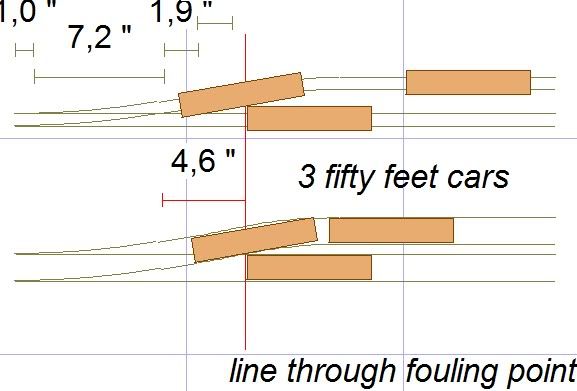
i used an atlas #6, come out at 4.6" . You’d better keep some extra space…how much is up to you, but…I made this drawing with 50 ft cars. If you are using longer cars you fouling point will be much further away from the frog.
You should also take in account switching moves…which asks some extra length too. (Un) Coupling can be done off-hand only on a straight part of the tracks. You could take the length of a switch as extra. For your 4,5 ft long train use the length of a #4 switch. which is 8" extra (12" for a #6 switch), so take 5’ 2" between the turnouts ( 5’ 6" if you’re using #6’s).
As said often here, set it up…but try out switching moves too.
smile
Paul
Ok so I need to use 2 peaces of flex track and a turnout and 2 of my longest cars. [8-|]
But I’m not sure what you mean by try out switching moves?[:^)] It’s just a passing siding.
Hi ZimDalf
yes you got it right…, maybe even 3 pieces of flex-track or some snap-track if you still have it.
And yes i can’t imagine a layout with just a passing siding, you can always add a spur for a freight-house or team track. If you like some switching to do later, you are ready for it.
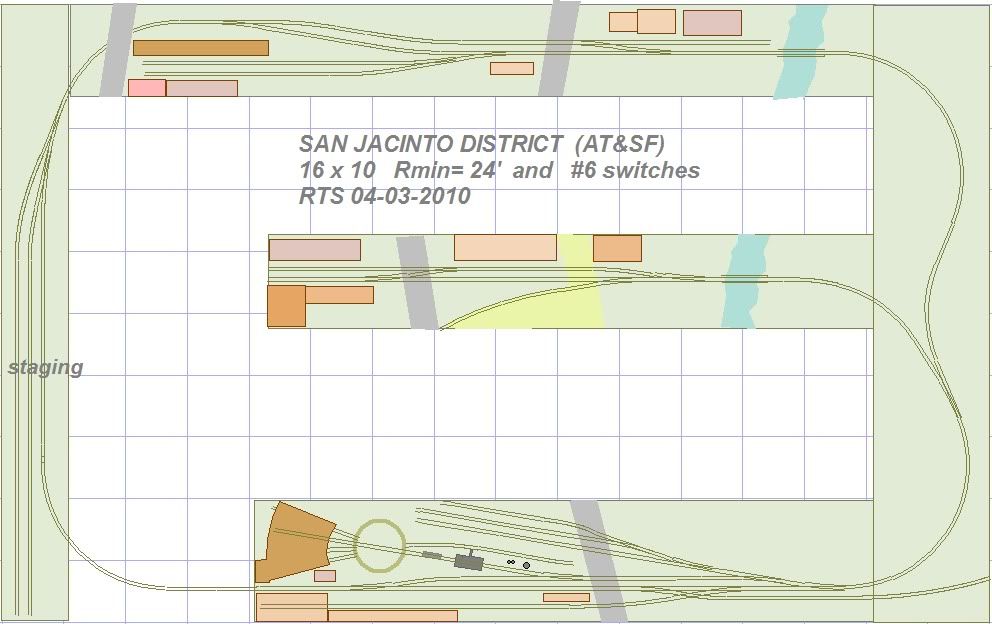
Look at the siding of the station at the top, an industry and a freight-house spur are added.
have fun
smile
paul
Oh, sure I’ll have other spurs and stuff, just didn’t seem relevant to my question. [:)]
While my period of work with the Santa Fe was in the HQ at Topeka, not train service, I learned a lot from my dad who was an fireman/engineer with Santa Fe for 50 years. Passing sidings can be several things. They can be a shorter passing track where the train taking the siding would have to stop and wait for the opposing train on the main, or the passing track might be a few miles long which allowed for rolling passes where the meet was timed so the mainline train maintained speed and the train on the passing track would slow but not stop if possible so the main would be clear when it arrived at the end of the siding. And then all sorts of variations inbetween.
On my layout, which is fairly large and three decks, I modeled the passing tracks on the Enid Dist. at a certain length (as the prototype) which had been outdated by longer trains so that only one passing track on the district of 45 miles between Guthrie OK and Enid OK is long enough to hold one grain train while another passed. So during harvest, grain trains were “fleeted” between Enid and Guthrie, and I do the same on my model which represents June and harvest season at full bore.
In the era I model, the passing tracks at the other towns are used to hold grain cars for loading, because of the short length.
Bob
Cool info Bob!
Long passing sidings to let trains roll past each other is a neat idea! I don’t have room for that on my layout though! I want to keep the siding as short as I can so as to have open scenery areas.