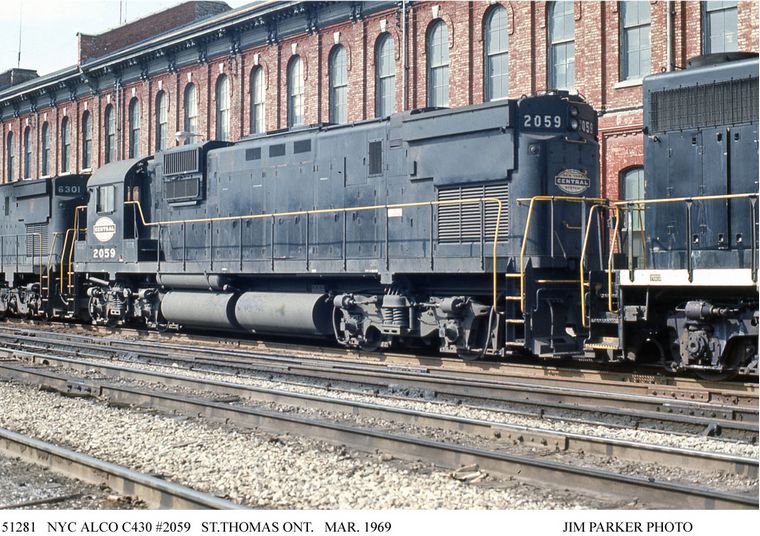
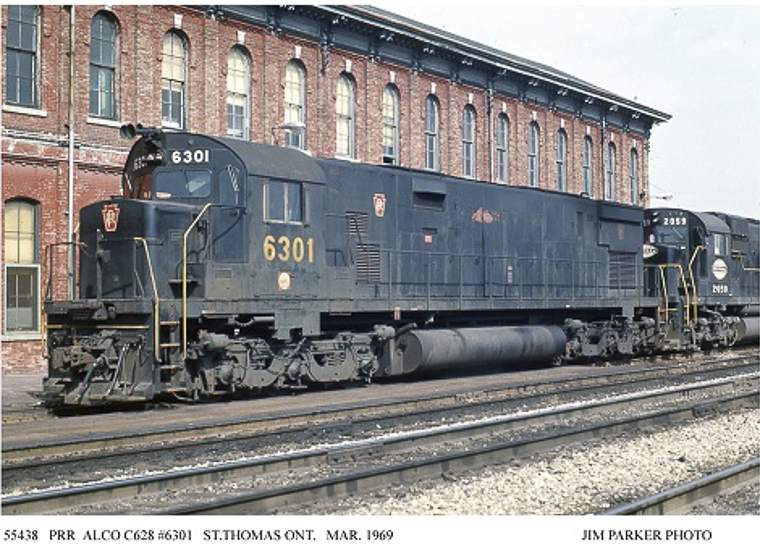
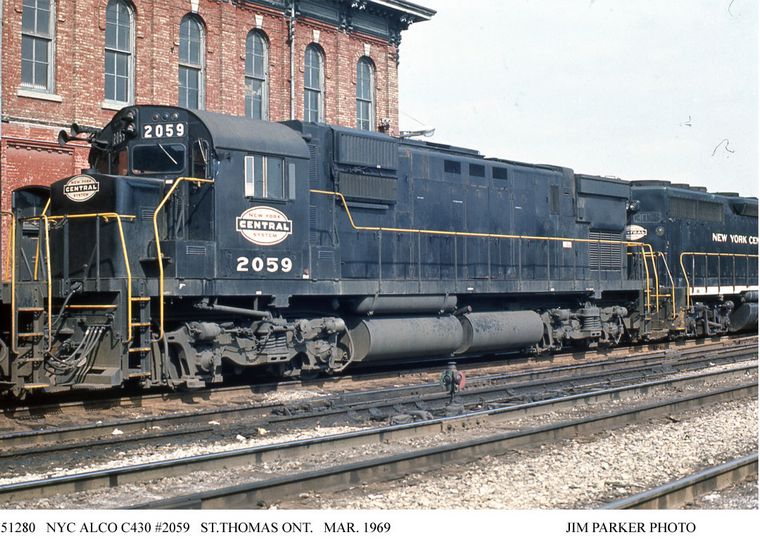
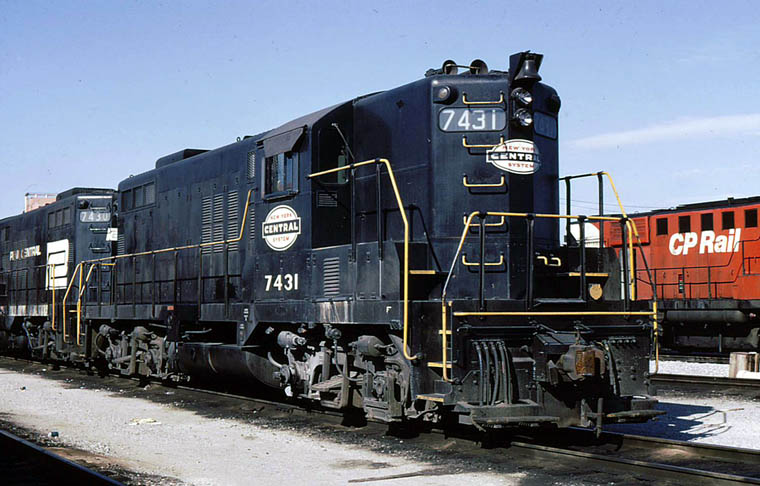
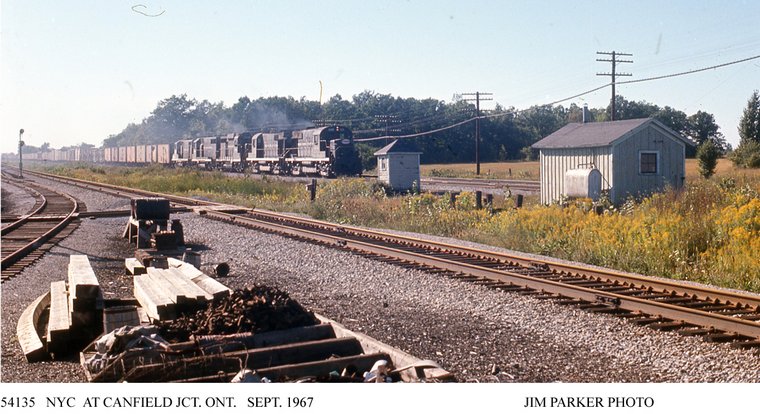
These powerful Alco’s were the last locomotives ever ordered by the mighty New York Central and delivered in their paint scheme. So it ends there, all those locomotives, 4-4-0’s, 999, Hudsons, Niagara’s, Mohawks galore, Mikes, PA’s, E7 & 8’s, Baldwin, Lima’s, all their history and contributions to moving people and freight and building Nations.
Next stop the ill fated and destitute Penn Central.
Enjoy this last glimpse of the astonishing and grand New York Central.
And how about this rare bird beauty…
NYC 2059 one of 10 (2050-2059) Alco C-430 3000 HP
Originally posted this in String Lining last year but I don’t think many saw it. We are already well into the merger in Mar. '69 and we are on the CASO in St.Thomas, Ont.
The NY Central is gone, the Penn Central is gone, the Alco C-430 is gone, the CASO is gone.
The magnificient and huge Freight/Passenger Station is however still with us.
Man, those ALCO’s looked formidable, didn’t they? More like weapons of war than locomotives. Imagine them with cannon sticking out of the nose and tail and machinegun turrets along the top and you’ll see what I mean.
Even harder to believe is that some C636s actually were delivered from Alco in PC paint; hard to remember they were so new when you’d see them on heavy freight. One of these, going through Trenton in the early Seventies, had the loudest exhaust I have ever heard in a locomotive, more painfully experienced than heard. And then there was the noble experiment of Hi-Ad trucks in both B and C styles, cutting-edge modern and fast as hell to a 10-year-old ignorant of anything like harmonic rock on worn-out track…
Air starters, those I never quite ‘got’. Except perhaps as budget alarm clocks, only need one for a whole subdivision and no need for a snooze bar …
It has its ups and downs, from a crew’s point of view the main advantage is that you can restart a dead unit simply by hooking up the main reservoir line from another locomotive, no fooling around with jumper cables.
The downside is that you need another locomotive for this, so air-start units cannot be manually shut down if you want to use them again later, as the starting air supply can leak off.
We had a incident a couple years ago where a train powered by 2 SD70M-2s was parked for a day, and the crew shut down both locomotives to save fuel as per our operating instructions. When the new crew arrived to pick up the train they could not restart either locomotive, and had to wait for another train to stop and help.
Well thank you guys for the air start explanations and videos.
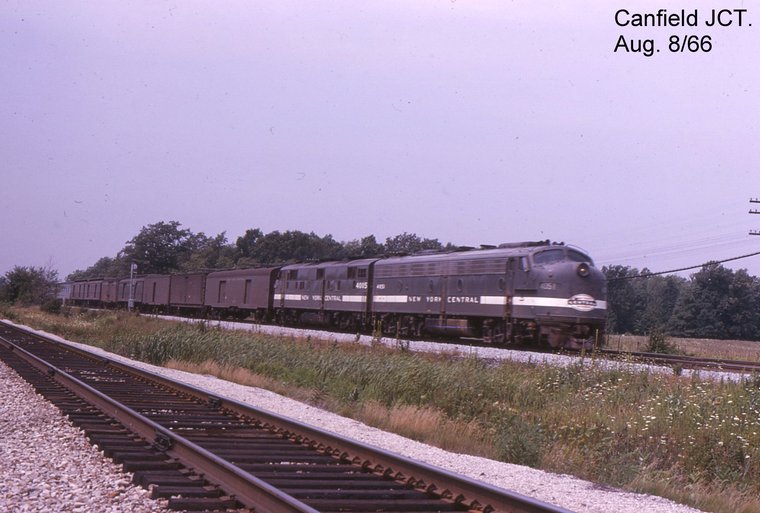
Here is the NYC on the CASO just before the merger. Those huge mail/mail storage trains were frequently seen over the CASO and continued on into the Penn Central era. The various Pennsy and NYC E units got real ratty looking as did the cars. Sometimes these were 30-35 cars long. They hustled along at a good clip but encountered several restricted speed areas as the deferred track maintenance caught up to operations in the Penn Central era.
Knew these trains were on their last legs just by their condition but the freights always looked ok. The C&O and N&W (Wabash) also had deteriorating track but appearances were kept up pretty well.
I was expecting that the Penn Central era would usher in new life for the CASO but how wrong that hope turned out to be.
Conrail was around for a wee bit, not long.
I can still picture Hudsons and Mohawks, 2-8-2’s galore on the main and some smaller tea pots for the branches. That was some railroading.
NYC 2028 leads freight on Canada Division mainline which also hosted C&O on trackage rights.
Parallelling CNR’s Cayuga Sub. which hosted Wabash (later, N&W then NS) on trackage rights.
and crossed CNR’s Dunnville Subdivision.
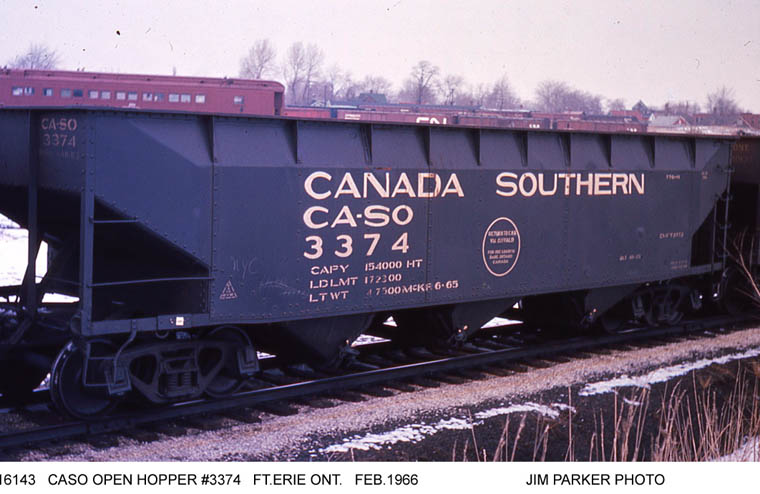
This iron ore traffic commenced in 1965 and continued until 1971 between Dane, Ontario, on the ONR and Jones & Laughlin steel mills in Pennsylvania on the NYC/PC. The participating road haul railways contributed cars to the pool based on the total mileage operated over their respective lines. The breakdown was 22% ONR, 40% CNR and 38% NYC. The total pool consisted of 345 cars - 75 ONR, 140 CNR and 130 NYC. Cars of NYC, TH&B, CASO and P&LE ownership comprised the NYC proportion of the pool. Lance Brown
Yes, but just transfers, not out on the road. Pretty sure this was the only point where PRR entered Canada. I wonder if they ever sent over a switcher on the Ashtabula in Port Burwell once in a while.
Baldwins to boot!!
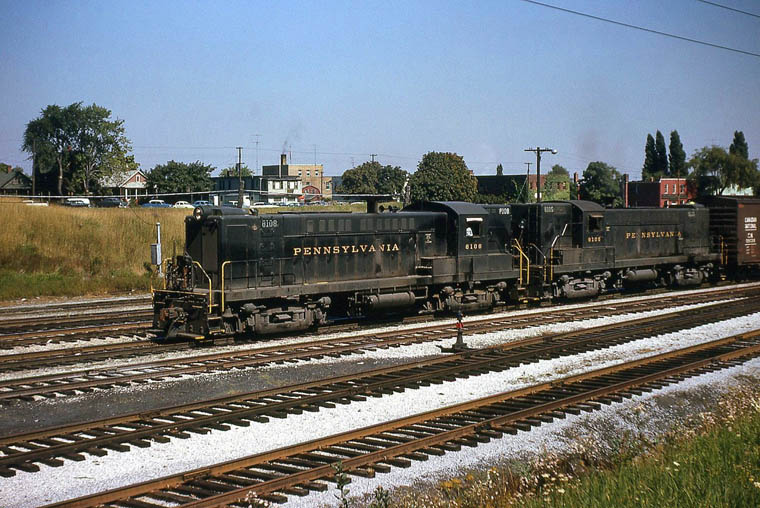
PRR 8108 8105 Baldwin RS12’s with a transfer from Buffalo to CNR. Fort Erie September 1963 Bill Thomson
I’m not afraid to admit that the PC was my favorite road. I started railfanning in 1970 at the age of 11 or 12. The PC Pennroad branch in Detroit was only a block away from my house. That summer, we flew to visit my aunt and uncle in New Brunswick, NJ. They lived only 4-5 houses from the NEC. They laughed when I’d run for the front door every time I heard the howl of a train. I was an early subscriber to X2200S and loved taking roster shots. The PC Junction Yard always had a lot of dead power and the employees were always friendly and helpful. Several years later, when I was driving, I got stuck in the snow at the engine terminal. One of the MoW employees hooked up a chain to his truck and pulled me out. The good ole days…
PS–Anyone got any old issues of PC Railroader magazine they want to sell or photocopy?
I remember one in the shops at Nelson Point Port Hedland that was very reluctant to start, and being connected to the shops air system was running for minutes until they decided to try something else…
Before GE adopted alternators, the generator was just used as a starter motor.
Despite the CP Rail M630 in the video, Australian M636s had electric starters, that were a lot quieter.
I’ve ridden hundreds of miles in C636s and M636s fitted with Alco HiAd trucks and they always rode very well. On one occasion I leaned way out of the cab window in a trailing unit to watch the movement of the big coil springs in a sharp curve (well, sharp by our standards).
When BHP took over the former Goldsworthy Yarrie line, built with jointed 94lb rail, but upgraded with second hand welded 132 lb later, some harmonic roll was experienced from the HiAds which by that time were under C36-7s that had been built on the C636 underframes. There were six Dash 8s that had been built new with GE floating bolster trucks and they were found to behave better on the rougher track.
But to return to air starters… I recall heading out to Sydney Airport in the late 1950s to farewell our
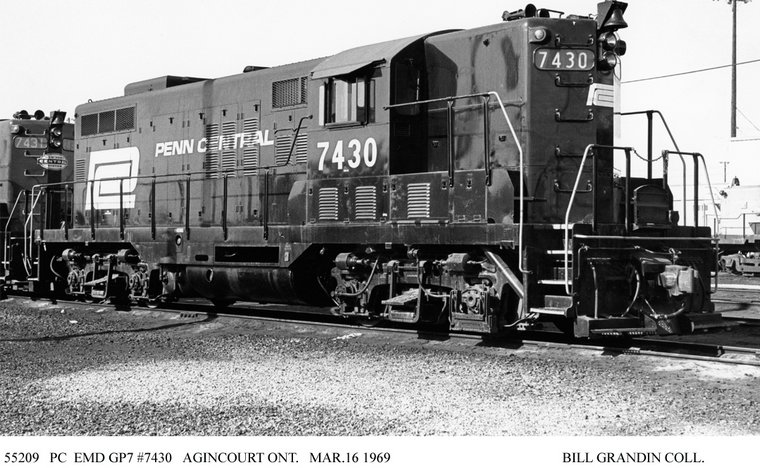
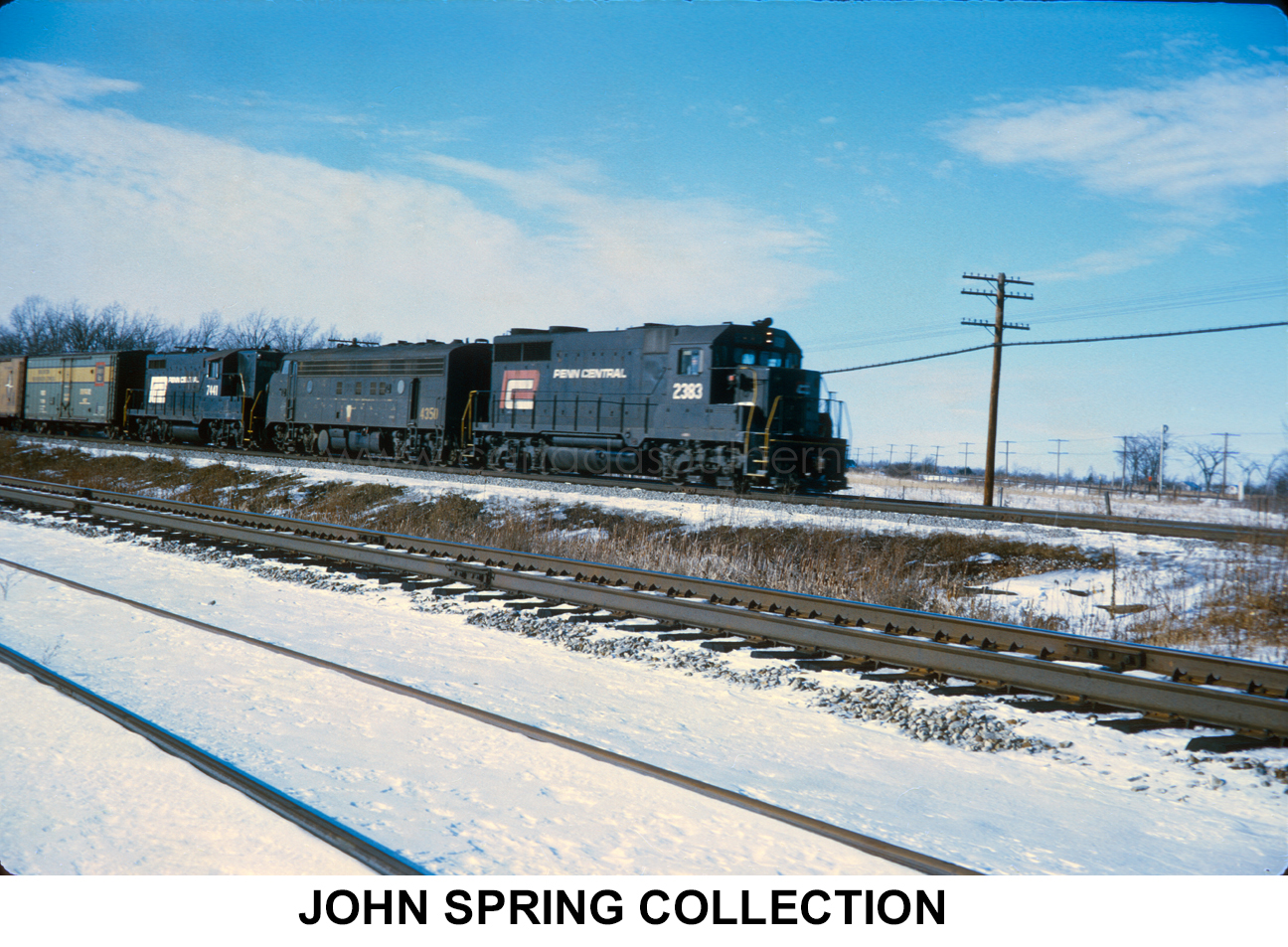
Interesting Penn Central lashup including first and second generation Diesels and the failed added colour to the mating worms logo. There was some criticism that their loco’s were too stark looking so they added red into the PC but its soon faded to an awful shade of pink. Nothing was going right for Penn Central at this point.
I believe what you have there is a fairly typical example of a ‘DeWitt Geep’. There is a 567 under the elevated cowling required for the greater engine height. These were successful conversions that lasted many years… unlike the NYC project to put a 16-567 in a PB as a test, similar to something ATSF tried in a trio of subsequently famous PAs, for a very short time.