Philosophy Friday -- Bridging The Gap

“Bridging The Gap”

Railroad Bridges across the Calumet-Saganashkee Channel near Chicago Illinois

Everybody knows the world ain’t flat. In fact, it’s full of hills and valleys. Even areas that seem totally flat nearly always have little peaks and dips that our senses tend to compensate for automatically and “smooth out” in our memories. But things are rarely completely level unless they’ve been specifically prepared, and thus the prototype railroad is always having to build bridges of some sort or another. Whether it’s a simple culvert to cross a little creek or a concrete and steel behemoth to traverse a mighty river, or something inbetween, railroads are always building bridges. Comparatively speaking, most model railroads don’t have anywhere near the same proportion of bridges, even considering “selective compression” and such, with respect to their prototypes. I suppose its an aspect of Modeler’s License. And when bridges are included, they are more often than not a large bridge of concrete or steel-- or a wooden trestle, they’re still quite popular it seems. However, the most common form of bridge on the prototype is the small concrete or steel beam (or “deck”) style bridge that crosses a small creek, roadway, or dip in the terrain. Of course, in saying that, it won’t be long before someone points out that the really most common bridge isn’t really a bridge at all, but rather a fill-- of dirt, which is another feature that is often under-represented (or even entirely missing) on many layouts. Railroads have been known to put a small culvert in pl
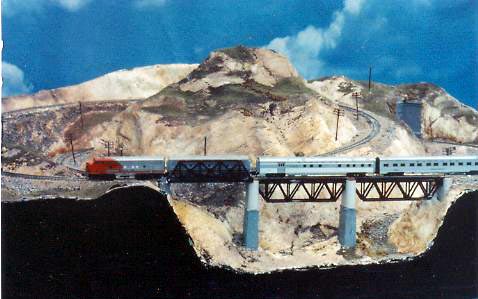
First off, that’s a very cool picture, John. Do you know where it was taken?

So My Questions This Week Are:

– Why do you suppose so few bridges are modeled, relative to the prototype, when that’s an item the prototype typically has in abundance?

Here’s a few of my thoughts about bridges:

  • It (and its placement) requires a lot of foresight and thought. You can’t just slap one down anywhere like you might a building or structure.
  • It requires a foundation (footers, walls) and some sort of expanse to cross. And these also have to be modeled to make them believable.
  • Since bridges are primarily found along mainline and spur, it generally requires that that section of the layout be out of commission until the project is complete - Most other structures and buildings can be added at any point in time without it disrupting the flow of train traffic. Not so with a bridge.

– Similarly, why do you think modelers often favor bridges over the more commonly used rock and dirt fill?

Familiarity. Unless you work for a RR, you see more bridges than fills. Bridges also stand out more (i.e. are more obvious) than fills.

– What do you think is the most common style of bridge? (Whether in general, in your area, or specific to the area of your interest?)

Probably girder and truss bridges - At least there are oodles of them in my neck of the woods (NE Ohio)

– What is your favorite style of bridge? Have you modeled that style on your layout?

A swing bridge - i.e. that pivots in the middle. No, I have not modeled one and doubt that I will.

– What style(s) of bridges have you included on your layout? Did you build them from

– Why do you suppose so few bridges are modeled, relative to the prototype, when that’s an item the prototype typically has in abundance?

Because model railroads generally have flat TABLELAND in more abundance than the prototype. At least beginning model railroads do. I remember a Lionel layout with a girder bridge on a flat table with blue painted on the flat surface of the table to represent a river. A layout needs to have some kind of open space under the track to have much of a bridge.

This is layout built in 10 days ca.1975 with a cookie-cutter plywood subroadbed under the twice-around track, hardshell Hydrocal terrain, and store-bought bridges that just drop in place.

– Similarly, why do you think modelers often favor bridges over the more commonly used rock and dirt fill?

Because a bridge is something you can buy and install. Rock and dirt fill is something a modeler has to actually do and model. Have to think about and plan more.

– What do you think is the most common style of bridge? (Whether in general,

Nice photo and good questions, John. Bridges take a lot more work to “work”. They require detailed planning, preparation, and placement. It is easier to lay roadbed and slap some rails into place. The more a person is a bridge nut, the more we’ll see on his/her layout.

Rock and dirt fill isn’t very sexy…and it seems ‘cheap’. Bridges are generally more expansive and grand, and tend to be higher than the observer. Fill bridges tend to be below the operating surface and low, so they aren’t very remarkable to the busy commuter or truck driver.

Truss bridges are the most common on the roads, whereas trestles and deck girders are found on the E&N Ry locally.

In the province, elaborate suspension bridges are the largest ones on heavy commuter routes in large urban areas.

My sentimental favourite, hands down, is the timber trestle. Next is the through girder with rounded girder ends. And yes, I have one of each.&nbs

Well, most of us have only limited room for our layouts, and devoting a disproportionate amount of space for bridges usually means that there’s less space for other important stuff, such as industries, stations, towns, and other types of scenery.

Well, there’s usually a little more pizzazz to a bridge than there is to a pile of dirt. [(-D] On the other hand, I think that lots of layouts have the pile o’ dirt option, too: it’s simply hiding behind stone or concrete retaining walls.

Bridge styles depend a lot on their location and purpose, especially for those of us modelling bygone eras. Available materials limited styles in some cases, and the performance of a particular bridge type often made it more suitable than other types, depending on the obstacles to be overcome. In my area (and especially in the era which I’m modelling) common types were/are steel girder (deck and through types), truss (again, deck and through types, including lift, bascule, and swing types), trestles (wood, steel, and pile-type), cut stone culverts, and through-type concrete arch highway bridges.

I like 'em all, although truss types are probably my favourites.

[quote user=“jwhitten”]

– What style(s) of bridges have you included on your layo

John,

Although I enjoy your topics each week, I hardly have had anything to add. This week you posed something I can share some comments on… Hope you don’t mind…

So My Questions This Week Are:

– Why do you suppose so few bridges are modeled, relative to the prototype, when that’s an item the prototype typically has in abundance?

Affordability & Selection, I think (IMHO) that many modelers are put off as to what may ‘work’ on their Layout. I built a Walthers bridge once & added over 80 parts, & it does look good in pix, but is pretty short for a scale unit. I saw a brass bridge being sold for $2K, & yeah, I want one, but that is just not possible.

– Similarly, why do you think modelers often favor bridges over the more commonly used rock and dirt fill?

I think it adds a dynamic that is just not present with a dry land scene, although, if things go like they are many creeks may be that, dry fill soon…

– What do you think is the most common style of bridge? (Whether in general, in your area, or specific to the area of your interest?)

Well, I prefer Truss Bridges, the common icon being one of the BLMA ones, in sense of when someone says ‘Porsche’ most folks think of a late 80’s 911/930, not a 9

Don´t railroads always go over a bridge and through a mountain (i.e. tunnel)?

Bridges, as well as tunnels, are the scenic highlights on each layout, but it takes some skill to model them. It also requires a certain kind of 3-D thinking and planning, which is not everyone´s cup of tea.

My little mini-modular layout has both, bridges and tunnels, sometimes in one of the little modules.

I think modelers use fewer bridges because we don’t compress the whole railroad. Our layouts have proportionately more stations and industrial areas than the prototype. Most towns/station areas are not built with a river or creek through the middle. So bridges aren’t needed there. These areas are also much flatter than the surrounding countryside.

Consider that the Ma&Pa had 111 bridges and trestles (per Hilton’s book) over 77 miles. That’s one every 3662 feet or 42 feet in HO. So if you have a typical around the walls layout in a 10x12 ft bedroom you have about 42 feet of mainline track, so one bridge or trestle does it for you. Considering that probably half of your mainline is in town, you could easily have none.

Rock and dirt fill is not as visually interesting as a bridge so modelers have less fill and more bridges.

Most common bridge I see is the girder bridge.

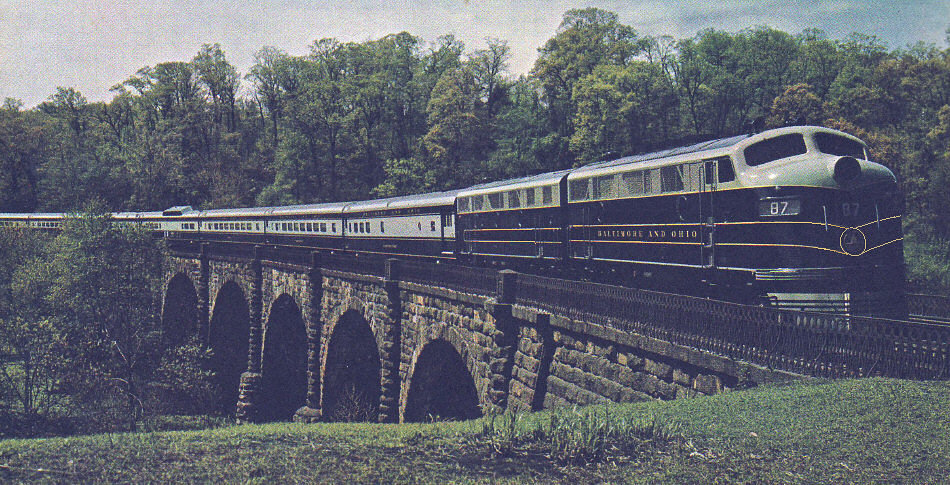
My favorite bridge is stone. But if I have one, it won’t match my prototype. As far as I know the Ma&Pa didn’t have any stone bridges.

My under construction layout has no bridges so far, though I will probably have on or two eventually.

I think it’s very common for modelers to have too many bridges. Except for large layouts, one or two bridges is probably enough. Add a couple of culverts as scenic details and you’re done. But of course if you like building bridges and trestles, why not have more.

Enjoy

Paul

That is Blue Island Junction here in Illinois.

http://www.historicbridges.org/bridges/browser/?bridgebrowser=illinois/blueislandjunction/

Several rail lines cross the Cal Sag Channel at this location, converge, and then head off in different directions.

A lot of the freight traffic entering Chicago from the south cross one of these bridges.

http://www.dhke.com/CRJ/blueisland.html

The Metra Rock Island commuter trains cross over this junction on an elevated portion of track that provides an excellent view of Blue Island Junction.

Rich

John,

First of all, I am not at all certain that I agree with your assertion that too few bridges are modeled on layouts. I would bet that a lot of us have at least one bridge on our layout.

Second, I would guess that the truss bridge is the most popular style on layouts.

Third, my favorite bridges are the bascule bridge and the lift bridge. Lots of examples of those two types of bridges on the prototype here in the Chicago area.

Fourth, it is impossible for modelers to go overboard and include too many bridges. There can never be too many bridges on a layout.

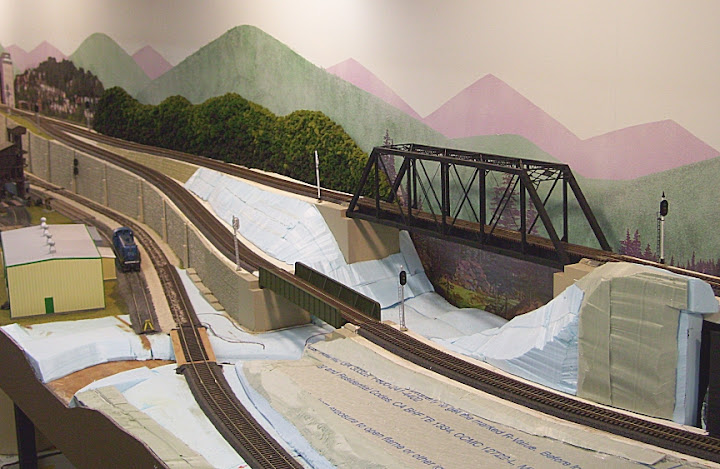
Here is a photo of my bridges.

Rich

– Why do you suppose so few bridges are modeled, relative to the prototype, when that’s an item the prototype typically has in abundance?

I suspect the reverse is true. I bet proportionately, there is a higher percentage of model railroad track on bridges than is the case with the prototype. Blue Island, IL is an exceptional case.

– Similarly, why do you think modelers often favor bridges over the more commonly used rock and dirt fill?

I’m not sure, but I suspect bridges and trestles are more interesting to look at.

– What do you think is the most common style of bridge? (Whether in general, in your area, or specific to the area of your interest?)

I believe truss bridges are more common. If you look at only the newer bridges, you will more likely find large gider type bridges.

– What is your favorite style of bridge? Have you modeled that style on your layout?

I think truss type is most interesting, and yes.

– What style(s) of bridges have you included on your layout? Did you build them from scratch, a kit, or acquire them ready-made?

I have truss-type, girder-type, and trestle-type made from kits or ready-made.

– Do you sometimes think modelers go overboard in some cases and include too many bridges?

I don’t think modelers go overboard. In most cases, they do what looks best.

Additional comment. Highway bridges add interst to the layout also. I have seen several good ones here in the forum.

I think the number of bridges one has on their layout depends on several factors.

  1. Is there a scenery excuse to use a bridge in the location chosen.
  2. Is there enough room on the layout to make a bridge installation look real.
  3. Does the surrounding scenery and track plan lend itself to a bridge.
  4. Is the modeler talented and experienced enough to design scenery around a potential bridge location.

The type or style of bridge I choose for a location depends on the location and the scenery around it. The more rugged the scenery, the more massive the bridge can be. In most cases you don’t want to hide detailed items behind it. I tend to think of the scenery being low at the front of the layout and going higher toward the back. This is true for cities as well as mountains. My bridges tend to work the same way.

Well, in my case, the Yuba River Sub has about 13 bridges on a model railroad that takes up about 24x24’ in my California Basement (2-car garage). In fact, a couple of my buddies on this Forum refer to me as “Bridge Tom”, LOL! I love 'em.

Most of my bridges are the shorter girder types, but I do have 3 ‘hunkers’, a long curved viaduct, a steel arch and a long truss. The viaduct is built out of 2 Micro-Scale ‘tall’ viaducts and built on a 36" radius curve (I’m in HO, BTW), the steel arch is an ‘Americanized’ Faller kit, and the long truss is two Walthers single truss kits. Most of the shorter girder types are modified from Atlas, Central Valley and Micro-Scale kits.

There’s only one ‘flat’ spot on the Yuba River Sub, and that’s the yards at Deer Creek, everything else is in mountain territory with ruling grades of 2-2.4%. Instead of a ‘canyon-bottom’ layout through the Sierra (a la the old Western Pacific Feather River Route), the Yuba River Sub is a ‘ridge-top’ crossing, similar to Espee’s Donner Pass line. That means quite a few bridges to span sudden deep gaps in the ridge faces. As a buddy of mine once remarked: “Good God, the whole thing’s on a CLIFF-SIDE!”

Here’s a few of them:

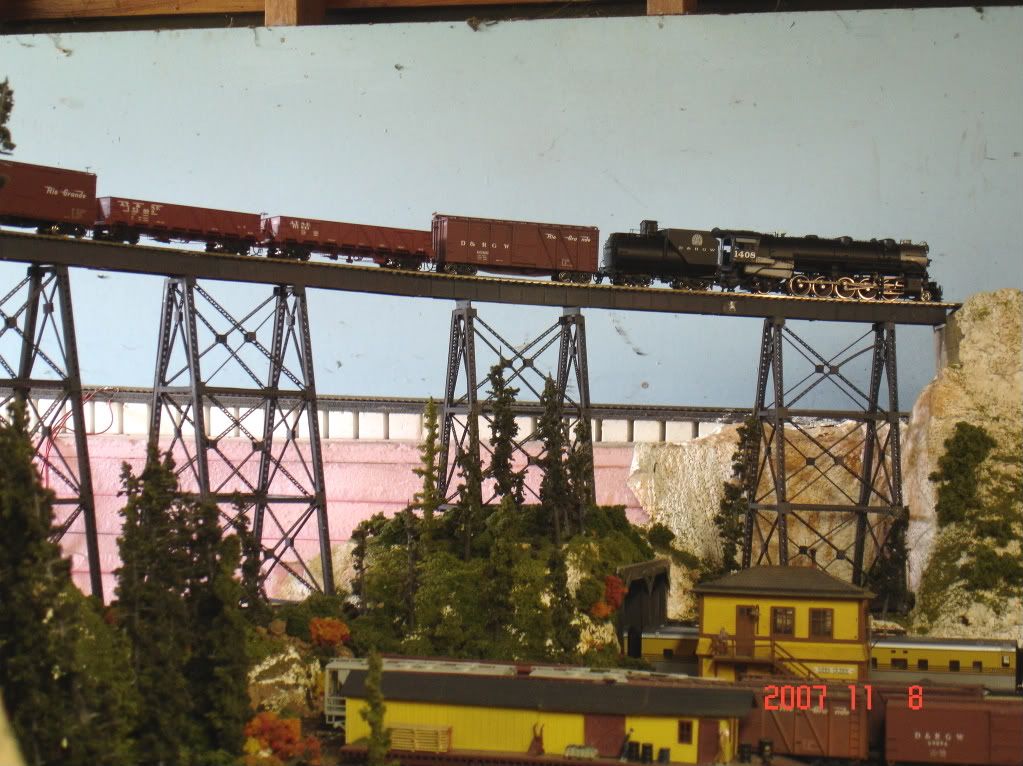
The Deer Creek Viaduct–two Micro-scale ‘tall’ viaducts on a 36" radius curve:

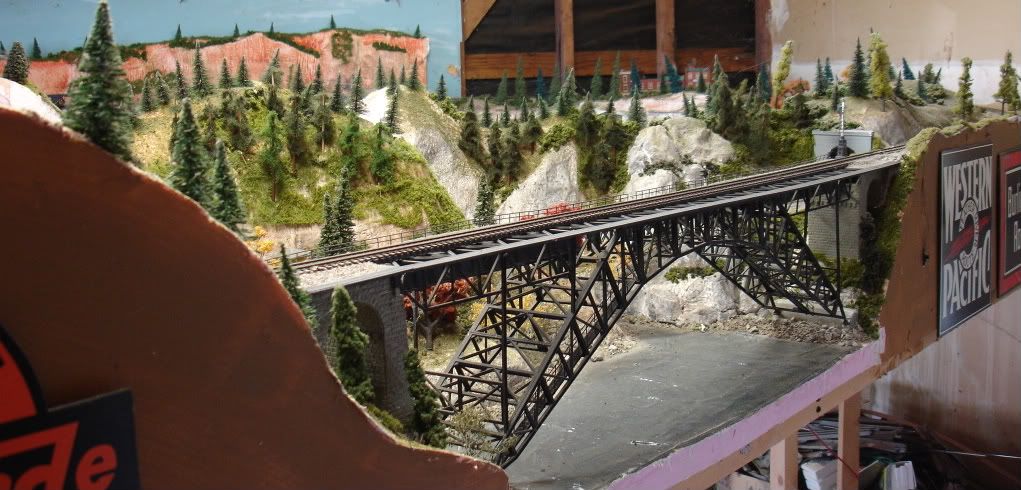
The Bullard’s Bar arch bridge–an ‘Americanized’ Faller Beichstahl kit

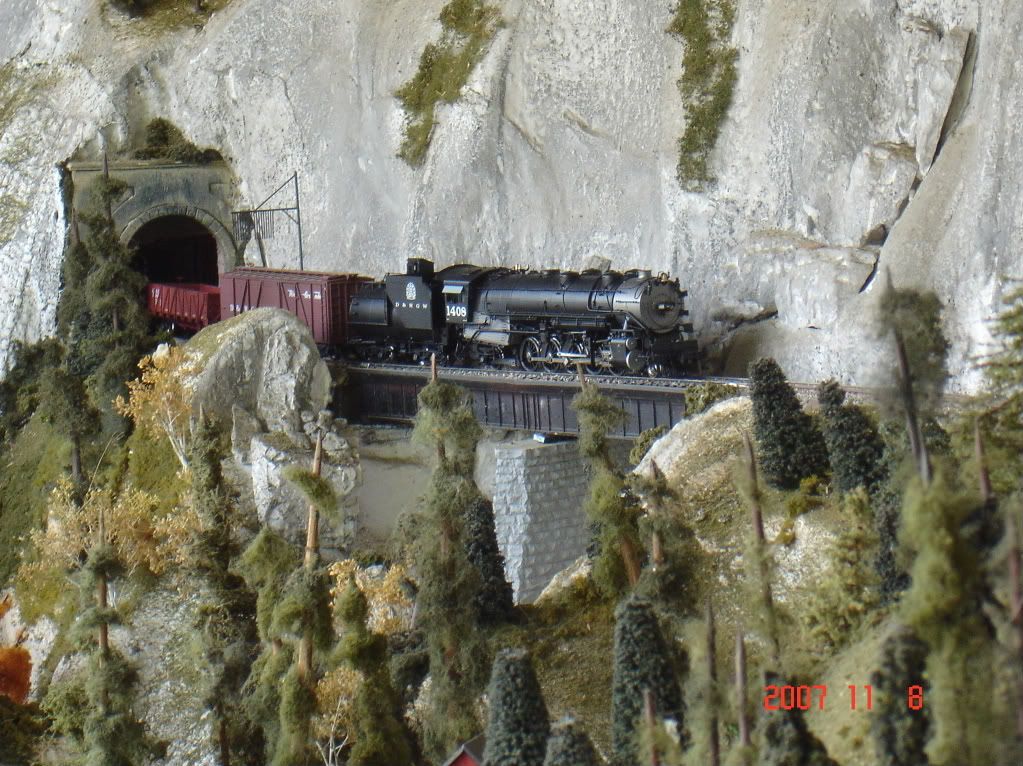
Plum Creek bridge on Sierra Buttes–Micro-scale girder

South Yuba Crossing–girder bridges

[IMG]http://i299.photobucket.com/albums/mm310/TWhite-014/Rio%20Grande%20

Great topic, John.

– Why do you suppose so few bridges are modeled, relative to the prototype, when that’s an item the prototype typically has in abundance?

Mu suspicion is that bridges require a lot of planning, whether you are buying the bridge or building it. As other folks have pointed out, the scenery and supports for the bridge have to be planned as well as the bridge itself. If you build a bridge from scratch, there is a lot to consider and a significant amount of math/geometry. I suspect that it’s a little daunting for some model railroaders.

Creating a realistic setting for a bridge is a challenge, too. Cutting a gap and dropping in a bridge would look silly. There as to be a reason for a bridge; creating those circumstances, realistically, is a challenge.

– Similarly, why do you think modelers often favor bridges over the more commonly used rock and dirt fill?

Fill is boring, a bridge has a kind of dynamic that makes it more interesting. Also, you can see through many bridges and under most; this allows for scenic elements on the other side of the bridge. Fill is like putting up a wall.

– What is your favorite style of bridge? Have you modeled that style on your layout?

My favorite is the timber truss bridge, followed closely by timber trestles.

– What style(s) of bridges have you included on your layout? Did you build them from scratch, a kit, or acquire them ready-made? Mine are all from scratch:

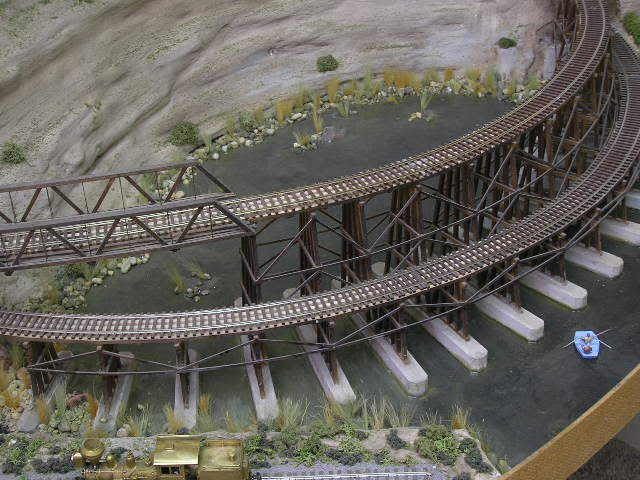
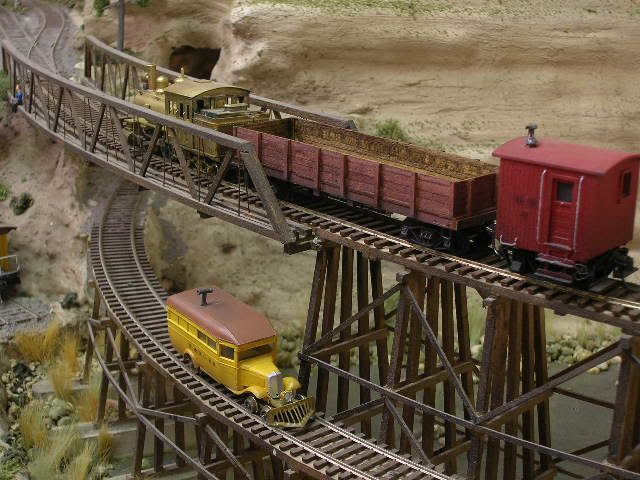
Trestle and wood truss bridge:

One of my favorite scenes on any layout is a bridge over a bridge. It’s probably rare in the prototype world, but I think it looks cool.

Short concrete span:

Actually, I think that modelers have more bridges per mile of track than prototype rail lines do. Part of that is a function of layout dimension. Our layouts are `Reader’s Digest’ versions of reality, so we try to include the interesting and leave out the mundane. Miles and miles of slightly-raised fill with an occasional culvert is condensed into the end curve of a peninsula - frequently without so much as a culvert. OTOH, those of us who model prototypes with lots of bridges tend to design layouts with lots of bridges. (Guilty as charged, Yeronner!)

Once again, it’s that selective omission of the mundane. Unless the fill has some unusual feature (like a facing of fitted masonry) it’s a prime candidate for elimination when it comes time to cram the spaghetti into the available bowl.

Open-floor deck girder, hands down. Painted oxide red, of course. It’s a Japanese thing.

Concrete spandrel arch on a curve, solid concrete floor.

I have a site for that concrete arch (and photos of its prototype) for future construction.

First, Paul, you’ll be pleased to know that the M&Pa did use stone abutments on many of the Maryland Division bridges, and even some steel. The York Road overpass in Towson is probably the best surviving example (abutments only… the steel ended up in a 1961 Rambler, I think…)

I’ll respectfully disagree with John on two key points.

  1. Model railroads (almost) always try to squeeze in a bridge of some sort, and…

  2. Real railroads avoided bridges like the plague whenever they could. They are expensive, not only to engineer and build, but to maintain. If a through truss is involved, it restricts the movement of large loads, and if it crosses another right of way, be it highway, commercial waterway or another railroad, it can be a nettlesome legal entanglement if there is ever a problem. Barges break loose and hit bridge piers, loose loads can fall from the railroad down onto a highway, and back in the early days, a competing transportation system kill your project by failing to grant right of way over their existing line. (Abraham Lincoln gained fame as the lawyer who won the case of the Rock Island Railroad vs. the Mississippi River steamboat lines, allowing the railroad to build a bridge across the Big Muddy.)

Anyway, on to your questions:

– Why do you suppose so few bridges are modeled, relative to the prototype, when that’s an item the prototype typically has in abundance?

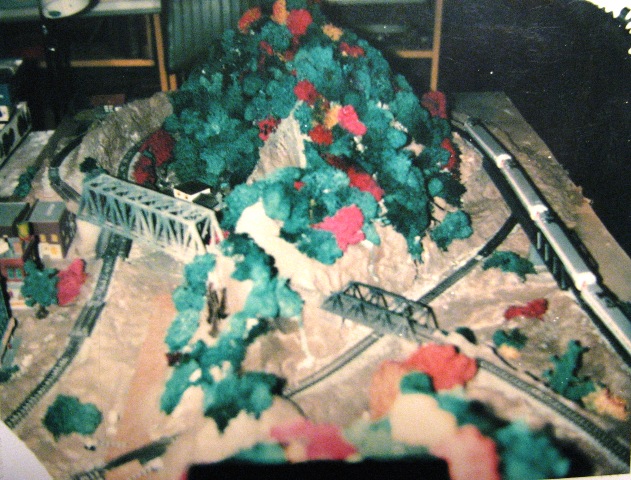
Again, proportionally, modelers build an almost ridiculous number of bridges. From our earliest “over and under” figure 8 train set to the N trak module of some giant bridge, we’ve all built signature scenes that involve some pretty acrobatic engineering, even on the smallest of layouts.

My earliest layout, a 4x6 over and under affair with an intertwined oval. There are

Stone abutments yes, but what I had in mind was more like the above.

Enjoy

Paul